
Your heart repairs at 52 if you give it a reason
By Maya · November 2, 2026

Priya turned 52 last spring and spent the week convinced she had missed her window. Her doctor had been gently nudging her about blood pressure for two years, and she had watched her mother navigate a heart scare at 68. Priya assumed any change now would be cosmetic at best. She was wrong, and the proof showed up in numbers she could check at home.
Priya is five foot four and started at 188 pounds. Her goal is 166. She didn’t overhaul her life. She started eating smaller portions at dinner, stopped buying the cookies she ate after work, and began walking with a friend every Wednesday evening. That’s it. Fourteen months later she was 22 pounds down, and her resting heart rate had fallen from 78 to 68 beats per minute. Her blood pressure came down enough that her doctor cut her medication in half.
A baseline beyond the scale
Priya didn’t own a fitness tracker. She used the free one on her phone to check her resting heart rate every morning before she got out of bed. The first week it was 78. She wrote it down in a notebook. Three months later it was 74. Six months later it was 70. By the end of the year it was 68. The scale moved slowly some months, but that number kept trending down, and it told her something the scale couldn’t: her heart was working less hard to keep her alive.
You can do the same with a brisk-walk time. Pick a route you know well, walk it at a pace that makes you breathe harder but still lets you talk, and time it. Fourteen minutes, eighteen minutes, whatever. Do the same route every two weeks and watch the number. When it drops, your heart and legs are getting more efficient. When it doesn’t, that’s a plateau, not a failure. The graph below shows Priya’s first thirteen weeks of weigh-ins. The line is not dramatic. It dips, it stalls, it dips again.
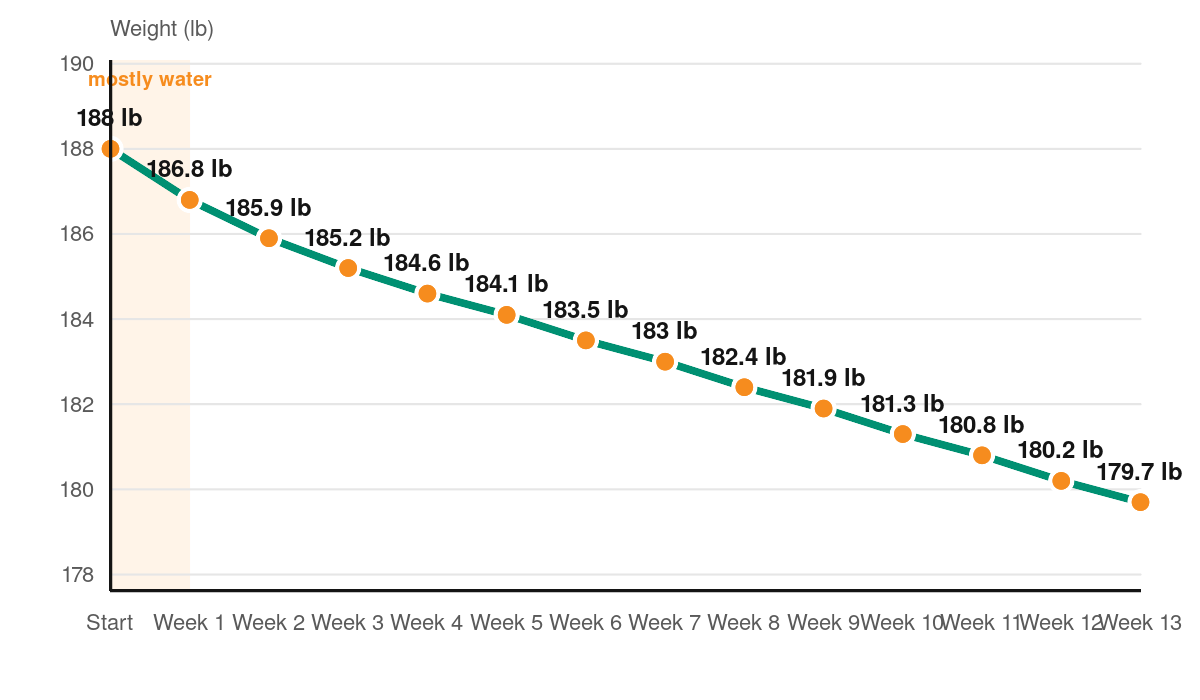
Priya’s first thirteen weeks are a good reminder that the scale is the least interesting measurement. She lost eight pounds in three months, which is right in the healthy range. But her resting heart rate dropped six beats in that same window. Her Wednesday walk went from 22 minutes to 19. Her jeans fit differently. The scale was just one of four signs.
What the change looks like
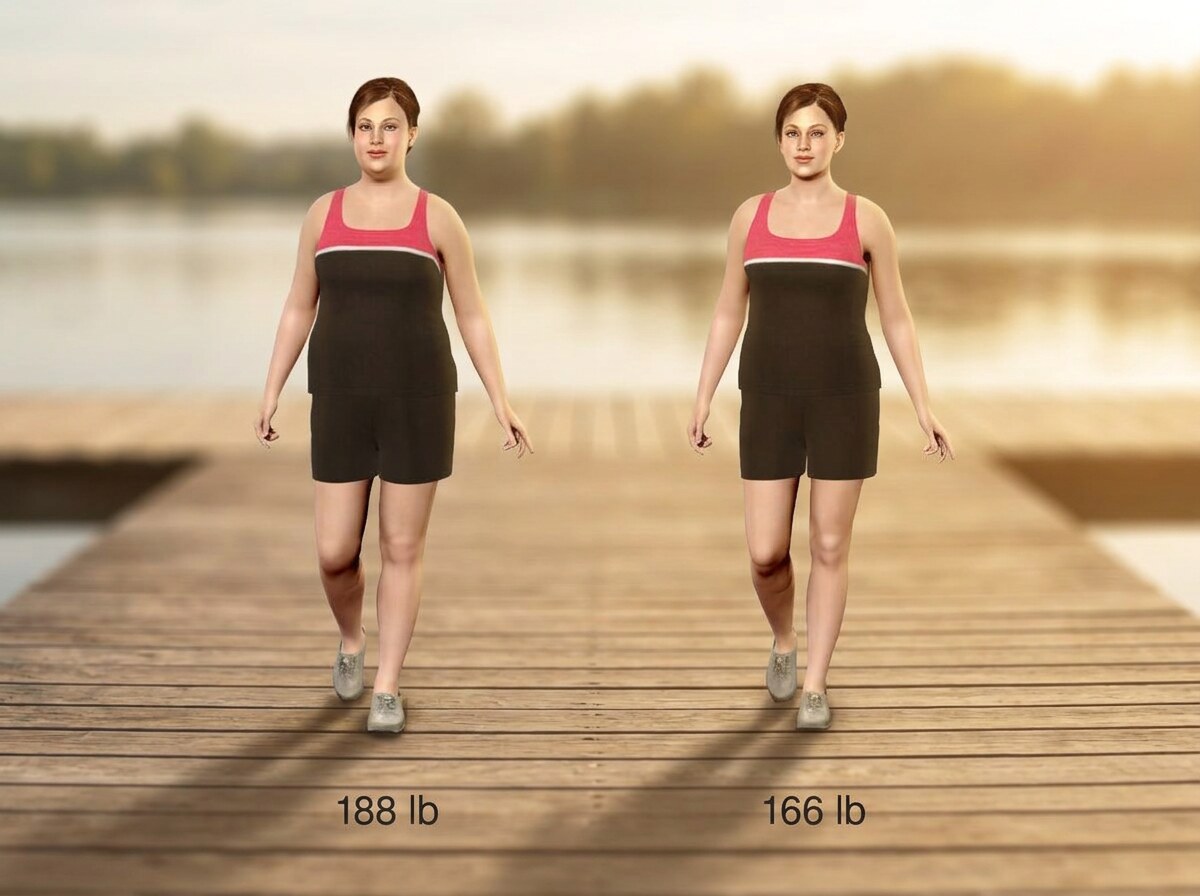
The figure above shows Priya at 188 and at 166, her goal. Twenty-two pounds on a five-foot-four frame is noticeable. Her face is the first place it shows: less puffiness under the chin, a sharper jawline, cheekbones that reappear. Her waist is the second. At 188, Priya carried weight around her middle, the kind that makes waistbands dig in. By 180, her pants were looser. By 172, she bought a belt. At 166, she’s down two dress sizes.
What Priya noticed in the mirror was not what the scale said. Some weeks the scale didn’t move but her face looked different. Other weeks the scale dropped three pounds and she couldn’t see a thing. This is normal. You see yourself every day, so the changes blur together. The figure above freezes the two endpoints side by side. You can’t do that in a mirror. When you’re in the middle of it, the mirror lies. The scale lies too, but differently. You can use the simulator at /women.html to see what your own goal looks like on your own height. It gives you a picture of where you’re heading.
The fear that it’s too late
The fear that the damage is done keeps plenty of people in their forties and fifties from bothering. Why start now, the thinking goes, when the heart has already had fifty years of bad habits? Priya’s own numbers tell a different story. Her resting heart rate dropped ten beats. Her blood pressure medication was cut. Her doctor used the word “remarkable,” which Priya found funny because all she did was walk and eat less.
The hard part is not the walking. It’s the waiting. Priya wanted to see her resting heart rate drop in two weeks. It didn’t. She wanted her blood pressure to normalize in a month. It didn’t. What kept her going was the Wednesday walk. It was social, it was outside, and it was the same time every week. When the scale stalled in month four, she kept walking because her friend was waiting on the corner. The habit carried the goal.
Expectation is the enemy. If you expect the scale to move every week, you’ll quit in month two. If you expect your resting heart rate to drop ten beats in a season, you’ll be disappointed. But if you record a baseline and agree to check it in three months, you give your body time to do what bodies do: adapt slowly, then all at once.
What to do this week
Pick one measurement beyond the scale. Resting heart rate is the easiest: take it every morning for a week and write down the average. Or time a brisk walk on a route you know. Or measure your waist with a tape measure. Record that number in the app at /app.html, and set a reminder to check it again in three months. That’s the whole task. A baseline.
Priya’s baseline was 78 beats per minute, taken on a Tuesday morning in April. She wrote it on a sticky note and stuck it to her bathroom mirror. Fourteen months later she wrote 68 underneath it. The sticky note is still there, curling at the edges. She says she’ll take it down when she hits 166. Knowing her, she’ll probably leave it up.