
Your bloodwork is a rearview mirror, not a verdict
By Maya · November 12, 2026
Ade is 39 and works dispatch for a regional courier service. He sits most of the day, talks to drivers through a headset, and unwinds after his shift with a plate of whatever his wife left on the stove and an hour of television. Three years ago his belt sat comfortably on the fourth notch. Now he uses the sixth, and some mornings he has to remind himself not to hold his breath when he buttons his work pants.
At his last physical, his doctor told him his bloodwork was unremarkable. Fasting glucose a little higher than she would like to see in a man approaching forty, but nothing that needed a prescription. Cholesterol fine. Blood pressure fine. Ade left the clinic with a sheet of numbers and a vague instruction to watch his weight, and for a few months he did what most of us do with a vague instruction. He thought about it occasionally and changed nothing.
A clean lab report feels like an acquittal. The numbers sit inside their reference ranges and the whole appointment takes on the tone of a formality. But a metabolic panel is a photograph of your last decade, developed slowly, and the picture it shows can lag behind the life you are living right now.
The score that looks backward
A metabolic score built from blood pressure, glucose, waist circumference, and cholesterol is a summary of the habits you have already logged. It describes the person you have been, not the person you are about to become.
Ade’s waist told a more current story than his bloodwork. The two belt notches had arrived over three years, about fifteen pounds of slow accumulation that his lab results had not yet fully priced in. His body was keeping its own records, and the waistband was the more recent entry.
The useful thing about a number that looks backward is that it responds to ordinary changes. Ade did not overhaul his life. He stopped eating after nine o’clock on two of the five weeknights when he used to, and he added two thirty-minute walks on his lunch break. That was the entire intervention.
Six weeks later his waist was down three centimeters and his fasting glucose had moved in the direction his doctor wanted.
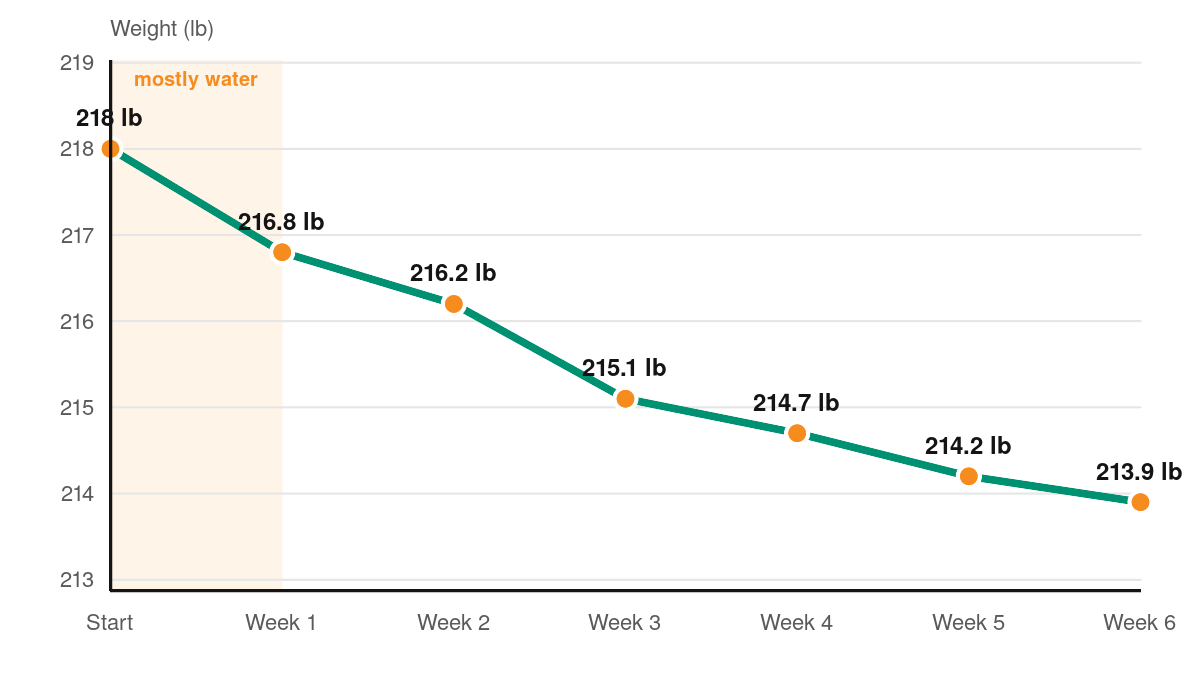
The graph below shows what those six weeks actually looked like on the scale. Ade started at 218 pounds and the line drifts down a little over a pound a week, settling at 213.9. The first drop was mostly water, as first drops usually are, and the rest came in half-pound increments that barely registered day to day. This is what a real change looks like on a graph: unremarkable, uneven, and headed in the right direction.
What the change looks like
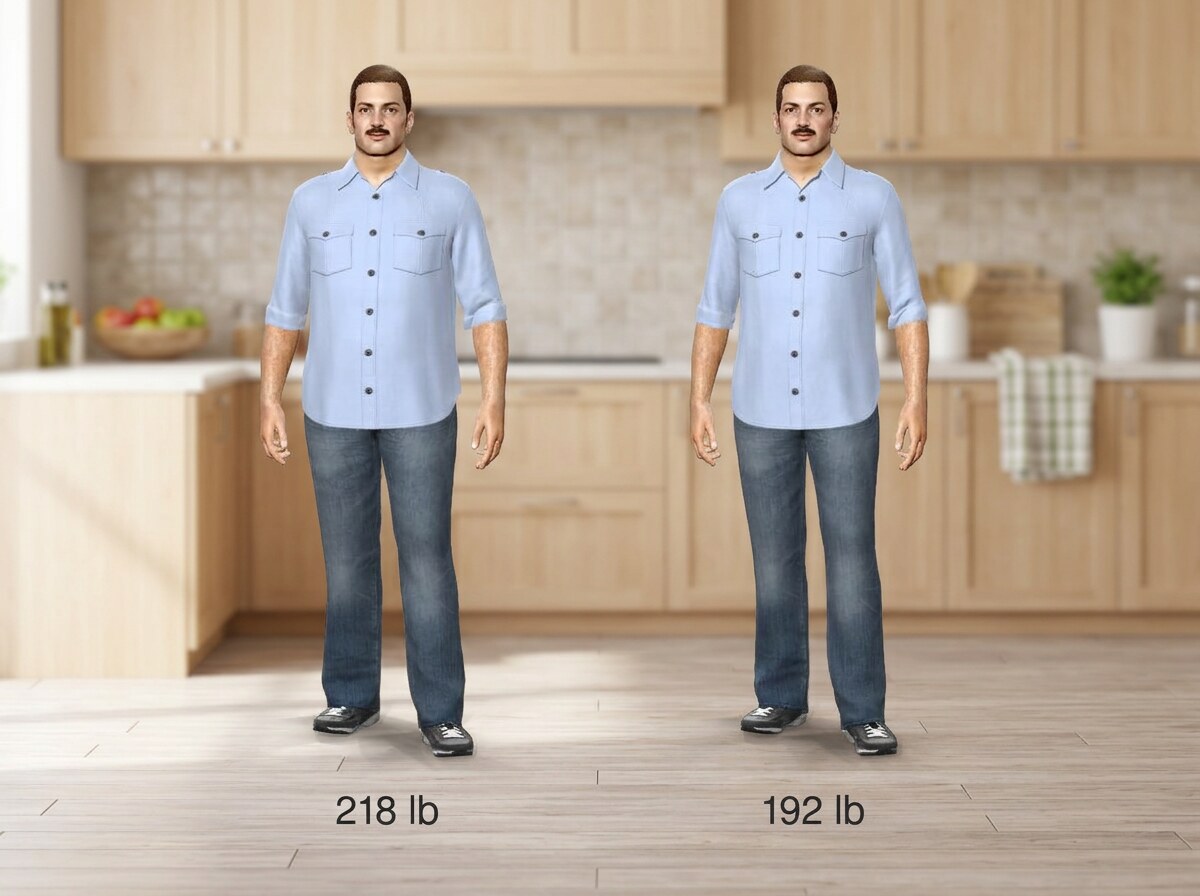
The figure above shows Ade at 218 pounds and at 192, the weight he is working toward. Twenty-six pounds is a substantial difference on a six-foot frame, and the render makes it visible in the places men tend to notice first. At 218 his face carries a little extra fullness along the jaw, and his waist sits soft above the belt. At 192 the jaw sharpens, the puffiness around his eyes thins out, and his midsection pulls in enough that a shirt hangs differently off his shoulders.
The face usually moves first, which is why other people sometimes notice before you do. The waist is slower, stubborn, and the last place many men lose. That mismatch between the mirror and the scale is one reason a waist measurement taken once a month is more useful than a daily weigh-in. The scale reports everything at once, water and waste and yesterday’s sandwich. A tape measure at the navel reports one thing, and it reports it slowly enough to trust.
You can try the same side-by-side view with your own numbers using the simulator. Set your height and weights and look at the difference for yourself.
Pick the number you can nudge
There is a particular kind of relief that comes from a clean lab report, and it can quietly work against you. The numbers say everything is fine, so the pressure is off, and the pressure being off is exactly why nothing changes. Ade felt that relief for three years. His bloodwork had told him he was healthy, and his belt had been telling him something else the whole time, and the belt was the one he could check without an appointment.
A metabolic score feels like a judgment and a waist measurement feels like a chore. One arrives in a lab coat and speaks in reference ranges. The other is a number you take yourself, first thing in the morning, with a five-dollar tape measure. But the second number is the one you can actually move this month. The first number will catch up eventually, and when it does, it will be describing the month you just lived.
Expectation is where most people lose the thread. You take your waist measurement once, then again a week later, and nothing has changed, and the whole exercise feels pointless. A waist at the navel does not move in seven days. It moves in thirty. Water weight comes and goes, digestion shifts, and a single week is noise. The habit that survives is the one that expects a slow number and checks it on a schedule.
Ade’s approach was to pick one number and log it once. He chose his waist, measured at the navel, first thing after using the bathroom. He wrote it down. Thirty days later he wrote it down again. The second number was lower than the first by enough to notice, and that was the whole reward.
This week, pick the one number you can nudge and log it once. A waist measurement at the navel, taken first thing in the morning, is a good one because it moves slowly and tells the truth about the last month. Write it down, put the tape measure back in the drawer, and take it again in thirty days. The score on your lab report will catch up. It always does.