
What I actually kept from two years of chasing longevity
By Maya · November 27, 2026

Ray, a 61-year-old hardware store manager in Ohio, spent two years chasing every longevity protocol that landed in his podcast feed. He bought the powders, the blue-blocker glasses, the standing desk mat shaped like a river rock, and a cold plunge tub that took up half his garage. He paid $349 for a biological-age test that told him he was fifty-eight, then $349 more six months later to learn he was fifty-nine. Last fall, after a bad month where his mother went into the hospital and his hours at the store got shuffled, he looked at the pile of supplements on his kitchen counter and realized he had not touched any of it in three weeks. His knees still ached on the stairs, his blood pressure was up, and the only thing he had done for his health that whole month was walk the dog with his wife after dinner. So he quit the protocols and kept the walk.
When even the New York Times runs a piece asking whether the longevity obsession has gone too far, you know the pendulum is swinging. The billionaire with the five-minute-block schedule and the no-email rule makes for a good headline, but his Tuesday looks nothing like yours. The question is not whether longevity matters. It is what you actually keep doing when life gets full, because those are the only habits that will still be there in a decade.
The Tuesday test
Every longevity habit sounds reasonable on a quiet Sunday afternoon when you have time to prepare a specific breakfast and your calendar is empty. The test is what happens on a Tuesday in February when your car needs a repair, your boss reschedules a meeting, and you slept poorly the night before. If the habit disappears on that Tuesday, it is a habit you are visiting, not one you live with.
Ray discovered this by accident. His cold plunge routine required fifteen minutes of setup and cleanup and a specific window before his morning shower. When his schedule shifted, the window closed. The supplements sat in a pill organizer he stopped filling. The biological-age test gave him a number he could not act on. The walk, though, survived every disruption because it was attached to something that did not move: his wife, their dog, and the hour after dinner when neither of them wanted to look at a screen.
Write down everything you are currently doing for longevity. Then cross out anything you could not keep during a bad month. The list that remains is your actual longevity plan.
The three things that actually move
The people who age well keep a handful of ordinary things going for decades. When you strip away the gadgets and the subscriptions, three things survive almost every serious look at what slows physical aging: something that raises your heart rate most days, something that keeps your muscle on your frame, and a bedtime you actually keep.
Ray landed on a nightly walk with his wife, two lifting sessions a week at the YMCA, and a lights-out time of ten-thirty that he protects more carefully than he ever protected his supplement schedule. The walk is not fast. The lifting sessions are forty minutes and he does not track his macros. The bedtime is unglamorous. But his knees stopped aching on the stairs after about six weeks, and his annual bloodwork stopped surprising him. His doctor noticed the difference before Ray felt it.
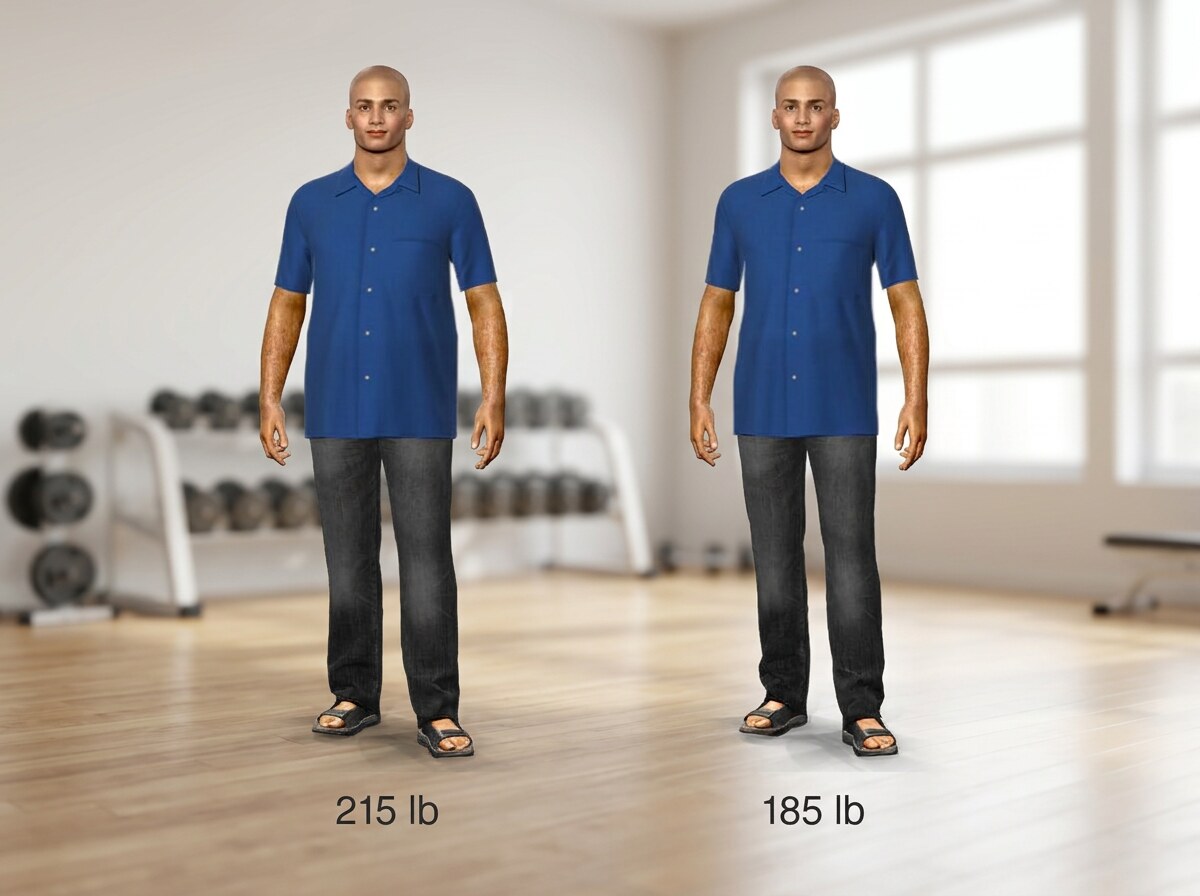
The figure above shows Ray at 215 pounds and again at 185, the weight he reached after about eight months of his stripped-down routine. His face lost the puffiness that had settled in over years of long commutes and vending-machine lunches. His jawline sharpened enough that his daughter mentioned it at Thanksgiving. His waist pulled in, and the belt he had been tightening one notch further each year reversed direction. Those are the changes that show up in a photograph and that the mirror eventually stops registering, which is why a side-by-side render like the one above can tell you what your own eyes have stopped seeing. You can try the simulator yourself on our men’s page and see what a similar shift looks like on your own frame.
There is a reason the longevity industry keeps selling new things. The old things are boring, and boredom feels like failure when everyone else seems to be optimizing. A walk after dinner does not come with a brand or a before-and-after testimonial. Two lifting sessions a week does not make a good Instagram story. A consistent bedtime sounds like something your grandmother would recommend. But boredom is exactly what a decades-long habit looks like from the outside. The excitement of a new protocol lasts six weeks. The quiet of a walk you take without thinking about it lasts thirty years.
Ray went through a stretch, about two months in, where he felt like he was doing nothing at all. The scale moved slowly, the mirror looked the same, and he missed the feeling of actively chasing something. That is the dangerous window where people add things back in: a new supplement, a fasting app, a gadget that tracks sleep stages. Ray stayed with the walk, the lifting, and the bedtime, and the feeling passed. By month five he had stopped wondering whether he was doing enough and started noticing he felt better on the stairs. The psychology that lasts is not motivation. It is the slow disappearance of a problem you had gotten used to.
Why muscle is the non-negotiable
If you keep only one thing from a longevity list, keep the thing that preserves your muscle. After fifty, muscle loss accelerates, and the consequences are not cosmetic. Getting out of a chair without using your hands, carrying a bag of groceries up a flight of stairs, catching yourself when you trip: those are muscle functions. When they go, independence goes with them.
Ray’s two lifting sessions are not elaborate. He does a handful of compound movements with dumbbells and a barbell, enough to keep his legs, back, and shoulders strong. He is trying to make sure that at seventy he can still lift his granddaughter and at eighty he can still get off the floor if he falls. That kind of strength does not require a gym membership, though a basic one helps. It requires showing up twice a week and moving weight that feels challenging.
The walk is the foundation
A nightly walk does not sound like a longevity intervention because it is free and your grandparents did it. But it ties together everything else that matters: heart health, blood pressure, joint mobility, mood, and the simple fact of moving your body through the world at the end of a day spent in chairs and cars. Ray and his wife walk for about thirty-five minutes, at a pace where they can talk but would not want to sing.
The walk also solves a problem Ray did not know he had: the hour after dinner when he used to sit on the couch and snack. That hour is gone now, replaced by movement and conversation, and the absence of the snacking did more for his weight than any supplement ever did.
Keep what survives a bad month
Ray still has the cold plunge tub in his garage. He uses it once in a while on a hot day, but he no longer calls it a longevity practice. He calls it a cold bath. The powders are gone, the biological-age test login is forgotten, and the standing desk mat is under a workbench. What remains is a walk, two lifting sessions, and a bedtime. Three things that fit into a life that sometimes gets hard.
This week, write down everything you are doing for longevity. Cross out anything you could not keep during a bad month. Put the survivors on a calendar, on actual days at actual times, and protect them the way you protect a doctor’s appointment.