
The scale stalled for a year. Your heart noticed anyway.
By Maya · November 5, 2026
Priya is 47 and works as a dental hygienist in Toronto. She started tracking her food and walking three evenings a week in January, the way a lot of people do after New Year’s. Eleven months later, she has lost 14 pounds. That number embarrassed her when she said it out loud to a friend. She had been expecting more.
The scale barely moved some months. If you only looked at the graph of her weigh-ins, you would call the whole thing a failure. The line goes down, but so slowly that on any given Tuesday it looks almost still. Priya nearly quit twice: once in March, when she lost nothing for three weeks straight, and again in September, when she realized she had been at this for most of a year and still could not see a difference in the mirror. She kept going anyway.
Then her doctor’s office called with the results from a routine physical. Her blood pressure had gone from 138 over 88 to 124 over 80. Her resting heart rate, which she checked on her own with a cheap monitor, had dropped from 78 to 68. The doctor said the words “better than last year” and Priya sat in her car afterward and cried a little. Not because the scale had finally cooperated. Because something underneath had been changing the whole time, and she had spent eleven months ignoring it.
The scale measures one thing. It tells you how much your whole body weighs at one moment, including water, food, and waste. It does not tell you how hard your heart is working when you sit still. It does not tell you what your blood pressure is doing. It does not tell you that walking up the two flights of stairs to your apartment no longer makes you breathe through your mouth. Those numbers are not as easy to check as stepping on a scale, but they are the ones that will matter when you are 65 and carrying your own groceries.
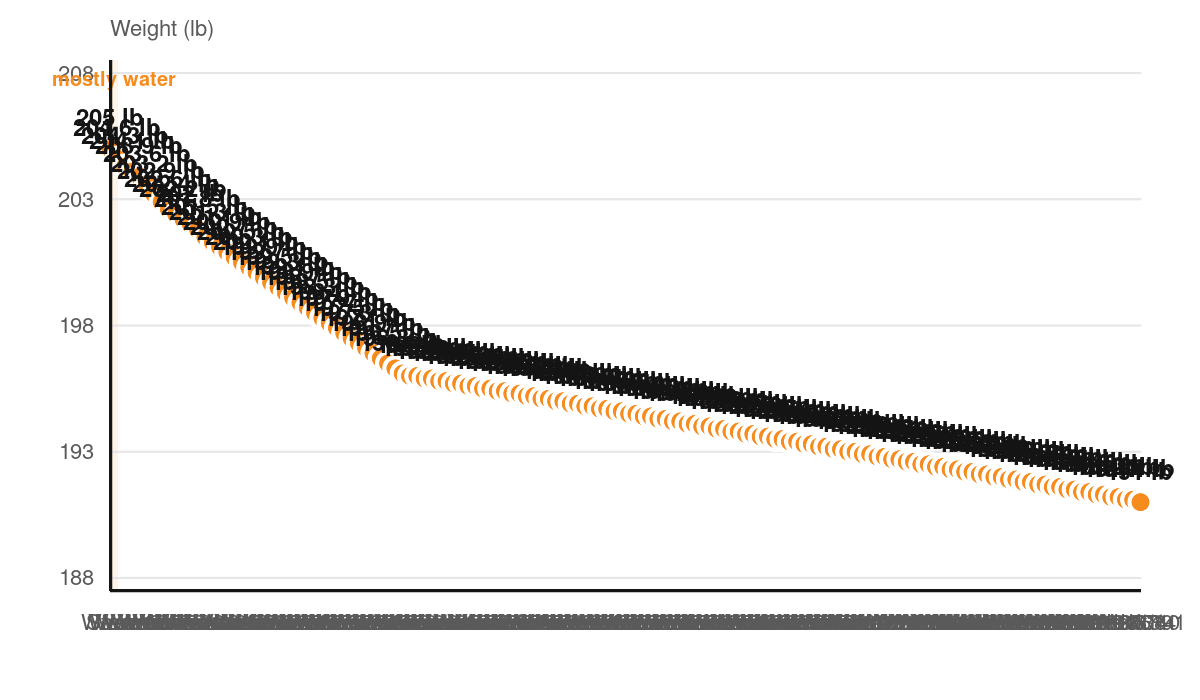
Priya’s weekly weigh-ins tell a story that looks like almost nothing. The graph below shows 141 weeks: 205 pounds at the start, 191 at the end, and a lot of weeks where the line barely moves. She has lost 14 pounds in 141 weeks. That is about a tenth of a pound per week on average. No weight loss app would celebrate that pace. But the same 141 weeks took her blood pressure from the high end of normal to the middle of normal, and her resting heart rate from 78 to 68. Those are the numbers her doctor circled.
What the scale misses
A pound of fat is 3,500 calories. To lose 14 pounds in 11 months, Priya had to eat about 100 fewer calories per day than she burned. That is a small change: one less slice of bread, a smaller bowl of rice, walking for 25 minutes instead of sitting. Small enough that the scale can hide it for weeks. Water weight shifts by two or three pounds from day to day. A salty dinner, a poor night’s sleep, the week before a period, all of it shows up as a number on the scale that has nothing to do with fat.
But the same small change does other things. Priya’s heart does not have to pump as hard to move blood through her body. Her blood vessels are under less pressure. Her lungs have an easier time on the stairs. None of that shows up on the scale. You can check it with a blood pressure cuff and a heart rate monitor, or you can just notice that the walk to the bus stop no longer leaves you winded. Those are real changes. They just are not measured in pounds.
Middle age is not a plateau
Weight loss after 40 is slower than it was at 25. You can still lose weight, but you will not lose it fast enough to keep yourself motivated by the scale alone. That is the trap Priya fell into. She expected the same pace she remembered from her twenties, and when she did not get it, she decided nothing was happening.
What she missed is that weight loss in your forties and fifties is about more than the scale. Priya’s 14 pounds put her in a different place than she was a year ago. Her blood pressure and resting heart rate are the proof. The scale tells you what you weigh. The blood pressure cuff tells you what your body is doing right now.
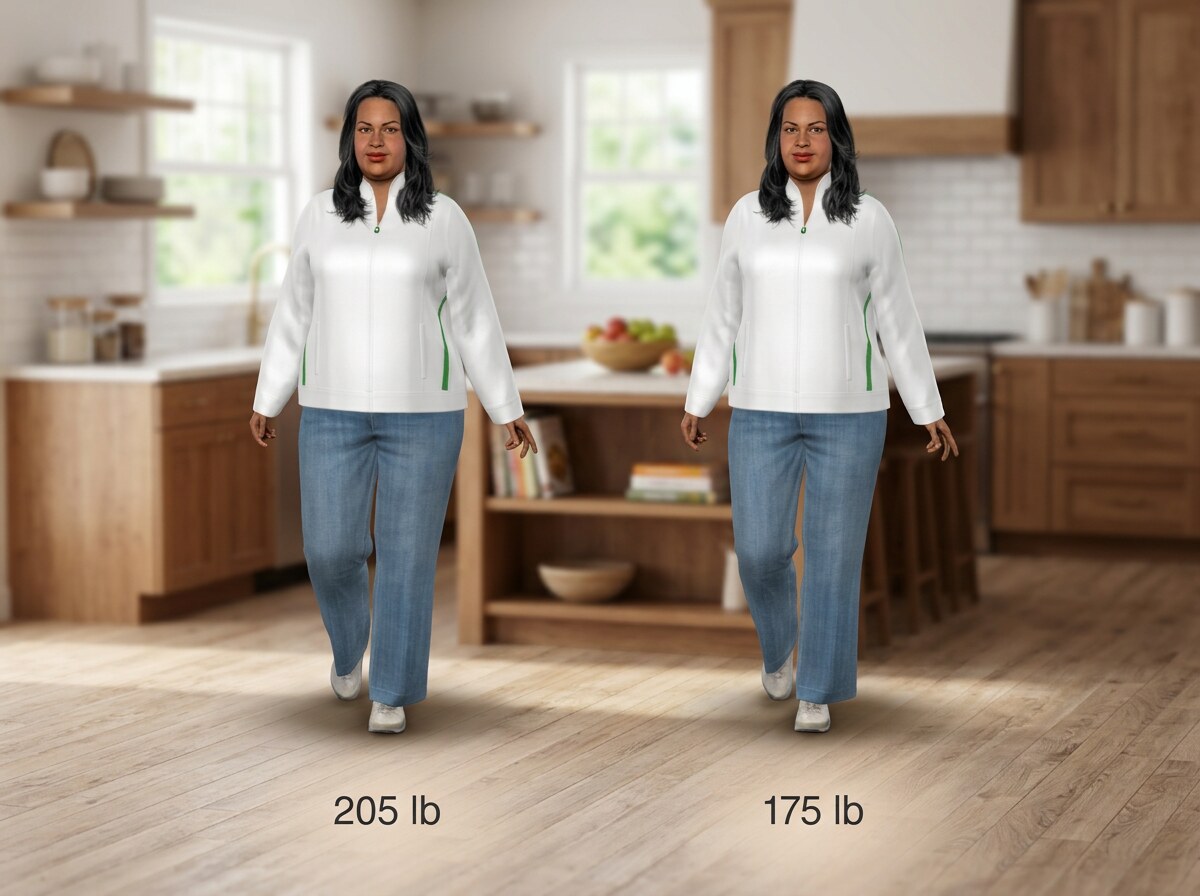
The figure above shows Priya at 205 pounds and at 175 pounds, which is where she is heading. At 205, the extra weight sits in her face and around her middle. Her jawline is softer, her waist is less defined, and her upper arms look fuller. At 175, the difference is visible: a sharper jaw, a smaller waist, less puffiness under her eyes. Those are the changes that show up in the mirror eventually. They happen slowly, and the mirror is the worst judge of slow change. You see yourself every day, so your brain adjusts to the new normal before you notice it. The scale and the mirror will lie to you for months. The blood pressure cuff will not. You can see what your own change might look like with the simulator at /women.html.
What Priya stopped doing
For the first several months, Priya weighed herself every morning. She wrote the number in a notebook and spent the rest of the day reacting to it. A good number meant she ate less that day to keep the streak going. A bad number meant she ate less that day to punish herself. Either way, she was miserable. Last summer, she put the scale in the closet and bought a blood pressure monitor instead. She checks her blood pressure on Sunday mornings, her resting heart rate on Wednesday mornings, and she measures her waist on the first of the month. Those are the three numbers she logs. She weighs herself once a month now, and only because her doctor asked her to.
The change in what she tracks changed what she notices. Her waist measurement has gone down two inches even though the scale has moved slowly. Her resting heart rate dropped ten beats per minute. Her blood pressure went from high-normal to normal. Those numbers tell her something the scale never did: the work is working. She is not losing weight quickly, but she is changing the body she will have at 65. That is the point.

The scale is the default measure of progress because it is easy. You step on it, you get a number, and the number goes down or it does not. But that simplicity is a trap. The scale gives you feedback every day, but most of that feedback is noise. Water weight, salt, sleep, stress, the time of day, the phase of the month, all of it moves the number more than fat loss does. When you rely on the scale, you are making decisions based on noise. You eat less because the scale went up, even though the scale went up because you had soup for dinner. You give up because the scale has not moved in three weeks, even though your blood pressure has dropped eight points.
Priya’s story is not unusual. Most people who lose weight slowly in middle age go through a period where they think nothing is happening. The scale stalls, the mirror does not show anything, and the only evidence of progress is a number they never check. Log three non-scale numbers this week. Take your blood pressure, check your resting heart rate, and measure your waist. Write them down. Then do not weigh yourself for 30 days. Check the three numbers again at the end of the month. If they have moved in the right direction, you are not stalled. You are just measuring the wrong thing.
Log three non-scale numbers this week. Take your blood pressure, check your resting heart rate, and measure your waist. Write them down. Then do not weigh yourself for 30 days.