
The protein debate won't save your arms at seventy
By Maya · November 18, 2026
Rosa is 58 and runs the front office at a middle school in Tucson. Last spring she noticed something small that stuck with her: carrying a case of copy paper from the supply closet left her arms tired in a way it hadn’t two years before. She wasn’t injured and she wasn’t sick. She had simply gotten a little softer, a little weaker, one school year at a time.
She ate what most reasonable adults eat. Toast with jam in the morning, a salad with dressing at lunch, and a regular dinner her husband cooked, chicken or pasta with vegetables on the side. She walked the dog most evenings. By any ordinary measure she was doing fine, and her doctor had no concerns at her last visit. But Rosa could feel the difference, and she didn’t like where it was heading.
Muscle retention
Muscle loss with age is real and it starts earlier than most of us want to think. After about forty, adults who don’t do anything to hold onto their muscle lose a little bit every year. The loss is slow enough that the scale doesn’t catch it, a pound of muscle replaced by a pound of fat weighs the same, but the body notices. Stairs feel taller. Grocery bags feel heavier. A granddaughter who wants to be picked up becomes a negotiation instead of a reflex.
Muscle responds to use at any age. Resistance work and protein together change how your body looks and feels, even when the scale moves slowly.
What Rosa actually changed
Rosa didn’t overhaul her life. She added one palm-sized portion of protein to breakfast and one to lunch. For breakfast that meant two eggs alongside her toast, or a scoop of cottage cheese, or last night’s leftover chicken when she was in a hurry. For lunch she put half a can of tuna on her salad or a hard-boiled egg and a handful of chickpeas. Dinner stayed the same because dinner was already fine.
For the strength piece, she found two twenty-minute windows a week. Tuesday evenings she did bodyweight squats, push-ups against the kitchen counter, and a few lunges in the living room while the news was on. Saturday morning she used a pair of ten-pound dumbbells her son left in the garage years ago. She wasn’t training for anything. She was just showing up and making her muscles do a little more than they did the day before.
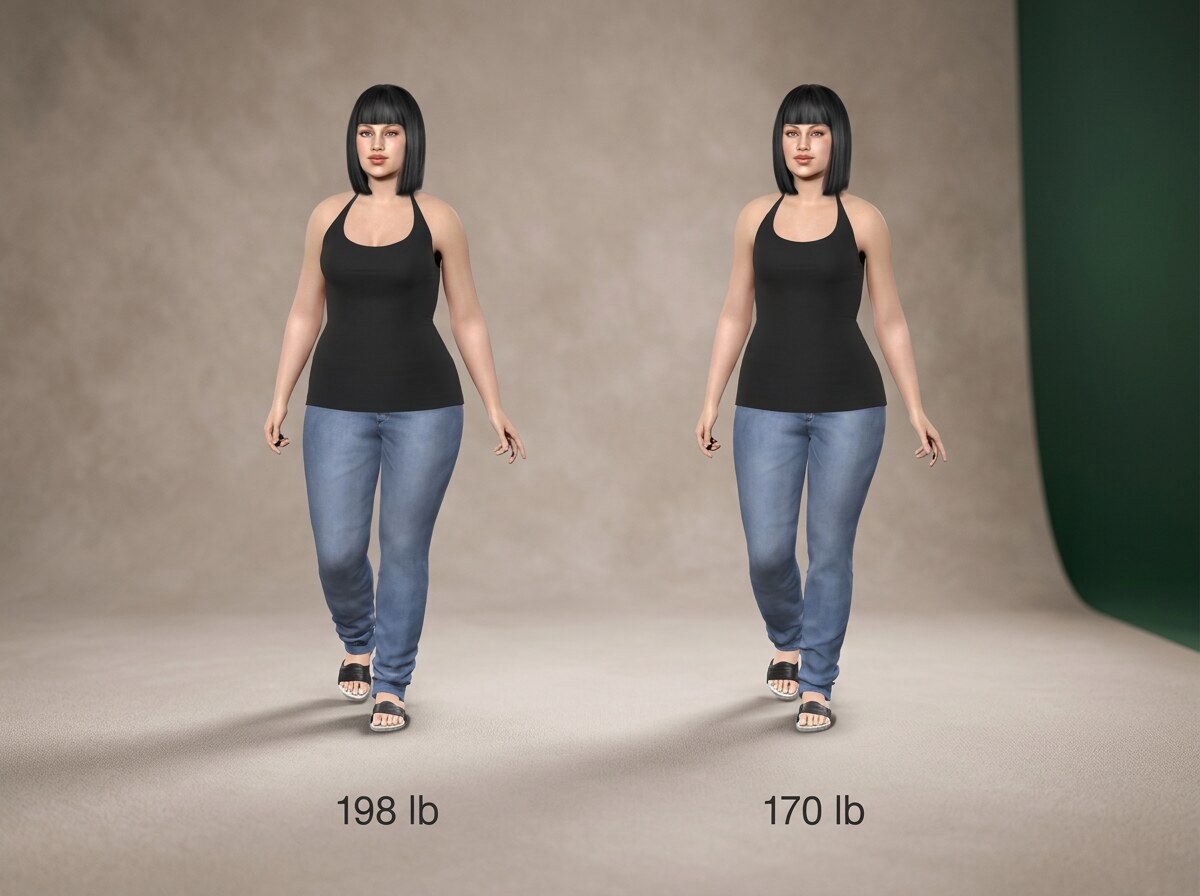
The figure above shows what a change like Rosa’s can look like on a body over the long arc. At 198 pounds, her weight sat comfortably on her frame, but a fair amount of it was fat her body had quietly traded for muscle over the years. At 170, she carries visibly more shape in her shoulders and arms, and her waist has definition that wasn’t there before. Keeping muscle changes the silhouette, not just the number on the scale.
If you want to see what your own starting point and goal might look like side by side, you can try the simulator at our women’s visualization page. Set your current weight and a goal weight at least twenty pounds down, and pay attention to the arms, the jawline, and the waist. Those are the places where muscle preservation and fat loss show up first, and they’re the places Rosa noticed after about eight weeks of her new routine.

The strangest part of Rosa’s first two months was that the scale barely moved. She lost three pounds in eight weeks, which by diet-industry standards is a failure. But her waistband loosened, her grip on the copy-paper box felt solid again, and the stairs to the second-floor office stopped making her breathe hard. The mirror was telling her one story and the scale was telling her another, and she had to learn to trust the mirror.
This is a hard mental shift because we have all been trained to treat the scale as the scoreboard. But muscle is denser than fat. A body that holds onto its muscle while losing fat changes shape faster than it changes weight, and a person who only checks the scale will miss the whole story. Rosa started tracking how she felt on the stairs and how her rings fit, and that gave her a steadier read on what was happening than any Monday-morning weigh-in.
Adding something feels completely different from taking something away. Rosa had spent decades hearing that midlife eating was about subtraction, less bread, less sugar, less of everything she liked. Adding protein to two meals felt like permission. She wasn’t dieting. She was feeding something she wanted to keep, and that reframe made the whole thing sustainable in a way no restriction ever had.
The protein floor
You don’t need a number from a headline to eat enough protein. The internet will tell you to calculate grams per pound of body weight and track every meal, and if that works for you, great. But for most people the simpler rule is this: at every meal, look at your plate and make sure there’s a palm-sized piece of protein on it. A palm of chicken, a palm of beans, a palm of yogurt, two eggs, a scoop of cottage cheese. If you eat three meals a day and each one has roughly that, you are almost certainly above the floor where muscle loss becomes a concern.
Breakfast is the meal where most people fall short. Toast, cereal, a banana, coffee, those are fine foods, but adding protein changes how you feel through the morning. Adding protein to breakfast is the single most effective change Rosa made, and it’s the one we’d tell anyone to start with. It takes three minutes and it changes the whole arc of the day.
The decades argument
Rosa is 58 now. She plans to be carrying her own groceries at 78 and picking up grandchildren at 68. The muscle she keeps this year is the muscle she’ll have to work with in ten years, and the muscle she loses this year is gone in a way that gets harder to reclaim with every passing decade. This is about getting up off the floor at seventy without needing a hand, and walking up a flight of stairs at eighty without stopping, and staying strong enough to live in her own house as long as she wants to.
Strength in midlife is a retirement account. You make deposits now that you draw on later, and the deposits are cheap: a palm of protein at breakfast, two short strength sessions a week, a walk that gets your heart rate up. None of it is dramatic. All of it compounds.
One meal this week
The protein debate will keep spinning through the headlines, and you can ignore almost all of it. The practical question is simpler: which meal this week gets a protein you weren’t giving it before? Pick one. Breakfast, lunch, the afternoon snack you eat standing at the counter. Add a palm-sized portion of something, an egg, a scoop of yogurt, a handful of edamame, a can of sardines if that’s your thing, and see how the rest of your day feels. You can track it in the app if you want a clear picture of what your week actually looks like, but the habit itself is the point. Rosa started with Tuesday breakfast and let that one meal carry the momentum.