
The longevity list that survives your week has two things on it
By Maya · November 10, 2026
Priya, 46, spent a Sunday afternoon in late January with a notebook open on her kitchen counter and eight browser tabs full of longevity advice. One tab told her a cold shower every morning was the key to a longer life. Another swore by a thirty-minute journaling practice. A third had a supplement stack that cost more than her monthly electric bill. By the end of the afternoon she had a list of six new habits she planned to start on Monday, and by the third week of February she had kept exactly none of them.
She is not unusual. A wave of longevity coverage this season has pushed the same fantasy: that the answer to a longer, healthier life is a longer list of things to do. The truth is quieter and a lot more forgiving. Most of the benefit sits in two or three behaviours you can do badly on a bad week and still keep doing the next week. The rest of the list can go unread.
Two habits that earn their spot
Priya tried again in March with a different approach. She picked two things: a twenty-minute walk after dinner and a breakfast with enough protein that she was not raiding the staff-room cookie tin by ten in the morning. She defined the smallest version of each. The walk could be slow, it could be twelve minutes if she was tired, it could be a loop around the block in her slippers if she had already changed for the evening. The breakfast could be last night’s leftover dal, a hard-boiled egg and a piece of toast, or Greek yogurt with a handful of walnuts. The point was that the smallest version still counted.
Eight months later the walk is as automatic as brushing her teeth, and she has not bought a box of granola bars for her desk drawer since April. Her afternoon energy crash is gone. Her waist is down four centimetres. She did not add cold showers or journaling or a supplement stack, and she is healthier than she was the year she tried to do everything.
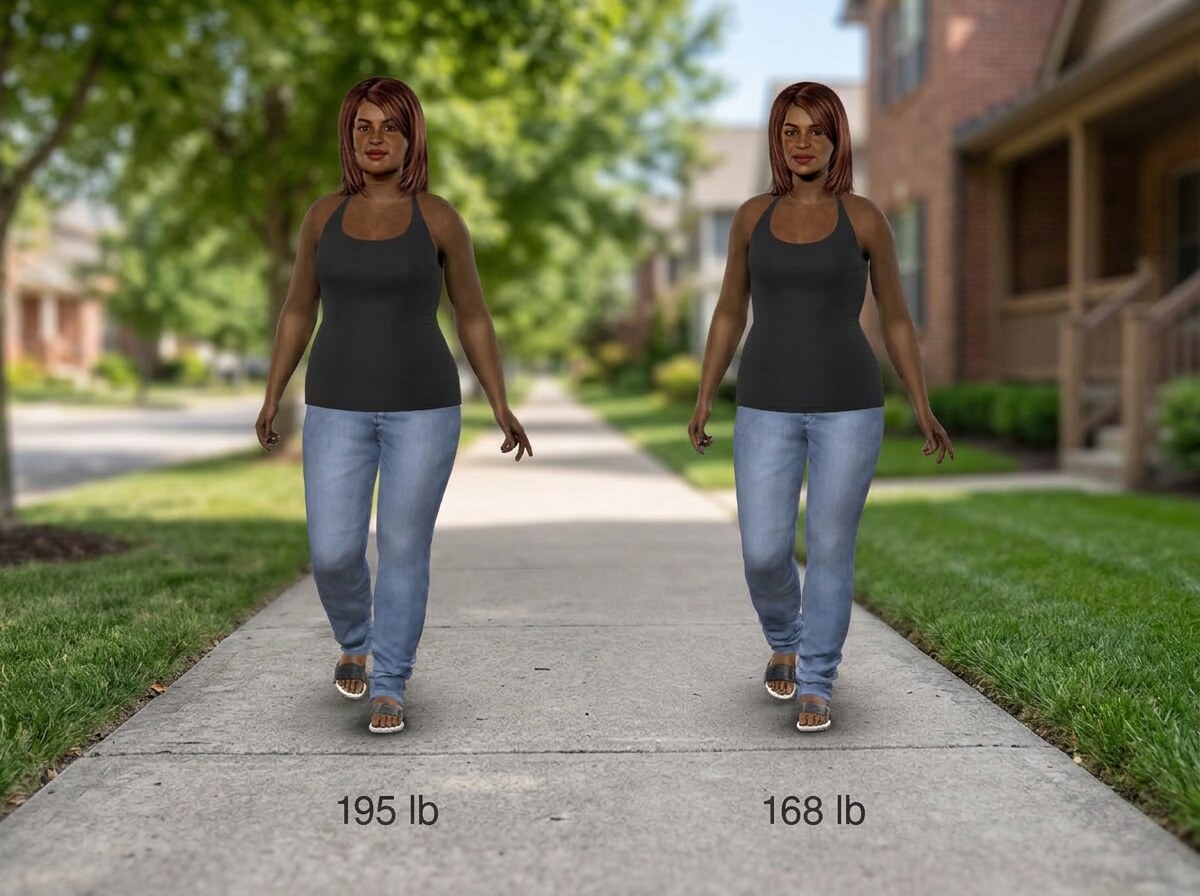
The figure above shows a woman of Priya’s height at 195 pounds and again at 168. Twenty-seven pounds is enough to redraw a silhouette. The face loses its puffiness first, and the jawline sharpens in a way that friends notice before you do. The waist pulls in, the upper arms sit closer to the body, and the line from hip to knee straightens out. These are the changes the mirror struggles to show you day to day but that a side-by-side render makes plain. If you want to see what your own twenty- or thirty-pound shift looks like, our body simulator lets you dial in the numbers and look at the figure from every angle. It is the same tool that produced the image above, and it is the quickest way I know to make a far-off goal feel concrete.
The smallest version rule
A habit that requires ideal conditions is a habit you will skip the first time conditions are not ideal. A hard day at work, a child home sick, a night of poor sleep, and suddenly the forty-five-minute gym session or the elaborate meal prep is off the table. The smallest version is the one you can still do when everything is going sideways.
For Priya, the smallest version of the walk was once around the block. She did it in her work clothes with her phone still in her hand, and she did not count the minutes. The smallest version of the protein-forward breakfast was a spoonful of peanut butter on a banana, eaten standing up while she packed her lunch. Both felt almost too small to matter. That is exactly why they stuck. A habit that feels trivial on a hard day is a habit that survives a hard week, and a habit that survives a hard week becomes a habit that lasts a decade. Longevity is not built on perfect months. It is built on the weeks you did something when you could have done nothing.
The psychology here runs counter to how most of us approach a new health goal. We want the ambitious version because the ambitious version feels like it should work faster. We equate effort with results, and we assume that a habit we can do badly is a habit that will not pay off. People who keep habits for years notice something different. Consistency beats intensity every time, and consistency is a function of how easy the habit is to restart after you miss a day.
There is a second piece to this. When you trim the list down to two things, you stop negotiating with yourself about which of the six you are going to skip today. A long list creates decision fatigue before you have taken a single action. A short list gives you a clear yes or no, and most days the answer is yes because the ask is small. Priya found that by week four she was walking longer without meaning to, not because she raised the bar but because the walk had become a pleasant part of her evening rather than a box to check. The habit grew on its own once she stopped trying to make it grow.
What the longevity list gets wrong
The longevity headlines that pile up in your news feed share a structure. They take a behaviour that shows up in large groups of people who live longer, turn it into a prescription, and present it alongside four other prescriptions in a list. The reader walks away with the impression that all five are equally important and that doing three out of five is a failure. Neither is true.
The behaviours that actually move the needle are the ones you see in people who stay healthy into their eighties and nineties: regular movement, enough protein to preserve muscle as you age, social connection, sleep, and not smoking. Everything else is a rounding error. You do not need to optimize your sauna protocol or your morning light exposure. You need to walk, eat something with protein in it, and call your sister. If you do those three things badly on a bad week, you are still ahead of someone who does a dozen biohacks perfectly for a month and then quits.
Muscle is the longevity asset nobody talks about
When people talk about adding years, they often mention metabolic health, cardiovascular fitness, and how cells age. But the thing that determines whether you can carry your own groceries at eighty is muscle, and muscle is lost slowly and silently starting in your forties unless you give your body a reason to keep it. The reason does not have to be a gym membership. It can be a walk that includes a hill, a set of bodyweight squats while the coffee brews, or a breakfast that leaves you full until lunch instead of sending you to the vending machine at ten.
Priya’s two habits did not include resistance training, and I am not going to pretend they did. But her protein-forward breakfast gave her body the raw material to hold onto muscle, and her evening walk kept her legs strong and her joints moving through their full range. At forty-six, the goal is not to look like a twenty-five-year-old. The goal is to arrive at seventy with the strength to get up off the floor without using your hands, and the habits that get you there look a lot like Priya’s Tuesday evening loop around the block.
Talk to your doctor before you start anything new, especially if you have a condition that affects how you exercise or eat. But once you have that clearance, pick two things. Define the smallest version of each. Let the rest of the longevity list sit unread in your browser tabs, and go take a walk that is too short to count.