
The longevity headline you saved won't change your Monday
By Maya · November 3, 2026
Renata is 44 and runs the front office at a school. This month she has saved eleven articles about longevity. One is about a tortoise’s genes. Another is about a supplement that did not work out. A third calls peptides the next big thing. She has read all of them and changed nothing. That is not a discipline problem. It is a filter problem.
Longevity news arrives the way weather does, a new system every few days, each one insisting the last one missed the point. A person could spend Sunday evening sorting it all out and still have no idea what to do Monday morning. The trick is to have a small set of questions that any headline has to survive before it earns a place in your week.
A three-question filter
Here is the filter. First, does it change what I do on Monday? Not someday, not when the science matures. Monday, this week, in my actual kitchen or on my actual street. Second, does it still make sense if the study disappears? If the habit only works because a lab found something, it is a headline, not a habit. Third, can I still do it in five years? If the answer is no, it is an event. Events are fine. They are just not a plan.
Most longevity stories fail the first question. A tortoise’s genes are interesting, but Renata cannot do anything with them on Monday. A supplement that did not work out fails the second question, because there is no habit left once the pill is gone. Peptides fail all three for most people, since they cost money, need a doctor, and depend on suppliers and prescriptions that may not last.
The stories are not useless. They are entertainment with a lab coat on. The problem is when they crowd out the unglamorous thing you could actually do. Renata’s saved articles are full of molecules she will never touch and empty of the one thing she knows she can do: walk for twenty minutes after dinner.
The habit that survives the filter
A twenty-minute walk after dinner passes all three questions. It changes Monday, because she can put her shoes on and go. It survives without the study, because people have walked after meals for as long as there have been meals. And she can still do it in five years, because it costs nothing and fits the shape of an ordinary evening.
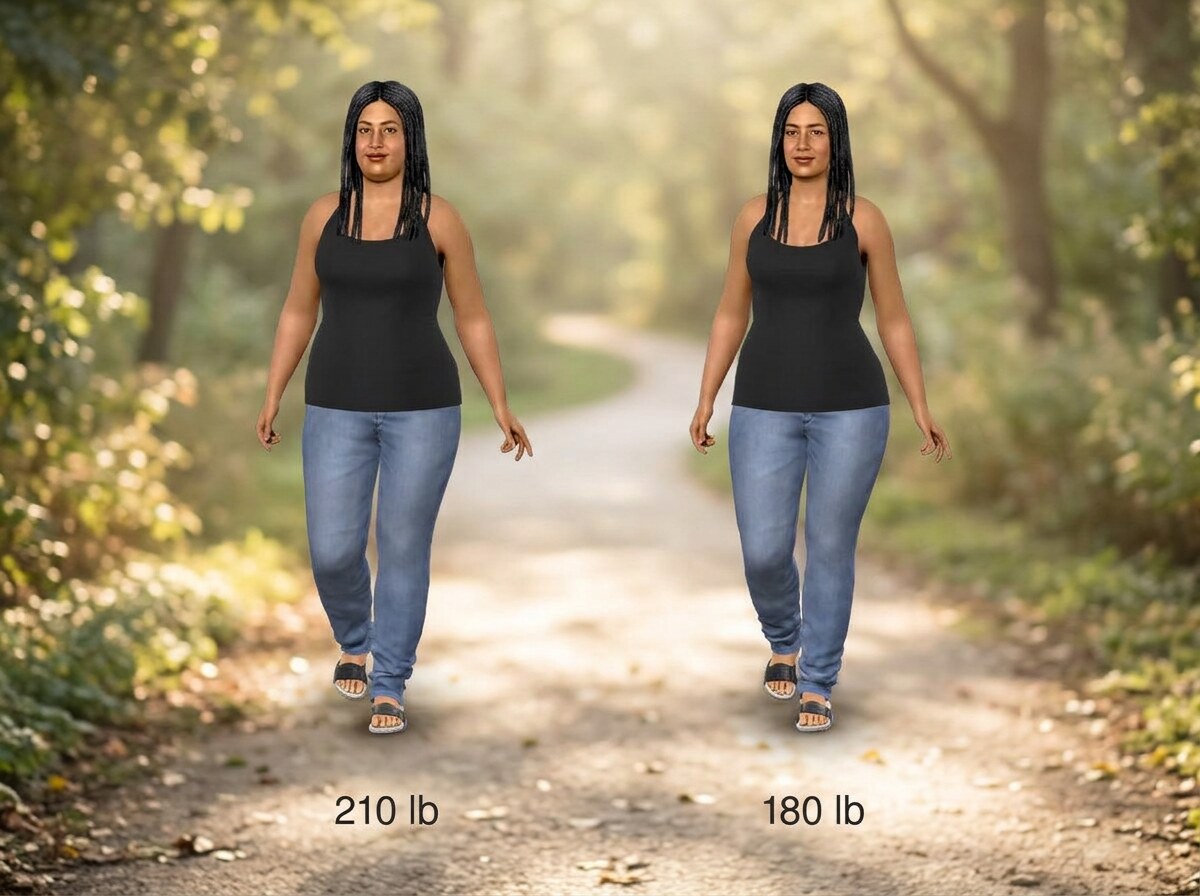
So Renata picked the walk. She did not pick the tortoise genes or the peptides. She picked the thing that was already waiting by the door. She started at 210 pounds, and her goal is 180. The figure above shows what that thirty-pound change looks like on a body her height. It is a slow, visible shift in the face and the waist, the places weight tends to show first.
She has been walking for seven weeks now. The graph below shows what actually happened on the scale.
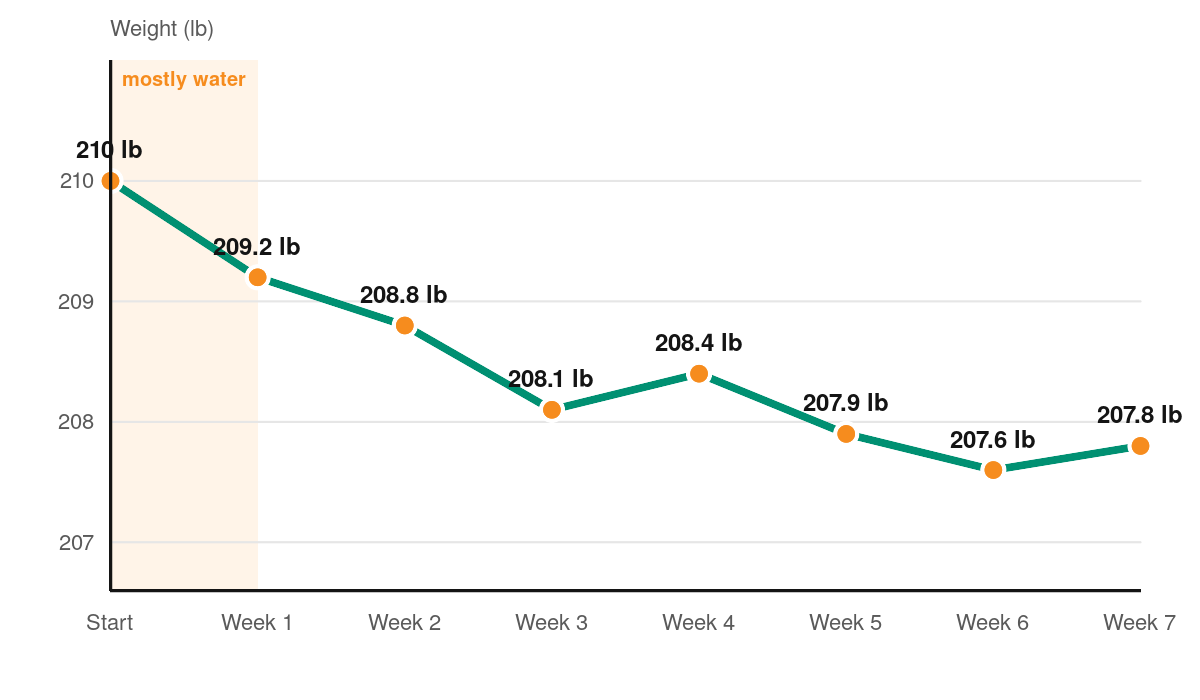
Seven weeks, and she is down a little over two pounds. The first week barely moved, because she was not dieting, just walking. Then a couple of small drops, then a week where the scale went up a little, then back down. This is what a real habit looks like on a graph. It is not a straight line and it is not fast. It is just steady enough to keep going.
What the scale says and what the mirror says rarely agree, especially in the first month. Renata’s face looks a little less puffy to her, and her waistband sits differently by the end of the day. The figure above shows the same thing from the outside. Thirty pounds is enough to change the shape of a face and the line of a waist, but it happens in small installments. The first five pounds are almost invisible. The next ten start to show. The last fifteen are the ones other people notice.
That is why the mirror lies. You see yourself every day, so the small changes get smoothed over. The scale lies too, because water and salt and a bad night of sleep can move it more than fat does. Renata checks the graph once a week and otherwise lets the walk be a walk. If you want a clearer picture of where you are headed, the simulator lets you see the same height and weights side by side on the women’s page.
Why the walk will still be here in five years
A habit that lasts is usually a boring one. Walking after dinner is boring in the best way. It does not require a subscription, a protocol, or a belief about what is happening inside your cells. It just requires the same twenty minutes and the same stretch of pavement. That is exactly why it can still be here in five years.
The longevity headlines will keep coming. Some of them will turn out to be right, and most will fade. What lasts is the thing you can do without thinking about it. Renata does not think about her walk anymore. She clears the plates, puts on her shoes, and goes. That is the whole habit.

There is a particular kind of relief in picking one small thing and ignoring the rest. Renata had spent months feeling behind on longevity, as if every article she saved was a test she was failing. The filter changed that. She was not behind. She was just trying to drink from a fire hose. Once she asked the three questions, almost everything fell away, and the one thing that remained was something she already knew how to do.
Expectation is the other trap. People start a walking habit expecting the scale to move like it does in a supplement ad. It does not. The first week is often unmoved, because the body is adjusting and water does what water does. The graph above shows that plainly. The win in the first month is not the pounds. It is the fact that the walk happened. The win in the second month is that it still happened. The scale catches up later, and it catches up unevenly.
What Renata is doing this week
This week Renata is not reading about tortoises or peptides. She is doing the same twenty-minute loop she has done for seven weeks. She will walk it after dinner, and when she gets home she will tap the walk into the app, same as always. The saved articles can wait. Monday is already full. Talk to your doctor before starting a new routine if you have health concerns, but if a walk after dinner is within reach, it is a fine thing to test against the filter yourself.