
The knee you think is 'just aging' might be carrying the answer
By Maya · November 19, 2026

Ray, 51, dispatches trucks from a desk outside Stockton. The job pins him to a chair for ten hours, and for the last two years the first ten steps after standing up felt like gravel packed inside his kneecaps. His doctor called it early osteoarthritis and mentioned that Ray’s weight wasn’t helping. Ray heard the words, filed them next to “you’re not thirty anymore,” and kept doing what he had always done. The snoring, his wife said, had gotten loud enough that she sometimes moved to the couch by two in the morning. Ray figured that was age, too.
Some people find their knees hurt less and they snore less after losing weight, whether they use medication or not. Ray’s story is not about a drug. He never took one.
The First Change
Ray’s knees began to complain when he hit 247 pounds. At 247 pounds, his knees hurt when he walked. When Ray started walking after dinner in late spring, he wasn’t trying to fix his knees. He just wanted to move a little before sitting down for the evening.
He walked half a mile the first week, on sidewalks, a pace slow enough that he could still talk. The scale dropped two pounds that week, mostly water, and his knees still hurt. By week three he was down four pounds and walking three-quarters of a mile, and the first five minutes after standing up felt less stiff. He noticed it because he stopped bracing himself against the desk. The pain wasn’t gone, but the edge was off, and the edge came off before the weight loss looked dramatic to anyone else.
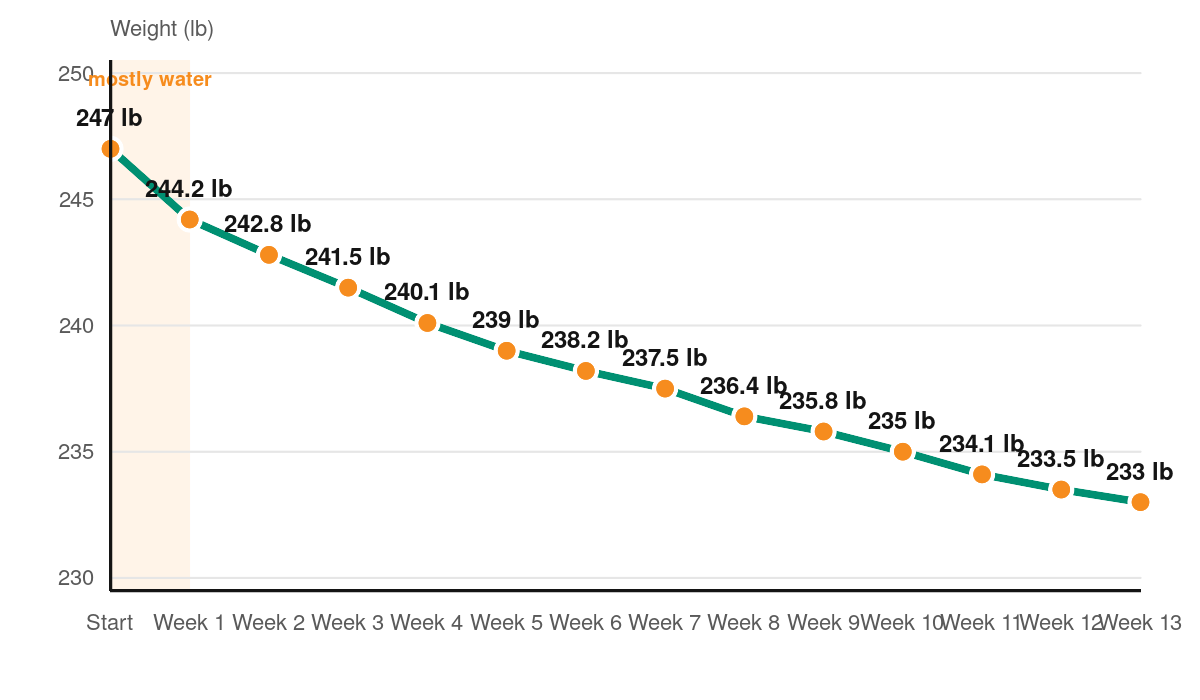
The graph below shows what happened over the next three months. Ray weighed himself every Friday morning and recorded the number in a notes app. He started at 247 pounds in mid-May. By mid-August he was at 233, a loss of 14 pounds spread across thirteen weeks. The line is not steep, and it is not straight. Week seven he lost nothing. Week eleven he gained half a pound. The overall direction, though, was steadily downward, and his knees tracked the direction more than the day-to-day noise.
What Weight Looks Like
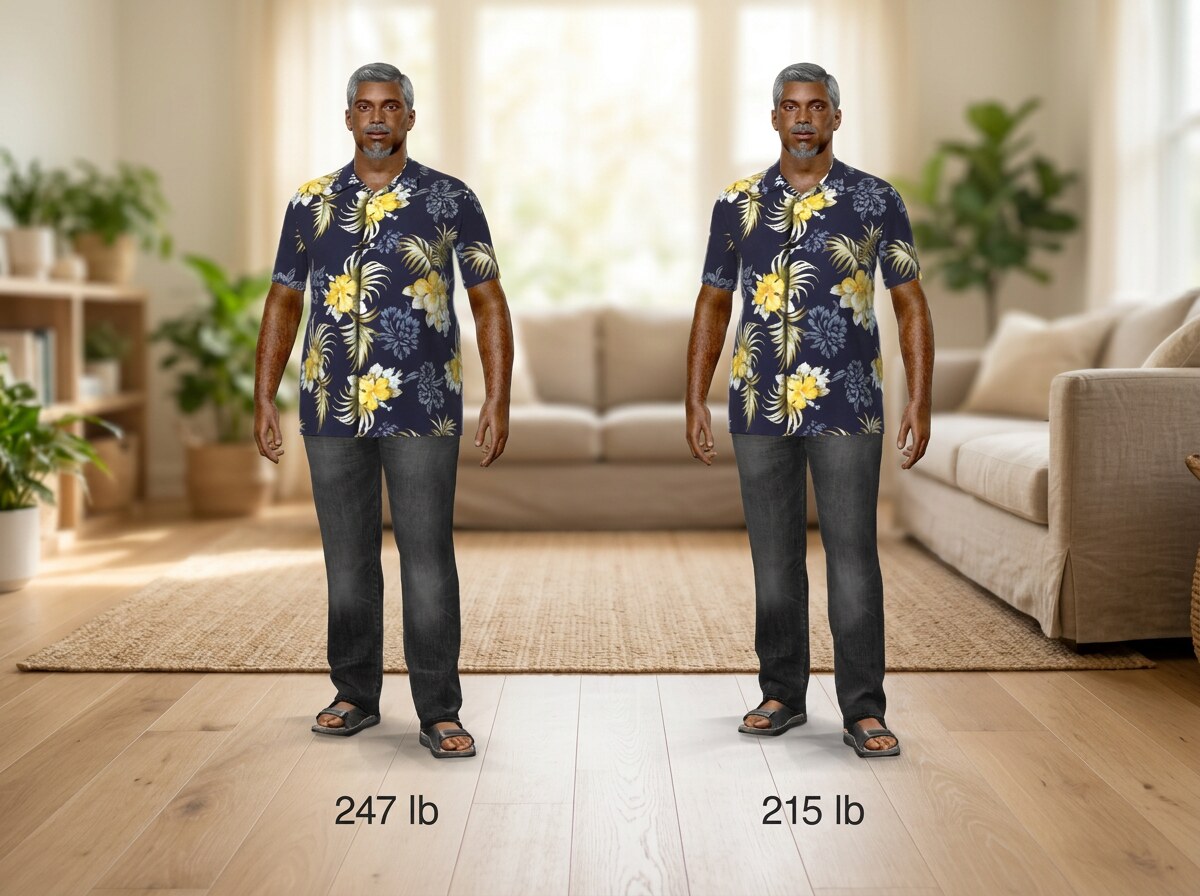
The figure above shows Ray at 247 pounds and again at 215, which is the weight he is aiming for by spring. Fourteen pounds down, at 233, he sits somewhere between those two images, and the difference is subtle but real. Weight tends to leave the face and the midsection first for most men, and Ray saw it in his jawline around week six. His belt moved one notch tighter without him consciously pulling it. You can try the simulator for men with your own starting point and see what a given loss does to your frame before the mirror confirms it. That matters because the mirror lies for the first month or two. Your brain adjusts to the image in front of it every morning, and a change of ten or fifteen pounds spread across a whole body can look like nothing in the glass even when your waistband tells a different story.
The Quiet Snoring
Ray’s wife was the one who noticed. About two months in, she realized she had slept through the night four nights in a row without decamping to the couch. Ray had not changed his sleeping position, his pillow, or his evening routine except for the walk and a smaller dinner plate. He was simply carrying less weight around his neck and chest, and that reduced the pressure on his airway enough that the snoring dropped from a roar to something closer to heavy breathing.
Sleep apnea has a reputation as a mechanical problem requiring a machine or a mouthguard, and for severe cases it often does. But weight is one of the strongest modifiable factors, and even a modest loss can shrink the soft tissue that crowds the throat during sleep. Ray still snores sometimes, especially after a late meal or a beer, but his wife no longer keeps a pillow and a blanket on the living room chair. That improvement cost him no copay and no prescription. It cost him a walk and a slightly lighter dinner.
Treating Symptoms
The temptation with symptoms like aching knees or bad sleep is to slot them into a mental category labelled “getting older” and stop investigating. The category is comfortable because it asks nothing of you. Once a problem is aging, it becomes something that happens to you rather than something you might influence. Ray nearly did that. He had spent two years telling himself that knees hurt at fifty-one, that everyone he knew snored, that his father had the same complaints and lived with them.
What changed was not a burst of motivation. It was a single experiment. His doctor had said weight might help, and Ray decided to test the idea for one month by walking after dinner and eating slightly smaller portions. He did not join a gym, count calories, or give up the foods he liked. He just shrank the evening meal by about a fifth and walked for fifteen minutes. When his knees felt a little better after three weeks, the experiment stopped being an experiment and became a habit. The habit stuck because the feedback was concrete and came quickly.
Perceptual adaptation works against you when you are losing weight because you stop seeing the changes in the mirror after a while. But it works in your favor when the change you are tracking is not visual. A knee that hurts less when you stand up is a signal you cannot adapt away. A wife who stops retreating to the couch is a signal you cannot ignore. Ray tracked the scale, but what kept him walking was the disappearance of two specific miseries he had written off as permanent.
Available Levers
None of this means that medication is the wrong choice for someone whose doctor recommends it. The point is simpler: the conditions those drugs improve are driven in large part by the physical load of excess weight, and load responds to the same boring levers whether or not a prescription is involved. Walking, a smaller dinner plate, a consistent bedtime, a few pounds off the frame. The levers are unglamorous, but they are available on a Tuesday evening without a prior authorization.
Ray is at 233 pounds now, aiming for 215 by spring. His knees are not perfect and he still gets winded on stairs, but he no longer braces himself against the desk when he stands. His wife sleeps next to him most nights. He still dispatches trucks from a chair for ten hours a day, but the hour after dinner now belongs to a walk around the neighborhood, and that single hour has rewritten two things he thought were just what happens when you get older.