
The diet that got it off is not the diet that keeps it off
By Maya · November 17, 2026

Priya is 39, a pharmacy technician, and she lost 30 pounds last year. She did it with a shake for breakfast, a salad for lunch, and whatever her family ate for dinner, only she ate half. She walked 45 minutes every morning and did a YouTube strength video three nights a week. By October she was 175 pounds, the number she had circled on a sticky note on her bathroom mirror, and she felt like she had cracked the code.
The problem came in November. Her daughter’s school play ate up two weeks of evenings. The morning walks got shorter, then disappeared. The shakes started tasting like obligation, and one Wednesday she just made toast instead. By March, twelve of the thirty pounds were back, and she stood on the scale at 187 wondering if the whole year had been a waste.
It had not been a waste. She had just run the wrong playbook for the season she was in. Losing weight and keeping it off are two different jobs, and the plan that works for the first one rarely fits the second.
The two different jobs
The losing phase has a finish line. You can see it, you are motivated, and you are willing to do things temporarily that you would never do forever. A shake for breakfast is a tool, not a lifestyle. A strict calorie target feels purposeful when the scale is moving every week. The problem is that the finish line is an illusion. You cross it, you stop the temporary things, and the body that got you there does not know the race is over.
Maintenance has no finish line. It is a Tuesday in April. Nobody is cheering. The scale does not move much, and that is the point. The job is to hold ground, and holding ground takes habits you can do on a boring week, a busy week, a week when your daughter has a play and you have not slept enough.
Priya’s first plan was a losing plan. It worked beautifully for losing. It fell apart the moment her life stopped revolving around it, because it was built on temporary intensity, not permanent fit.
What Priya kept and what she dropped
When she decided to try again in April, she did not restart the shakes. She asked herself a question she had never asked the first time: what am I actually willing to do at 175 pounds, forever, on a normal week?
She wrote down two things. One was the morning walk. Not 45 minutes at a power clip, just 25 minutes, the loop around the park near her house, the one she actually missed when she stopped. The other was Sunday cook-ahead: two sheet pans of roasted vegetables, a pot of brown rice, and a few chicken breasts she could slice into lunches. Nothing measured, nothing weighed, just food ready when Tuesday got busy.
She dropped the shakes, the salads, the YouTube videos, and the half-portion dinners. She ate breakfast. She ate lunch. She ate dinner with her family. She aimed for a small deficit instead of a large one, and the scale moved slowly.
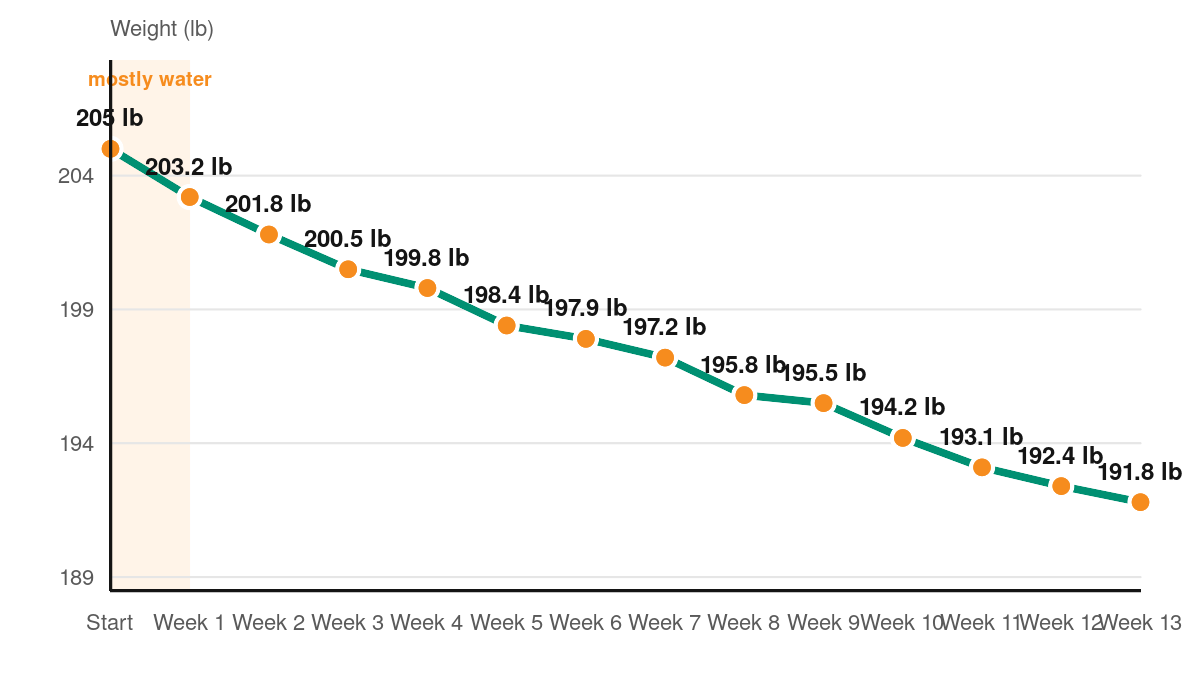
The graph below shows her next thirteen weeks. She started at 205 in mid-April and lost about a pound a week. Some weeks the line barely budged. One week it went up half a pound. But by mid-July she was at 191, and the difference was that she was not exhausted. She was just living.
The maintenance test
What are you still doing at your goal weight, on a regular Wednesday in March, with nothing special happening? If the answer is nothing, if every habit you are using right now feels like a countdown to the day you can stop, you are on a losing plan, and the regain clock is already ticking.
Losing plans are the right tool for a specific phase. But you need to know which phase you are in, and you need to switch tools when the phase changes. Most people never switch. They hit the goal, exhale, and drift back toward the old normal, because the new normal was never built to last.
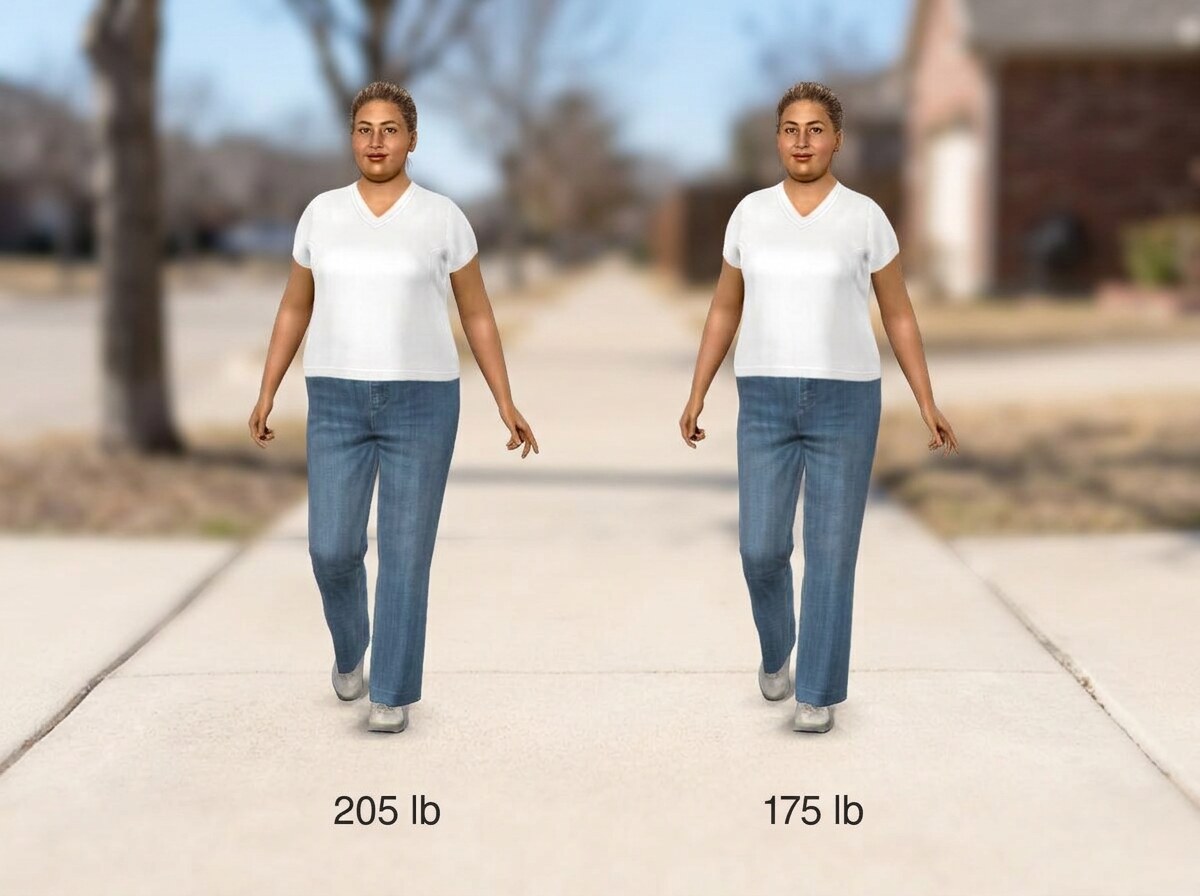
Look at the figure above. The render on the left shows Priya at 205 pounds, where she started her second effort. The one on the right shows her at 175, the goal she is working toward. Thirty pounds is enough to change the shape of a face. The jawline sharpens, the cheeks lose some of their fullness. The waist comes in, and at her height of 5’4”, thirty pounds moves her from a size 16 toward a size 12. That is visible to other people, but it is also the range where the mirror starts to lie. The change is real but gradual, and the eye adapts faster than the scale moves. You can try the simulator with your own numbers to see what a slower, smaller deficit looks like across a year instead of a season. The difference between losing fast and losing slow shows up on the graph, but it also shows up in what the person in the picture is doing on a Tuesday.
The two-habit rule
If you take one thing from Priya’s second attempt, make it this: write down two habits you would still do at your goal weight, on the most ordinary week you can imagine. The week where your kid is sick and your boss is emailing at 8 p.m. and you just need to get through Thursday.
Those two habits are your maintenance plan. Everything else you are doing right now, the shakes, the tracking, the gym sessions at 6 a.m., is a losing-phase tool. Use it, appreciate it, and let it go when the phase ends. But protect the two. They are the difference between hitting the goal and staying there.
There is a psychological trap built into the losing phase, and it is the feeling that you are finally in control. The scale moves, the clothes loosen, and you think you have solved the problem permanently. That feeling is real, but it is attached to a set of conditions that are not. When the conditions change, when the motivation fades, when life gets loud, the feeling goes with it, and the old habits come back because they were never replaced, only suppressed.
Maintenance feels like a letdown at first. There is no downward trend to chase. Nobody asks how much you lost this week. The reward system in your brain, which got a little hit every time the scale dropped, goes quiet. You have to learn to feel okay without that feedback, and that takes practice. Priya said the hardest month was the one where she lost one pound and had to remind herself that was the point. Losing nothing, in maintenance, is winning.
A slower deficit helps here too. When you lose a pound a week instead of two, the scale is less dramatic, and you get less attached to the drama. You learn to trust the trend instead of the daily number. You notice that your jeans fit the same on a Thursday as they did on a Monday, and that becomes the new signal. The mirror still lies, but the waistband does not.
Priya is still walking toward 175. She will get there around November, a full year after she first did, and this time she will not be throwing a finish-line party. She will just keep walking the loop around the park, because that is what a Tuesday in April asks for.