
On a GLP-1, your muscle has a say in what leaves
By Maya · November 24, 2026
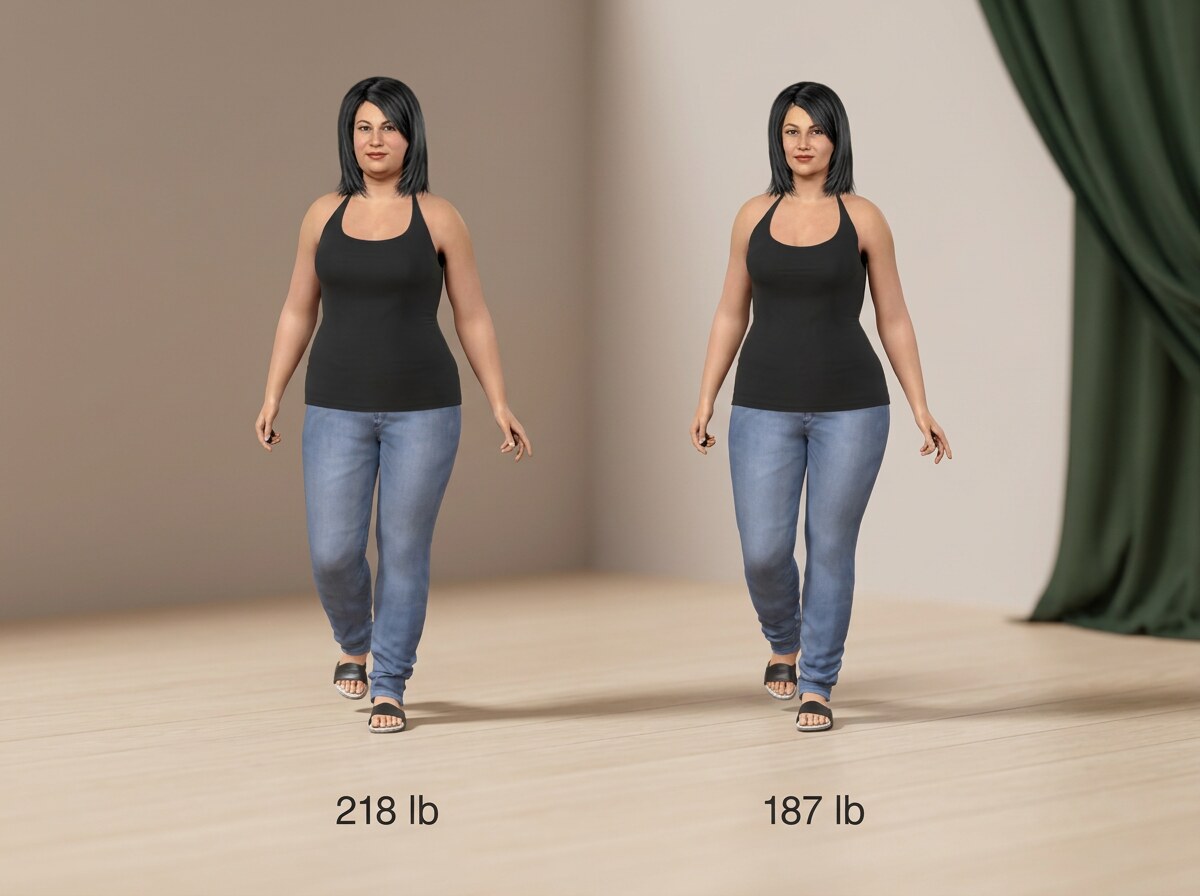
Priya is 44 and coordinates billing for a hospital, which means she spends most of her day on a headset, fixing claims that should have been simple. She started a GLP-1 at 218 pounds, aiming for 187. The first month felt like the easiest diet she had ever been on, because for once the food noise was quiet. The second month, her scrubs fit differently. The third month, she noticed something she did not expect: her own stairs felt taller.
She was losing weight quickly, and a lot of the early loss was water, but not all of it. Some of what was leaving was muscle. Her legs felt shaky on the landing. Her arms got tired carrying a crockpot from the car to the kitchen. She was lighter, but she was not stronger, and for a while she assumed that was just the price of progress.
The mistake is common and it is fixable. The medication does not decide what leaves your body. Your habits do. If you lift, even a little, and eat enough protein, you are more likely to keep the muscle you need for the next forty years. You notice the difference in ordinary tasks: stairs feel steadier, bags feel lighter, you stop bracing on railings.
What the scale does not tell you
Priya’s first thirteen weeks looked great on paper. She went from 218 to 195 pounds, which is the kind of line on a graph that makes a doctor nod. But the number on the scale does not separate fat from muscle, and her body was making a trade she had not agreed to.
When weight comes off quickly, some of it is lean tissue. The body keeps muscle that gets used. For Priya, the weakness showed up in ordinary moments. She braced a hand on the railing going up to bed. She asked her son to carry the laundry basket down two flights. She felt fine sitting down, which is why the change snuck up on her. The scale said she was winning. Her legs knew something different.
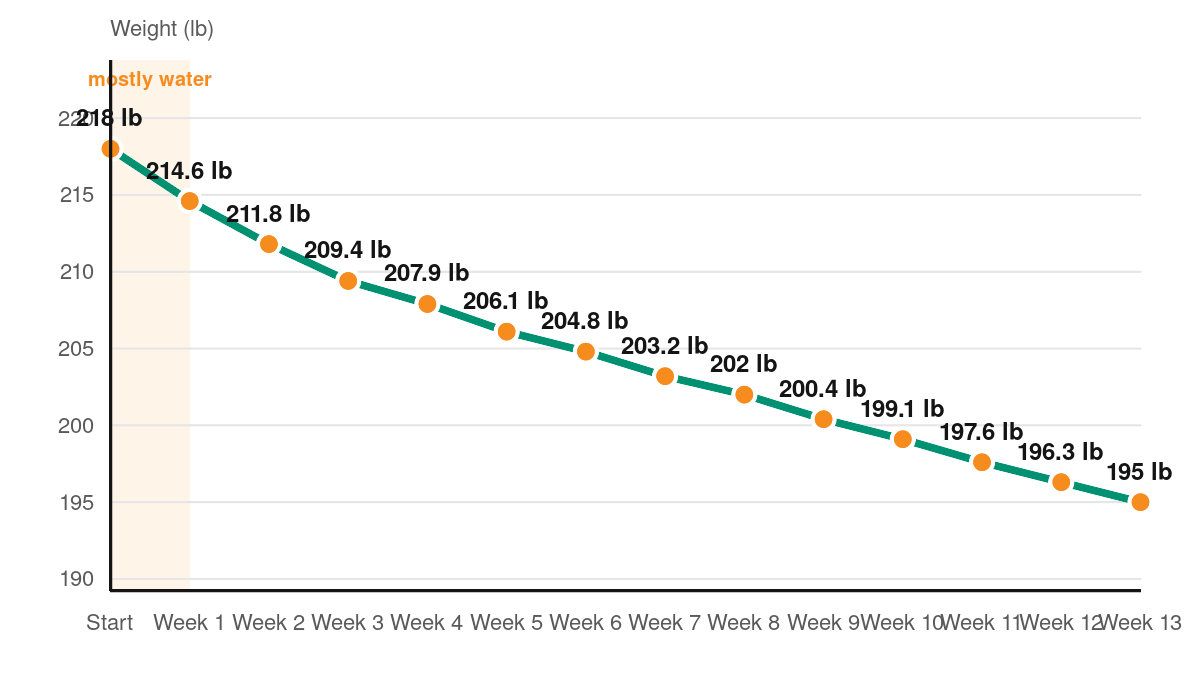
The graph below shows her first thirteen weeks on the medication, before she touched a dumbbell. The line drops steadily, a little over a pound a week on average. What the graph cannot show is what kind of weight was leaving. By week thirteen she was down 23 pounds, and a meaningful slice of that was muscle she would later have to earn back.
The fix is smaller than you think
Priya did not join a gym. She did not hire a trainer or buy a rack of equipment. She bought two dumbbells, a 10-pound pair and a 15-pound pair, and put them next to the couch where she watches the evening news. Twice a week, for 25 minutes, she did the same five movements: squats, rows, presses, a deadlift pattern with both dumbbells, and a carry from one end of the apartment to the other.
A 25-minute session, twice a week, is enough. You notice the difference in what you can carry and how steady you feel on stairs. The scale may move slower, but the weight you lose is more likely to be the kind you wanted to lose.
She also changed one thing about breakfast. She had been starting the day with toast and coffee, which was easy and fast. She swapped the toast for a bowl of Greek yogurt with a scoop of protein powder stirred in, or two eggs and a slice of whole-grain toast when she had ten minutes. The goal was a protein source at the start of the day, every day.
What changed by month four
Priya added the strength sessions at week 14, after a work trip where she struggled to lift her own suitcase into the overhead bin. She had lost 31 pounds by then and felt like a smaller version of a weaker person. Four months later, the picture was different.
She still lost weight, but the quality of the loss changed. The scale moved a little slower, which bothered her for the first two weeks. Then she noticed that her legs did not shake on the stairs anymore. She carried the crockpot without setting it down halfway. On her next work trip, she put her suitcase overhead with one smooth motion and did not think about it until she was back in her seat.
She is not a bodybuilder. She is a 44-year-old billing coordinator who lifts twice a week and eats protein at breakfast. That is enough to keep the muscle she needs for the life she actually lives.
The figure above shows Priya at 218 pounds and at her goal of 187 pounds. The first thing you notice is her face. The puffiness around her jaw is gone, and her chin has a cleaner line. Her waist is the second thing. The weight came off her midsection early, which is common, and by 187 her waistband sits lower and looser.
What the render cannot show is the difference between the 187-pound version of Priya who lifted and the 187-pound version who did not. The scale would read the same. The mirror would look similar in clothes. But one version carries her own luggage and walks up two flights without thinking about it, and the other braces on the railing. The mirror is not the right tool for that comparison. You can see the shape of the change in the figure above, and you can feel the rest in your legs on a Tuesday. The simulator at /women.html lets you set your own numbers and see what your goal looks like.
Why protein has to be in the room
Lifting helps you keep muscle. Protein helps too. If you lift twice a week but eat very little protein, you may still feel weaker than you expected. Priya did not count grams. She made one change at breakfast and kept her other meals mostly the same, just smaller than before.
A protein source at breakfast matters because it is the meal most likely to be all carbohydrate. Toast, cereal, a bagel, a banana. None of those are bad, but none of them give your muscles much to work with after a night without food. Adding eggs, yogurt, cottage cheese, or a protein shake changes the math without turning the day into a project.
You do not need a maximum. You need enough, and enough is more than most people eat when they are losing weight quickly. The habit that matters is the same one Priya built: a protein source at breakfast, every day, even the busy ones.
The hardest part of Priya’s first month of lifting was not the soreness. It was the slower scale. She had gotten used to watching the number drop every few days, and when the loss slowed, she felt like she was doing something wrong. She was not. She was trading a little speed for a lot of function.
That trade is hard to feel good about in the moment. The scale is a number you can check in ten seconds. Strength is slower to show up. You cannot step on a scale and see that your legs are more stable on the stairs or that the suitcase feels lighter. You only notice it later, in the middle of an ordinary task, when you realize you did not think about it.
Expectation matters here. If you start a GLP-1 expecting the scale to drop at the same rate forever, the first slowdown feels like failure. If you start it knowing that the first month is mostly water and that the pace will settle, the slowdown feels like what it is: the normal rhythm of a long process. Priya’s graph shows the early drop, and it also shows the weeks where the line flattened for a while. Those weeks were not wasted. Her body was adjusting, and she was still showing up.
The other psychological shift is identity. Priya had never thought of herself as someone who lifted weights. She thought of lifting as something for athletes or people who already looked fit. What changed her mind was the realization that she wanted to carry her own luggage and climb her own stairs for the next forty years. That is not a fitness identity. That is a regular life.
Start before you feel weak
The mistake most people make is waiting until the weakness shows up. Priya waited until month four, when the stairs were already a problem and the suitcase already felt heavy. She got the muscle back, but it took longer than keeping it would have taken in the first place.
If you are on a GLP-1 or about to start one, book the strength sessions before the first injection. Two 25-minute sessions a week, with whatever dumbbells you have or can borrow, is enough. Add a protein source at breakfast on the same day you start the medication. Do not wait until the scale has dropped 30 pounds and your legs feel like someone else’s.
Priya is at 195 after thirteen weeks, heading toward 187, and she still lifts twice a week. She does not think about it much. It is just what she does on Tuesday and Thursday evenings, between the news and the dishes. She carried her own luggage on her last trip, and she did not think about that either until she was already in the aisle, reaching for the overhead bin.