
Muscle is the retirement account nobody starts early enough
By Maya · November 16, 2026
Desmond is 58 and a building inspector. He spends his mornings walking sites, climbing ladders, and carrying a sixteen-foot extension ladder from his truck to whatever roof hatch he needs to reach. For years the ladder felt like part of the job. Then one Tuesday last fall he had to stop halfway up a stairwell, set the ladder down, and catch his breath before he could keep going. He was not injured and he was not sick. He was just weaker than the job asked him to be, and he had not noticed it happening.
That moment is what the longevity headlines miss. They talk about muscle as if it is a supplement you can take. But muscle is a physical savings account, and the withdrawals begin decades before you feel them. Desmond’s stairwell was a withdrawal notice. The question is what you can deposit this week that changes the balance twenty years from now.
Two short sessions
Desmond did not join a gym. He bought a pair of twenty-pound dumbbells and cleared a corner of his garage. Twice a week, on Tuesday and Friday mornings, he set a timer for twenty-five minutes and worked through four movements: a squat to an old kitchen chair, a one-arm row braced on the chair back, a floor press, and a suitcase carry down the driveway and back. That is it. No program name, no tracking beyond a note on the fridge.
The first month felt awkward. The second month the movements felt familiar. By month three he noticed he was reaching for the dumbbells without dreading it, and by month four he carried his ladder up the same stairwell without thinking about it until he was already at the top. The ladder had not gotten lighter. Desmond had gotten stronger in a way that mattered for the one task he actually needed to do.
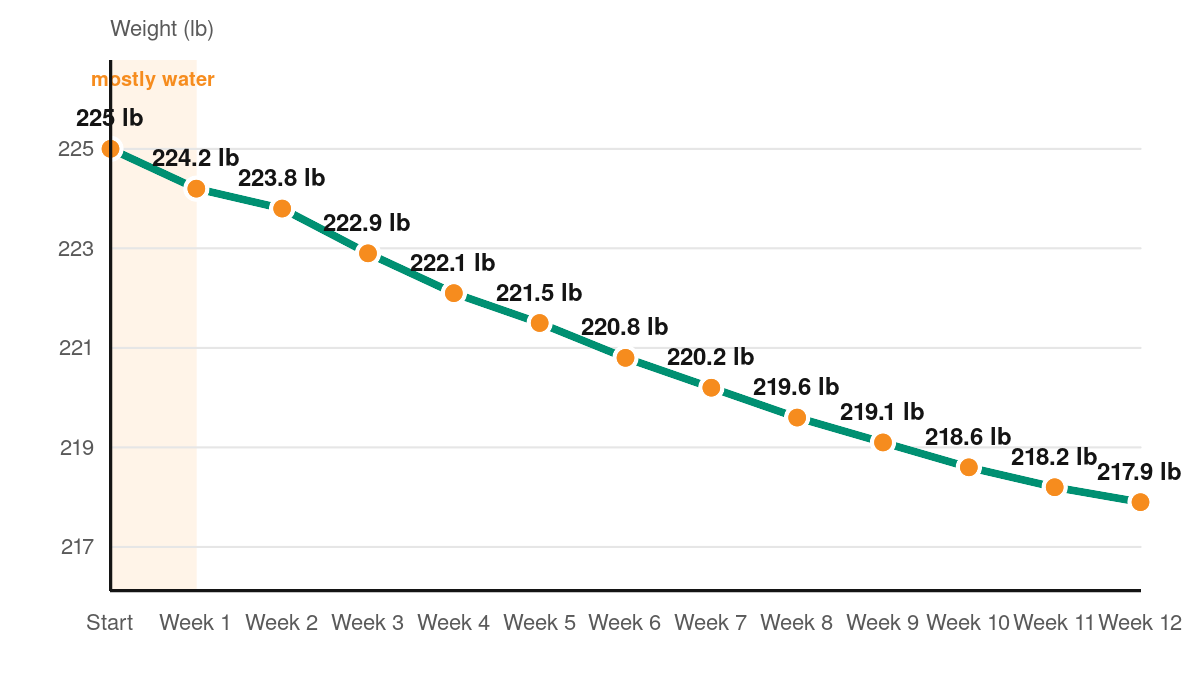
The graph below follows his scale weight over the first twelve weeks. It drifts down slowly, about half a pound a week on average, but the number on the scale is the least interesting thing that happened.
What a palm of protein buys you
Desmond’s other change was smaller. He had always eaten toast or a granola bar for breakfast, sometimes nothing. His wife read somewhere that older adults need more protein to hold on to muscle, so he started adding a palm-sized portion to his first meal: two eggs, or a scoop of cottage cheese, or last night’s chicken thigh sliced onto the toast. He did not count grams. He just looked at his hand and matched the portion.
That single change gave his Tuesday and Friday sessions something to work with. Desmond noticed he was less sore by Friday morning, and the movements that had tired him in month two felt steadier by month three. A morning with no protein after a morning with dumbbells is like depositing a cheque and then emptying the account before it clears. Desmond’s breakfast filled the gap he had been leaving open for years.
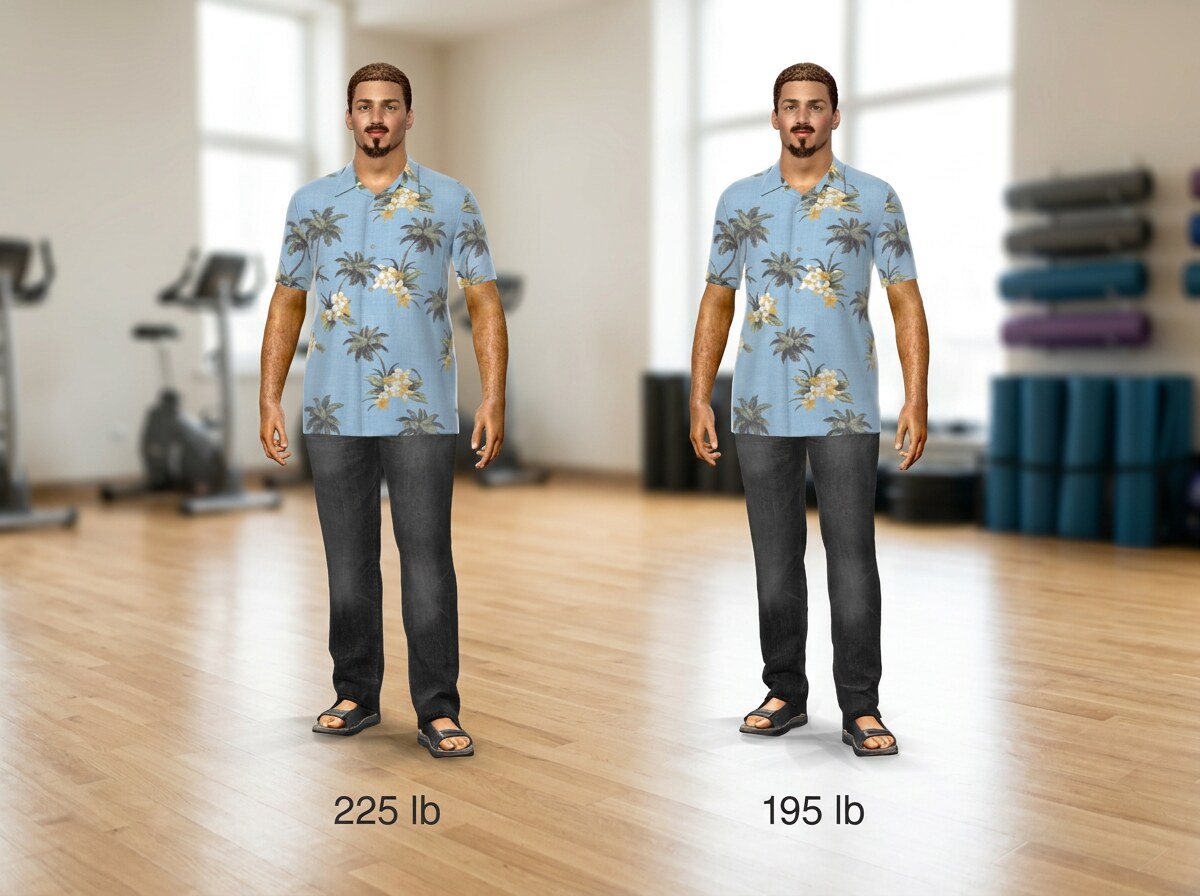
The figure above shows Desmond at 225 pounds and at his goal of 195, a thirty-pound difference spread across a year and a half. His face is the first place the change shows. The jawline sharpens, the puffiness around the neck recedes, and the shoulders begin to square off rather than slope. The waistband loosens next, and by the time he reaches 200 the ladder carry is no longer a test, it is just a thing he does. The last ten pounds come off slowly, mostly from his back and hips, and that is where the mirror and the scale most often disagree. The scale says the loss has slowed; the mirror says the shape has changed. Both are true.
If you want to see what a thirty-pound shift looks like on a frame like yours, the simulator lets you set your own start and goal and see the figure change in real time. It is a useful check when the mirror is not cooperating. You can try it for men at our men’s simulator.
The decades you do not feel
The real payoff of Desmond’s dumbbells and breakfast eggs is not the ladder. It is 2035, when he is 70 and still carrying his own groceries up the front steps without a hand on the railing. Muscle lost in middle age does not announce itself. It subtracts quietly: a chair that is harder to stand up from, a grandchild you cannot lift, a walk you cut short because your legs feel heavy. The losses compound, and by the time you notice them the account is already thin.
Two twenty-five-minute sessions a week will not make anyone a bodybuilder. But they are enough to slow the withdrawal rate. A 70-year-old who kept a handful of muscle she would otherwise have lost is a 70-year-old who lives in her own house, walks her own dog, and gets off her own toilet without help. Those are the dividends. They pay out in ordinary Tuesday mornings thirty years from now.

Desmond did not feel different after two weeks. He felt sore and a little foolish, standing in his garage with dumbbells while his neighbours jogged past with their earbuds in. The first sign of progress was not a mirror or a scale. It was the timer on his phone: the twenty-five minutes began to pass faster. A session that dragged in week two felt routine by week six, and the routine itself became the reward. He was no longer a guy trying to get strong. He was a guy who did his Tuesday and Friday thing, and that identity shift mattered more than any single workout.
Perceptual adaptation works against you here the same way it does with weight loss. You stop noticing your own body’s changes because you see yourself every day. Desmond’s wife noticed his shoulders filling out his shirt before he did. The ladder moment was the objective proof: a task that had defeated him was now unremarkable. If you are starting something similar, pick a real-world test that is not the scale. A flight of stairs, a bag of groceries, a child you can lift. Check it once a month and trust the answer it gives you more than the mirror.
This week’s deposit
Pick two days this week. Put them in your calendar as “strength” with a start time and a twenty-five-minute block. Do not research a program, do not buy equipment, do not wait until you feel ready. Bodyweight squats, a backpack with books in it, a sturdy chair for dips, you have enough to start with what is in your house right now. The number of weeks it takes before the same flight of stairs feels different is shorter than you think.
Desmond’s Tuesday session is tomorrow. He will set his timer, pick up his dumbbells, and get it done before his first site visit. The ladder is already back in the truck.