
Getting out of a chair without using your hands is a strength score
By Maya · November 23, 2026

Ray is 58 and supervises maintenance for a school district. He spends his days walking long hallways, climbing onto stages to check rigging, and occasionally hauling a box of ceiling tiles up a flight of stairs. He had always thought of himself as strong enough for whatever the job asked. Then one evening last fall he sat down on the couch after dinner, realized he had left his phone on the kitchen counter, and went to stand back up. His hands shot to the armrests before his legs even tried. He caught himself doing it and made a mental note that his knees were getting stiff. He blamed thirty years of ladders and concrete floors and moved on.
A month later his daughter handed him her toddler at a family barbecue and he lowered himself onto a low patio chair to settle the kid on his knee. When it was time to hand her back he rocked forward twice, planted both palms on his thighs, and heaved himself up. His brother-in-law noticed. Nobody said anything, but Ray felt it. He was not injured. His knees did not actually hurt. He had simply lost the ability to stand up from a chair without a running start from his arms.
Kitchen chair test
Standing from a chair without using your hands tells you whether your legs still have the strength to lift you from a dead stop, or whether your arms have already taken over the job. If you can stand up cleanly, your legs are still doing the work. If you rock, twist, or need to push off with your hands, they are not. The change is gradual enough that you might not notice your hands creeping in to help. One month you are standing up normally. A year later you are bracing on the kitchen table every time you get up from breakfast.
Pick a straight-backed chair without wheels, the kind you have at your kitchen table. Cross your arms over your chest so your hands are pinned to your shoulders, and stand up. If you can do one clean rep, you are above the threshold that matters. If you rock, twist, or have to uncross your arms to push off, you have found the thing to work on. Try it once a month and write the number down. Treat it as a strength score you are trying to hold.
Two months of effort
Ray decided to treat the problem like a work order. He had no interest in a gym membership and no time for a complicated program. He picked three things he could do at home twice a week without changing out of his work clothes. The first was the chair stand itself, doing three sets of as many clean reps as he could manage and stopping when his form broke. The second was a step-up onto the bottom stair of his basement, leading with his right leg for one set and his left for the next, holding the handrail only for balance. The third was a walk every Saturday morning on a route that included two long hills he had been avoiding for years.
He started at three chair stands per set, shaky on the last one. He could manage eight step-ups before his quads burned. The first Saturday walk took forty minutes and he stopped twice on the second hill to catch his breath. He kept going. By week four he was doing eight chair stands per set and his wife mentioned he was not rocking forward anymore when he got up from the dinner table. By week six he carried two bags of groceries from the car in one trip without thinking about it. By week eight he could do fifteen clean chair stands in a row, his step-ups had grown to fifteen per leg, and the Saturday walk had become something he looked forward to instead of something he endured.
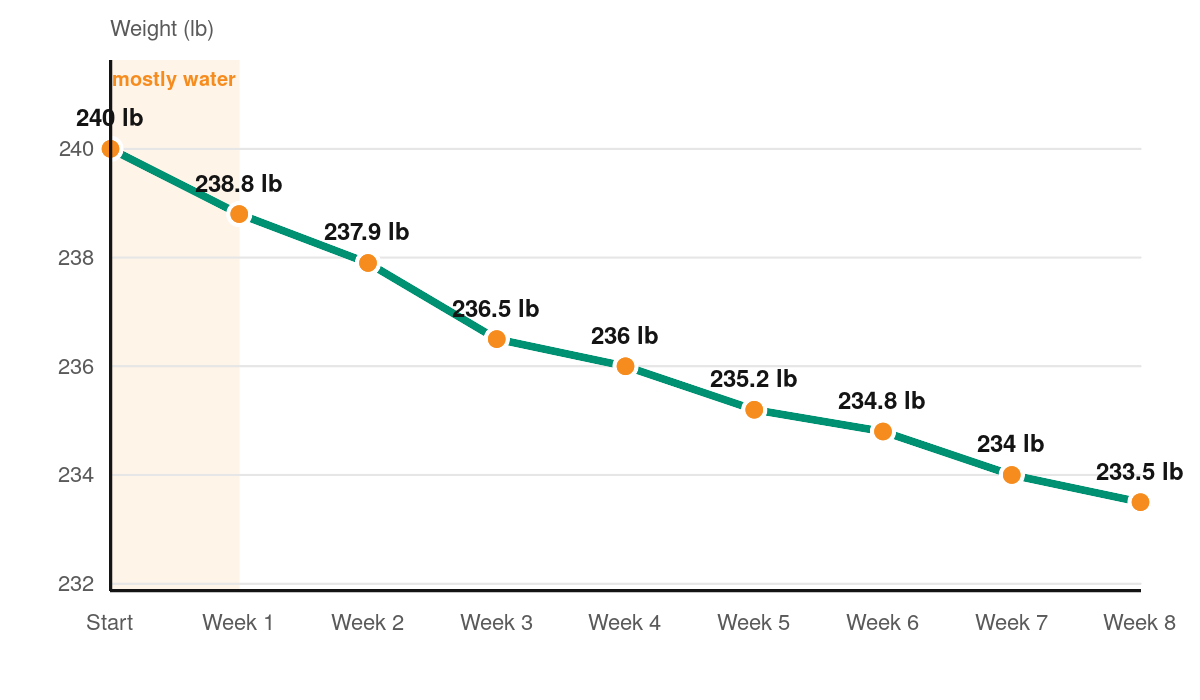
The graph below tracks Ray’s weight across those eight weeks. He was not dieting and he was not trying to lose a specific number. The six and a half pounds came off because he was moving more. The first two weeks show the usual drop that comes when a body unaccustomed to regular effort starts using stored energy. After that the line flattens into a slow, steady half-pound a week, the kind of loss that does not feel dramatic but adds up by the end of two months.
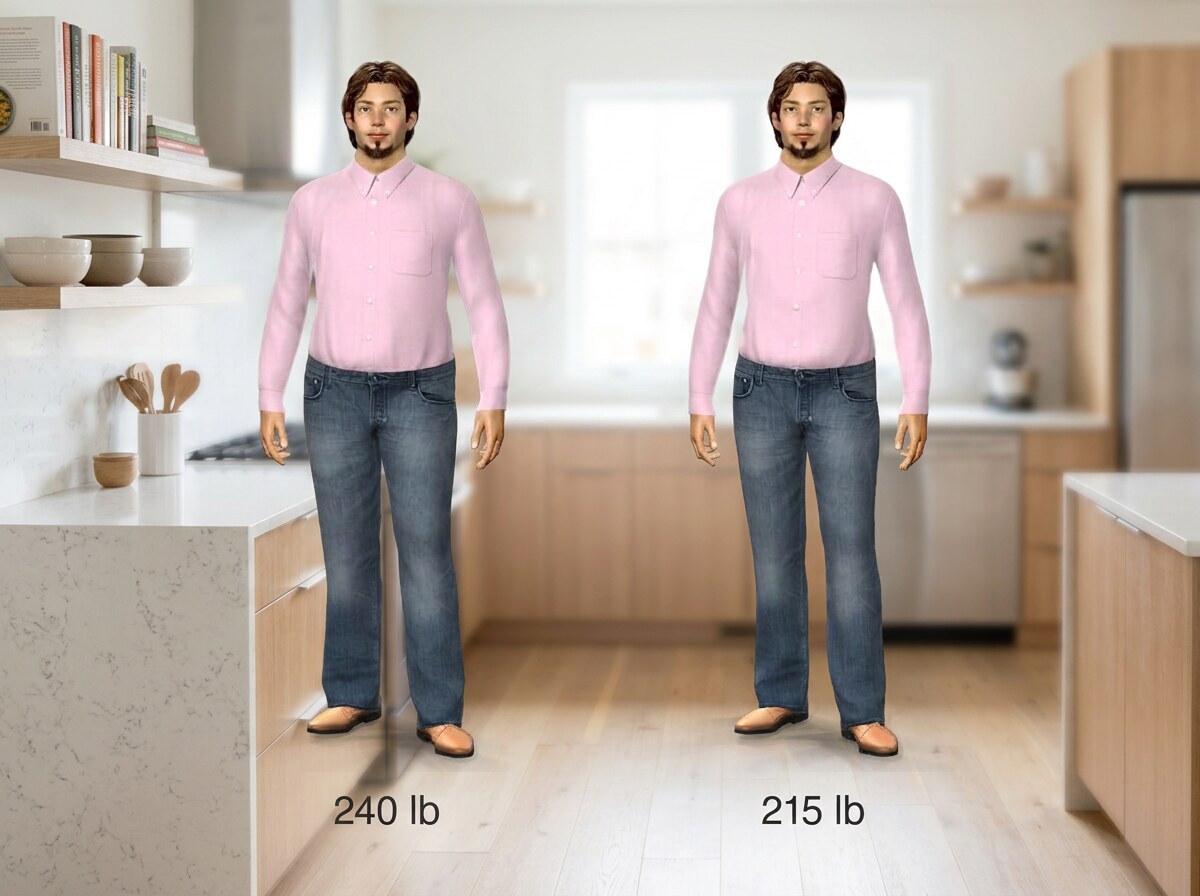
The figure above shows Ray at his starting weight of 240 and again at 215, the goal he set once he realized what was happening. On a man who carries weight in his torso, twenty-five pounds changes the geometry of standing up. Less mass in the belly means the hip angle is less cramped at the bottom of a chair stand, and the glutes can engage sooner. Ray noticed the difference first in his waistband and then in his face, where the jawline sharpened enough that his daughter asked if he had been sleeping better. The mirror caught up to the scale slowly, as it always does, because the person looking back at you every morning changes in increments too small to register. You can try the simulator for men with your own numbers and see what a difference of twenty-five pounds looks like on a body shaped like yours.
Ray almost quit after week three. The scale had moved less than two pounds from the start, his step-ups still burned, and he could not yet see anything in the mirror that looked like progress. The thing that kept him going was the chair stand count he had written on a sticky note stuck to the inside of a kitchen cupboard. Three became four, then five, then six. The number was small enough to change week to week and concrete enough to trust when the mirror lied. A rep count is harder to argue with than a reflection.
There is a quiet shift that happens when you stop treating a physical ability as something you have lost and start treating it as something you are training. Ray had spent a year thinking of himself as a guy with bad knees. The first time he stood up from his desk chair without touching the armrests and realized he had done it automatically, he was surprised. The movement had become normal again. His knees had not changed. The muscles around them had.
Next steps
Find a straight-backed chair, cross your arms, and stand up. If it is easy, you have your baseline. If it is not, you have your starting point. Either way, write the number down and put the note somewhere you will see it next month. Ray still does his twice a week, not because he is chasing a number anymore but because he likes carrying the groceries in one trip and standing up from the patio chair with a kid on his knee without thinking about it first.