
Cold showers won't fix your heart. A hill will.
By Maya · November 11, 2026

Tom is 58 and carries mail in a town with more hills than level blocks. He has read the same headlines you have, the ones about cold water and worms living longer, and for a while he considered ending his showers with a blast of cold. Then he remembered that he hates being cold, and that his real problem is the hill at the end of his route. He used to walk around it. Now he walks up it.
A worm is not a person, and three minutes of cold water in the morning does not change your core temperature for the day, let alone for a decade. If you enjoy the cold, keep enjoying it. If you are doing it because a headline promised you extra years, you can stop.
The thing that is actually worth paying attention to is a number you can watch change over months. Tom started weighing himself once a week, same morning, same conditions. His starting weight was 225 pounds. He set his goal at 195, a weight he last saw in his early forties.
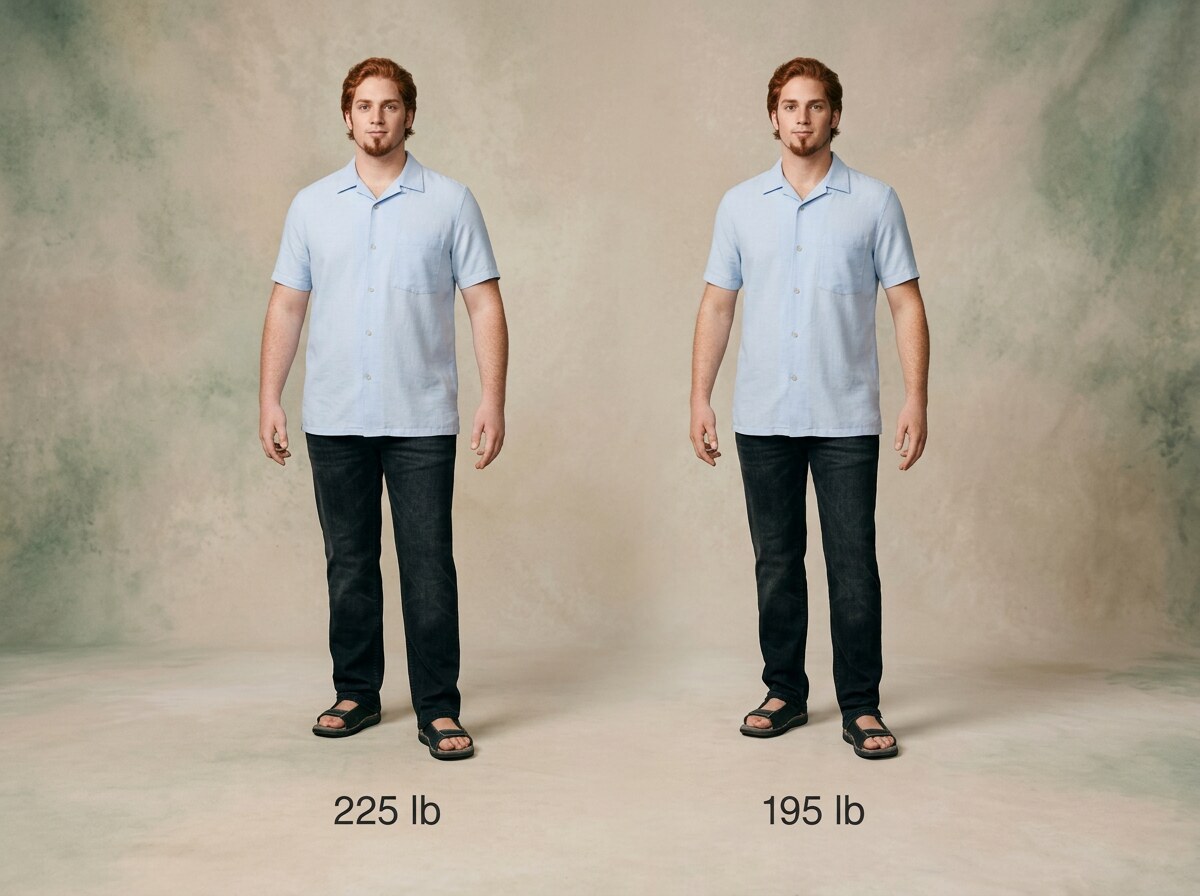
The figure above shows Tom at his starting weight and at his goal. The change from 225 to 195 is not dramatic in the face at first; his jawline sharpens a little and the puffiness around his eyes recedes, but the real story is in the waist and the arms. At 225 the waistband sits tight and the shirt pulls across the middle. At 195 the same shirt hangs straight and his arms look longer, which is just what losing thirty pounds does when there is less softness over the muscle. If you are around his height and build, expect the face to change first and the waist to be the last place that lets go. The mirror will lag behind the scale for months, and that is normal. You can see the difference your own numbers would make with the simulator for men, because the mirror is the least reliable witness you have.
What Tom actually did was small. He kept his route the same, kept his lunches the same, and added one thing: the hill he used to avoid. It takes him an extra six minutes. A brisk walk is roughly 3 to 3.5 miles per hour, and a hill at that pace is enough to make you notice your breathing without wrecking your knees. He did not join a gym, buy a wearable, or change his shower temperature.
The graph below shows his weight, taken once a week, over twelve weeks.
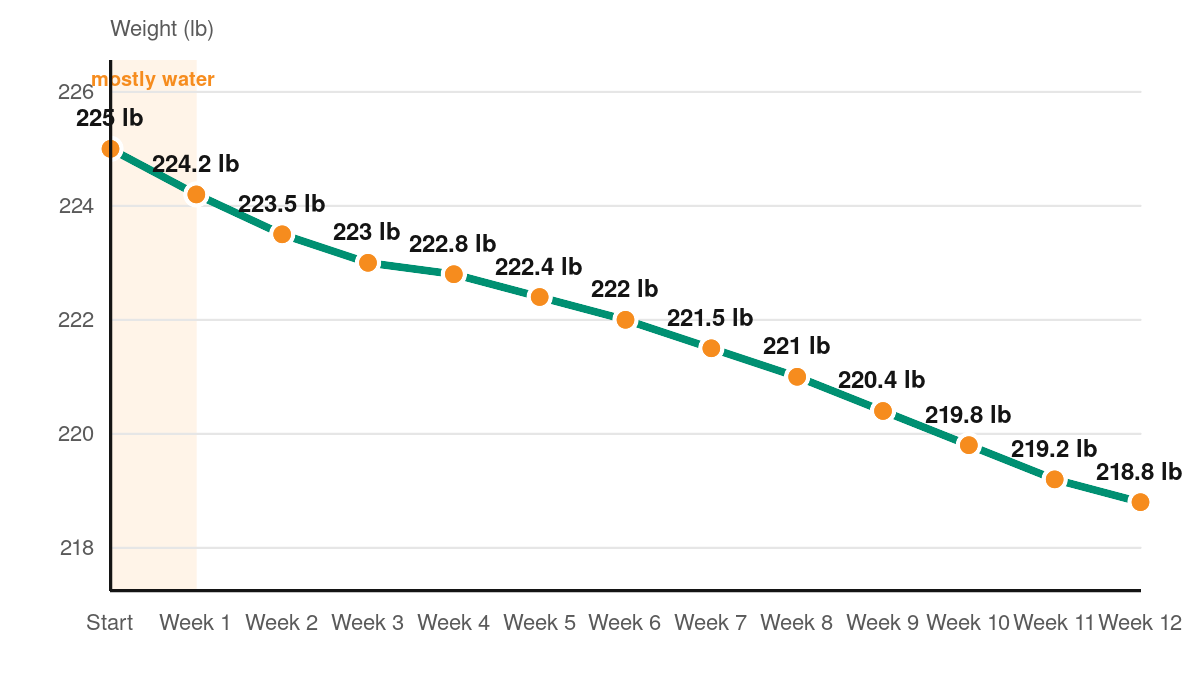
The first month looks like nothing. 225 to 224.2 to 223.5, with a week where it barely moved. That is the part where most people quit, because the change is smaller than the noise. But by week eight the trend is clear, and by week twelve he is at 218.8, a little over six pounds down. He also noticed the hill stopped making him breathe through his mouth. Those two facts are the same fact, seen from different angles.
The psychology here is that a slow change is hard to stay interested in. You want a reading that moves every day, and a weekly weigh-in moves slowly, often not in the direction that tells you anything useful. It stays the same after a salty dinner, goes up after a stressful week, stays the same when you are getting sick. If you check it daily you will chase noise. Once a week, same conditions, is enough to see the line under the noise.
There is also the identity piece. Tom is not a person who does longevity protocols. He is a mail carrier who walks a hill. That is a smaller identity, and a more durable one, because it does not depend on a headline staying true. When the next worm study comes out, his hill will still be there. When the cold plunge trend fades, his knees and his route will not care. The habit survives because it is attached to a place and a time, not to a promise about lifespan.
A body that works a little harder at ordinary things keeps its capacity. You can measure how hard a familiar hill feels, and you can measure the weight on the scale when you are doing nothing different except walking up it. Those two numbers move together, and they move in the direction you want.
This week, weigh yourself once, first thing in the morning. Then add one hill or one faster block to a walk you already do. That is the whole experiment. No cold water required.