
Before you buy the longevity app, name the Tuesday habit it replaces
By Maya · November 20, 2026
Denise, 63, retired from the postal service two years ago and found herself with a morning that stretched out in front of her and a body that felt a little more creaky than she remembered. She wanted to feel sturdy again, the way she had at fifty. So she did what a lot of us do: she opened her laptop and started reading. One article led to a subscription, a podcast mention led to a supplement, and a month later she had spent just under $400 on a longevity membership platform and a bottle of NAD capsules.
She took the capsules every morning with breakfast. She logged her sleep and her step count into the platform’s dashboard. She read the weekly reports it emailed her. And after eight weeks, she felt exactly the same.
What actually changed her week was something she started around the same time almost by accident. A neighbor asked if she wanted to walk the two-mile loop around the local park on weekday mornings, and Denise said yes because the company sounded nice. She also started opening a can of tuna on top of her lunch salad three days a week after her daughter mentioned she probably was not eating enough protein. The walk cost nothing. The tuna added maybe three dollars a week to her grocery bill. By week three, she noticed she was sleeping a little deeper and her knees did not ache at the bottom of the stairs.
She kept the walk. She kept the tuna. She dropped the subscription before the third month renewed, and she finished the supplement bottle and never ordered another. The $400 taught her something useful: the longevity industry is very good at selling you a story about your future self while quietly ignoring what your actual Tuesday looks like.
Tuesday test
There is a new longevity app, a new longevity membership, and a new longevity supplement every few months. The headlines this week are full of them: open-source tools that read your health data, programs that turn longevity research into a personal plan, a supplement market racing toward two billion dollars. The language is impressive.
None of it changes what you do on a Tuesday. A Tuesday is a regular day. You wake up, you eat something, you move your body or you do not, you go to bed. The things that actually shift how you feel a year from now are the things you do on about two hundred and fifty Tuesdays in a row. Walking. Lifting something heavy. Eating mostly real food. Sleeping long enough that you wake up without an alarm. Those are unglamorous and free, and the wellness industry cannot charge you for them, so it sells you things that sit on top of them instead.
Before you buy anything longevity-branded this month, name the habit it is supposed to replace. Not the habit it is supposed to complement or optimize or track, the actual thing you will do differently on a Tuesday because you bought it. If you cannot name one, the product is a story you are buying about yourself.
What Denise actually saw
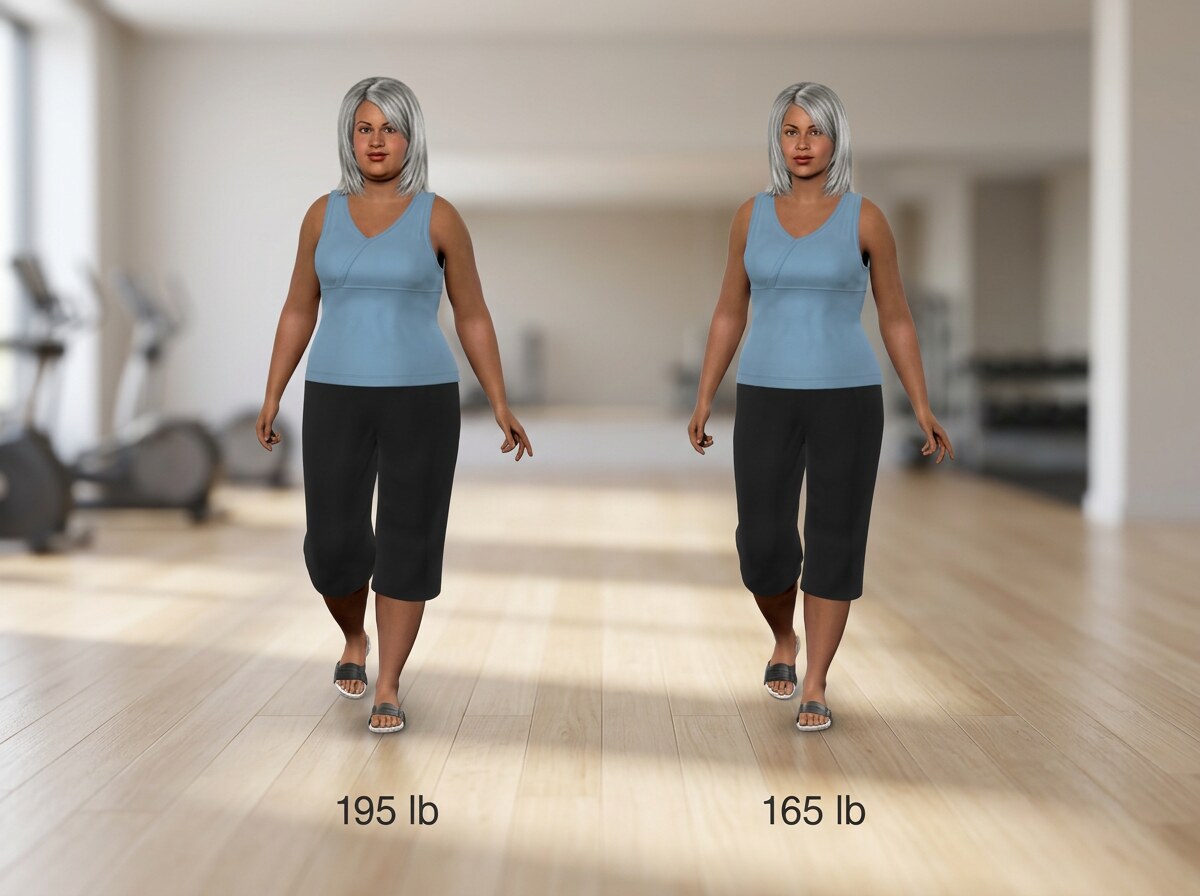
Denise started at 195 pounds. Her goal was 165, a weight she remembered feeling strong at in her early fifties. She did not set a deadline. She just started walking the loop and adding the tuna, and she stopped logging into the longevity dashboard because it was giving her numbers she already knew.
The figure above shows what 30 pounds looks like on a frame like Denise’s. At 195, the extra weight sits across her middle and softens her jawline. By 165, her waist pulls in enough that her clothes hang differently, and her face sharpens just enough that she looks in the mirror and sees the woman she remembers. The simulator lets you see that shift on your own numbers, and it is worth doing because the change is more visible than you think. You can try it at our simulator page with your own starting weight and goal.
What surprised Denise was where she noticed it first. Not her stomach. Her ankles. After four weeks of walking, the puffiness around her ankles disappeared. That was the first thing. Then her watch band felt looser. Then her neighbor said something about her looking more awake, and Denise realized she had not been squinting against a low-grade headache in days. The scale was moving, but the mirror was telling a different story, and the mirror was slower. That is normal. The scale drops water weight first, and the face and the waist are usually the first places you see it. The mirror catches up later, and by the time it does, you have stopped noticing because you see yourself every day.
Graph tells the smaller story
Denise’s first month after dropping the supplement looked like this: she started at 195, and by the end of week one she was at 193.8. Week two brought her to 193.1, week three to 192.4, and week four to 191.8. That is four pounds in a month, a sensible, unremarkable rate. It is the kind of progress that does not make a headline and does not sell a subscription.
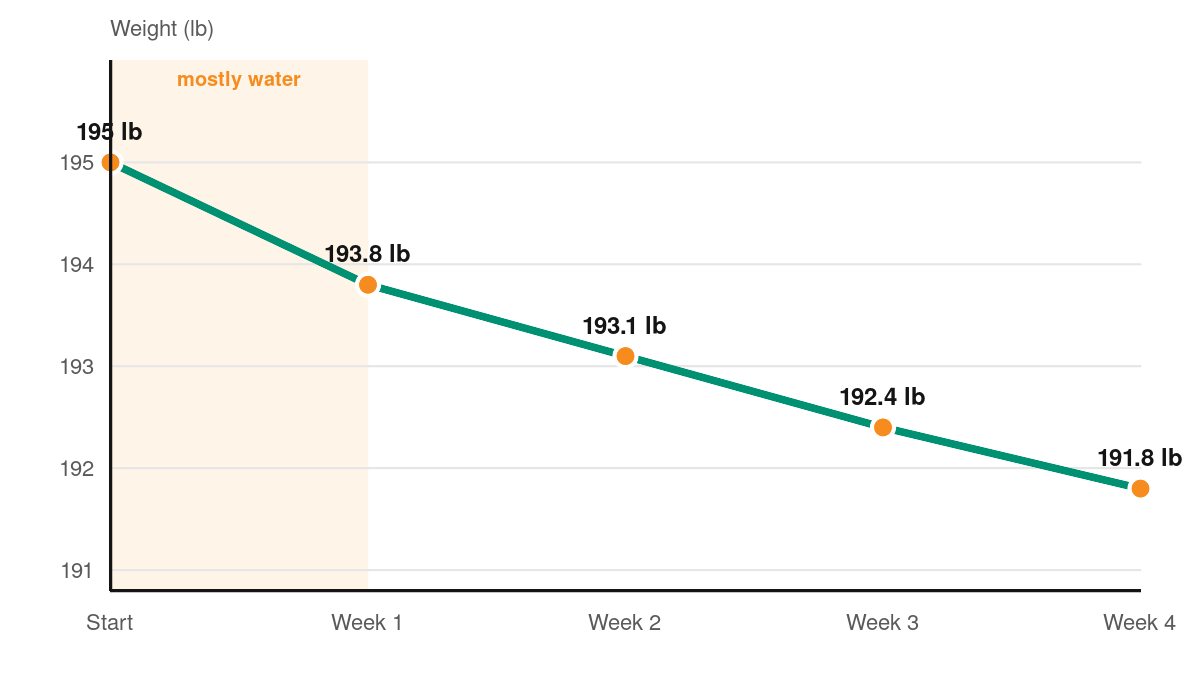
The graph below shows those four weeks. There is no dramatic drop. There is a little squiggle at week two where the number barely moved, which is probably water or a salty dinner or just a body doing what bodies do. The point is that the line goes down, slowly, and the habit behind it is a walk and a can of tuna. Denise can do that on a rainy Tuesday. She can do it on a Tuesday when she slept poorly and does not feel like leaving the house. The subscription asked her to log things and read reports. The walk just asked her to put on her shoes.

There is a psychological trap built into buying a longevity product, and it works like this: the act of purchasing feels like the act of doing. You hand over your credit card, and for a few days you feel like you have already made progress. You are the kind of person who takes longevity seriously. You are in the club. But the feeling fades, and what you are left with is a subscription you have to maintain and a supplement you have to remember to take, and neither one asks you to move your legs or eat something real. The walk asks. The tuna asks. And because they ask, they actually change the Tuesday.
Denise felt a little foolish about the $400 at first. Then she decided it was tuition. She learned that she does not need a platform to tell her she slept better after a morning walk. She can feel it. She learned that the supplement bottle was a talisman, something she held onto because it made her feel like she was doing the right thing, even though the right thing was already happening on the pavement and at her lunch table. The habit that sticks is the one that does not need a login.
One thing to keep
If you are looking at a longevity app or a membership or a supplement this month, pull out your phone and open a note. Type the one habit you think the product is supposed to replace or support. Be specific. Something like “walk two miles on weekday mornings” or “eat protein at lunch” or “go to bed by eleven.” Then put that habit in the simulator and look at what a year of it does to the figure on the screen. The visual is more motivating than any dashboard because it shows you your own body changing, and it costs nothing.
Denise still walks the loop five mornings a week. Her neighbor still joins her. She still eats the tuna, and she added cottage cheese on the other days because she likes it. She is not at 165 yet, but she is on her way, and she does not need an app to tell her she is doing fine. She can see it in her ankles and feel it on the stairs.