
What 57-year-old Dana added to three meals to keep her muscle
By Maya · October 12, 2026

Dana is 57 and runs the front office at a middle school. Last fall she noticed her grocery bags felt heavier than they used to, and the stairs to the second floor left her legs tired in a way that was new. She was not injured and she had not gained weight. She was simply losing muscle the way most of us do after fifty, a few ounces a year, until one day the ordinary things feel different.
She did not overhaul her life. She added one protein anchor to three meals she already ate and started carrying a fifteen-pound kettlebell up and down her basement stairs twice a week. Eight weeks later the groceries felt like groceries again.
That is the protein story worth paying attention to. The question is whether you are eating enough to keep the muscle you have.
What sufficiency looks like
A protein anchor is a palm-sized piece of chicken, a cup and a half of Greek yogurt, a can of tuna with crackers, or three eggs with cheese. It is food you can find at any grocery store, and it is enough at one sitting to give your muscles the raw material to rebuild.
Dana’s breakfast used to be toast with jam. She swapped it for a bowl of plain Greek yogurt with a handful of walnuts and frozen blueberries. Her lunch was often a salad that left her hungry by two o’clock, so she started adding a can of chickpeas or the leftover chicken from Sunday dinner. Dinner already had a protein on the plate most nights; she just started paying attention to whether the portion covered her palm.
Three meals, one anchor each. The grocery list barely changed.
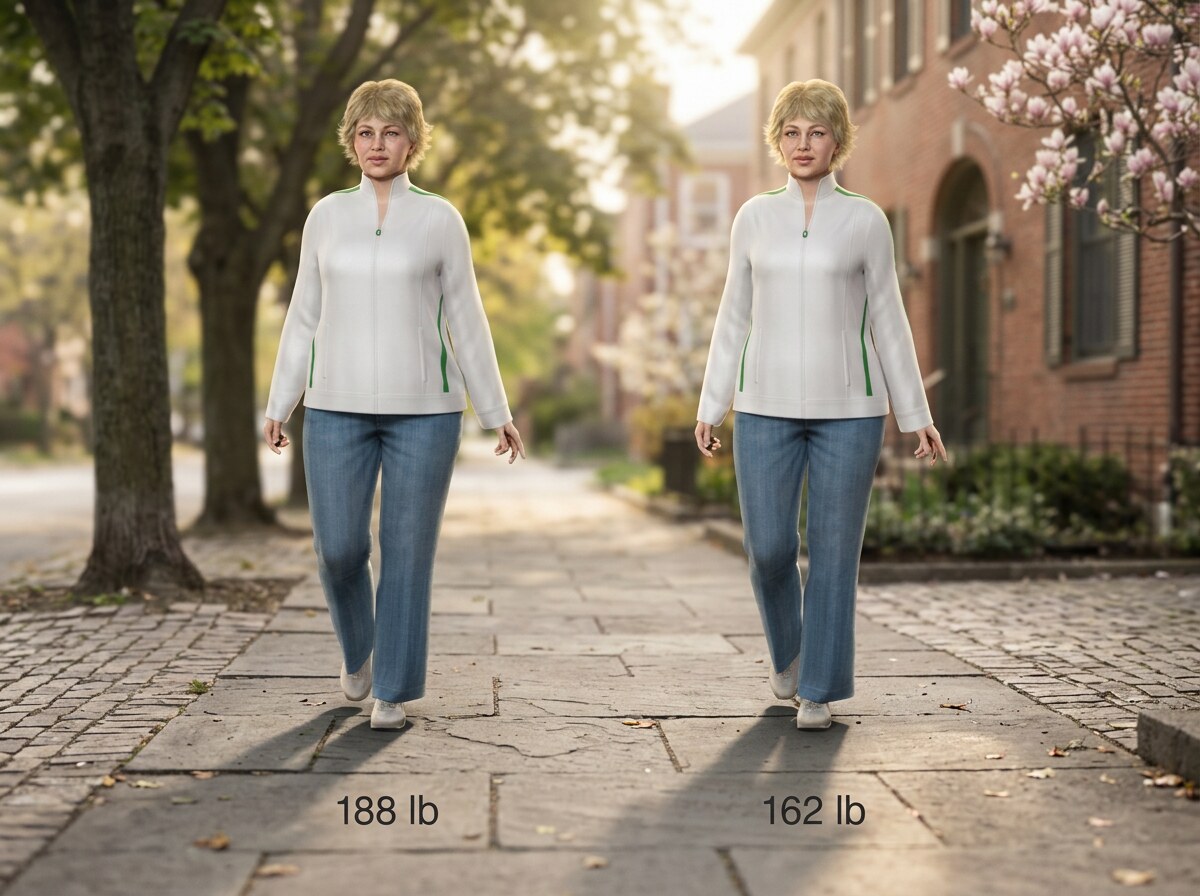
The figure above shows Dana at 188 pounds and again at 162, the weight she is working toward over the next year. Her jawline sharpened first, the way it often does, because the face lets go of fluid and fat early. Her waist followed, and then her upper arms, where a little less tissue makes the muscle underneath more visible. That is the part the mirror gets right: the shape changes even when the scale moves slowly.
What the mirror gets wrong is how quickly you stop seeing it. After a few weeks your own reflection looks ordinary again. The simulator at Model My Diet is useful for that reason. It shows you the change your eyes have already stopped registering, and it reminds you that the woman on the left and the woman on the right are separated by the same twenty-six pounds, whether you can see them today or not.
Why the headlines keep arguing
The headlines argue because they ask different questions. One asks what happens when a middle-aged adult eats far more protein than most people ever will. Another asks what happens when an older adult eats too little. Dana’s own observation is simpler: one headline warns you, the next tells you to eat more, and neither one tells you what to put on your plate on a Tuesday.
The useful middle ground is sufficiency. Enough protein to maintain the muscle you have, spread across the day, paired with enough resistance work to give that muscle a reason to stay.
There is a temptation to turn protein into a score. A score invites maximization. Maximization invites a cabinet full of powders and bars and a low-grade worry about whether you are doing it right.
Dana never counted. She looked at her plate and asked if there was a palm-sized piece of protein there. If the answer was yes three times a day, she called it good. The habit works on a busy Wednesday when the fridge is half empty and it works on a Sunday when you have time to cook.
The other half of the equation
Protein gives your body the materials. Resistance work gives it the instructions.
Dana’s twice-a-week kettlebell sessions take twelve minutes. She carries the bell up and down the basement stairs, does a few goblet squats, and presses it overhead until her arms are tired. It is not a workout class and it is not a program she paid for. It is just enough load to tell her legs and shoulders that they still have a job.
Two sessions a week is not a fitness magazine’s idea of commitment, but it is enough. A body that lifts a little moves better and holds onto more muscle than one that lifts nothing at all.
One week of tracking
If you want to know where you actually stand, track your protein for one week without changing anything. Write down what you eat and note which meals already have a protein anchor and which ones do not. Most people find the gaps are predictable: breakfast is light, lunch is rushed, dinner carries the whole day.
Dana’s gaps were breakfast and lunch. She closed them with yogurt and leftovers, and the total cost was maybe twelve dollars a week. The app’s food tracker on Model My Diet makes this kind of weeklong audit straightforward, but a notebook works too. The point is the audit, not the tool.
After eight weeks, Dana noticed the stairs at school felt ordinary again. Just ordinary, the way ordinary feels.