
The habit that survives a bad week
By Maya · October 19, 2026

Denise is 39 and works three twelve-hour shifts a week on a hospital floor. She has restarted her diet every Monday since January. Not the same diet each time, but the same shape of Monday: a grocery run, a plan written on a notepad, a promise to eat better in the abstract, and by Thursday afternoon a bag of chips from the vending machine and a feeling that she had already failed. The problem was never that she did not care. The problem was that caring was the whole plan.
Willpower is a terrible plan because it runs out. It runs out on Thursday, or on the first bad shift, or the first night she gets home too tired to cook. A plan that depends on wanting it enough is a plan that depends on the weather. What Denise changed was not her level of commitment. She changed where the commitment lived. She stopped trying to eat better as a general project and bolted one small food habit onto something she already did every single day without thinking: she put a pot of coffee on when she woke up.
While the coffee brewed, she ate a hard-boiled egg.
That is the whole trick, and it is almost embarrassing how small it is. She did not decide to eat a healthy breakfast. She did not decide to cook eggs every morning as a new identity. She decided that when the coffee maker started, she would take an egg out of the fridge, peel it, and eat it standing at the counter. The coffee maker was the anchor and the egg was the stack. The anchor had been true for ten years, so the egg just rode along.
Six months later that one stacked habit had pulled breakfast into place, and then lunch. Not because Denise became a different person with a different character, but because the first small win made the next small step obvious. Once she was eating an egg every morning, she noticed she was not ravenous at eleven. Once she was not ravenous at eleven, she could pack a lunch without it feeling like a punishment. Once lunch was packed, the vending machine lost its grip. None of those steps required a big decision. Each one was attached to something that was already happening.
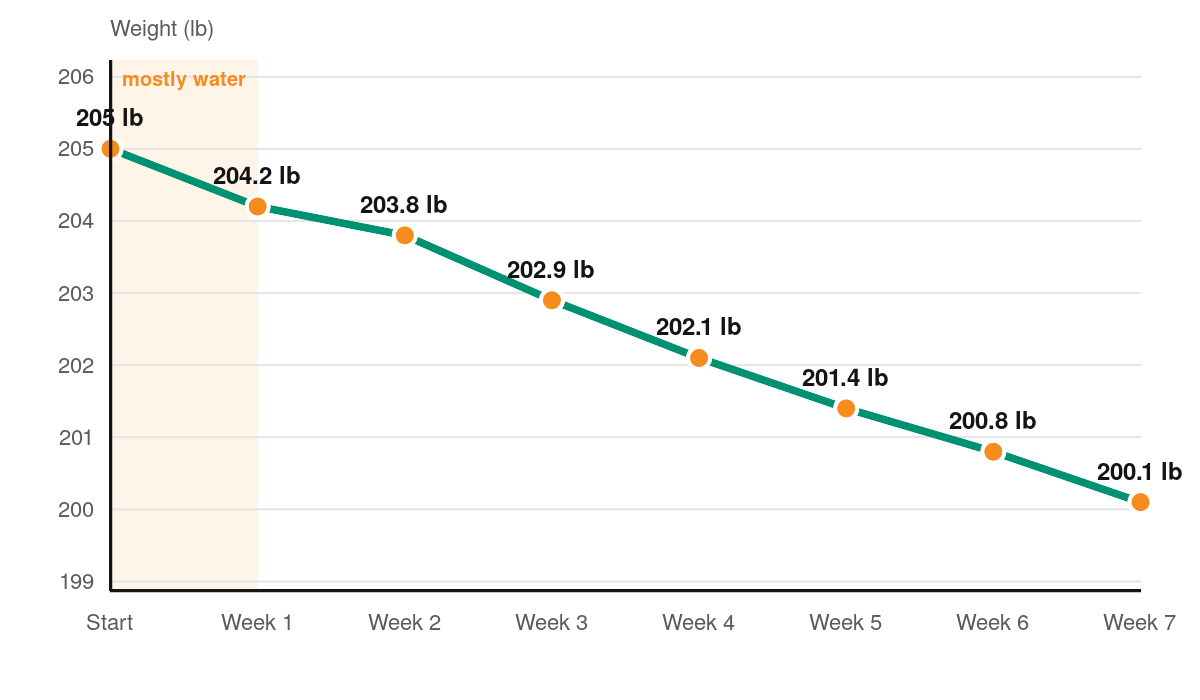
The graph below shows what the first seven weeks actually looked like. Denise started at 205 pounds, and the first week moved less than a pound. The second week moved a little more. There is no dramatic drop, no moment where everything clicked, just a slow downward line with a couple of weeks where the scale barely budged. That is what a habit looks like on a scale. It does not announce itself. It just keeps showing up.
What to try this week: Pick one existing daily anchor. It can be the coffee maker, brushing your teeth, walking the dog, getting the mail, or the five minutes you spend waiting for the shower to warm up. Bolt one small food or movement habit onto it. One. Not a meal plan, not a workout, not a new morning routine. One egg. One glass of water. Ten squats. One piece of fruit. Then track it in the app for seven days before you add anything else. Seven days is the whole experiment.
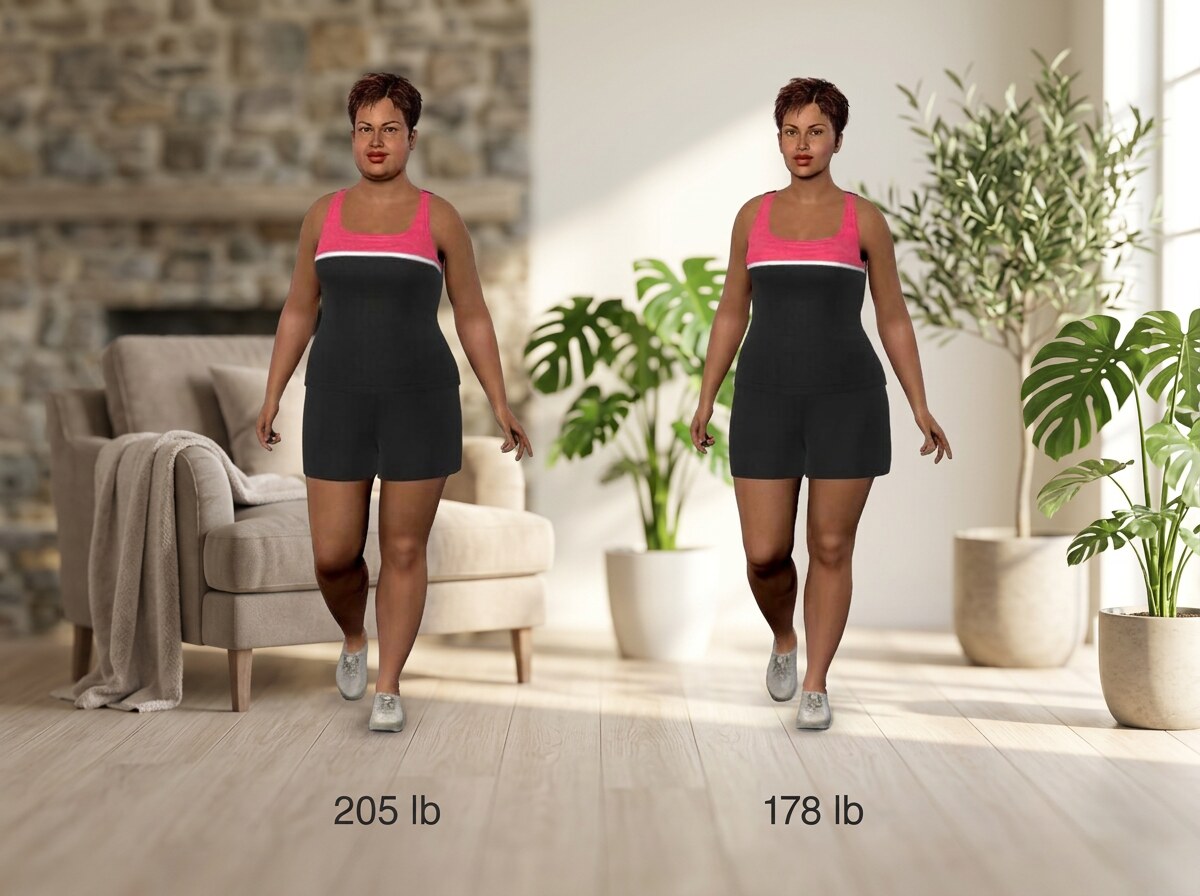
The figure above shows Denise at 205 pounds and at her goal of 178. At 5 foot 4, twenty-seven pounds is a real change, and the render makes it visible in the places she would notice first. Her face is where the change shows up earliest. At 205 there is a softness along the jaw and under the chin; at 178 the jawline is sharper and the cheekbones have more definition. Her waist is the next place to change. The figure at 178 carries less around the middle, and the arms look leaner even though she has not done any formal arm work. The scale and the mirror will disagree for months, because perceptual adaptation means she will stop seeing her own progress while everyone else sees it clearly. That is normal. You can try the simulator for women with your own numbers to see what a given loss looks like on your frame.
Habit stacking works because the anchor is already there. You do not decide to make coffee; you just do. The egg rides along. Every time Denise had to decide what to eat, the decision used up a little of her attention, and by Thursday the attention was gone. The coffee maker does not care how her shift went. It does not ask whether she feels motivated. It just brews, and the egg gets eaten because the egg is attached to the brewing.
There is a second piece that matters. A small habit that survives a bad week is worth more than a perfect plan that dies on Thursday. Most people who restart their diet every Monday are not failing because they lack discipline. They are failing because the plan was too big to survive contact with a normal week. A hard-boiled egg is small enough to survive. A seven-day streak of one small thing is enough to change what the next week feels like, and the week after that. The goal is not to feel motivated forever. The goal is to build something that works when motivation is nowhere in sight.
For the next seven days, Denise is doing the same thing she has done for six months. She sets the coffee pot the night before, and when it starts in the morning, she eats an egg. That is the whole plan. It is small enough to keep, and that is exactly why it is still working.