
The habit that survives a bad week
By Maya · October 23, 2026
Priya is 44, works in a billing office, and has restarted her diet every Monday for two years. She would download a new plan on Sunday night, throw out the crackers, and wake up determined. By Thursday she was tired of the rules. By Saturday she had ordered pizza and told herself next week would be different. It never was.
Then she tried something smaller. Instead of a new diet, she attached a five-minute walk to the cup of tea she already drank after dinner every night. She did not count calories and she did not join a gym. She just drank her tea, put on her shoes, and walked around the block for five minutes. Three months later the walk is automatic. She has not restarted anything. Her weight is down 8 pounds.
A tiny action bolted onto something you already do works.
Why willpower keeps failing
Willpower runs out. You can white-knuckle your way through breakfast and lunch, and by eight in the evening the rules feel like a stranger’s. That is why your diet holds until 3 p.m. and collapses after dinner. That is why Monday morning feels possible and Thursday night feels impossible.
A habit runs closer to autopilot. You brush your teeth at the same point in your routine without thinking about it. The action is tied to a cue. The cue triggers the behavior, and soon the behavior becomes the default. No decision, no drain.
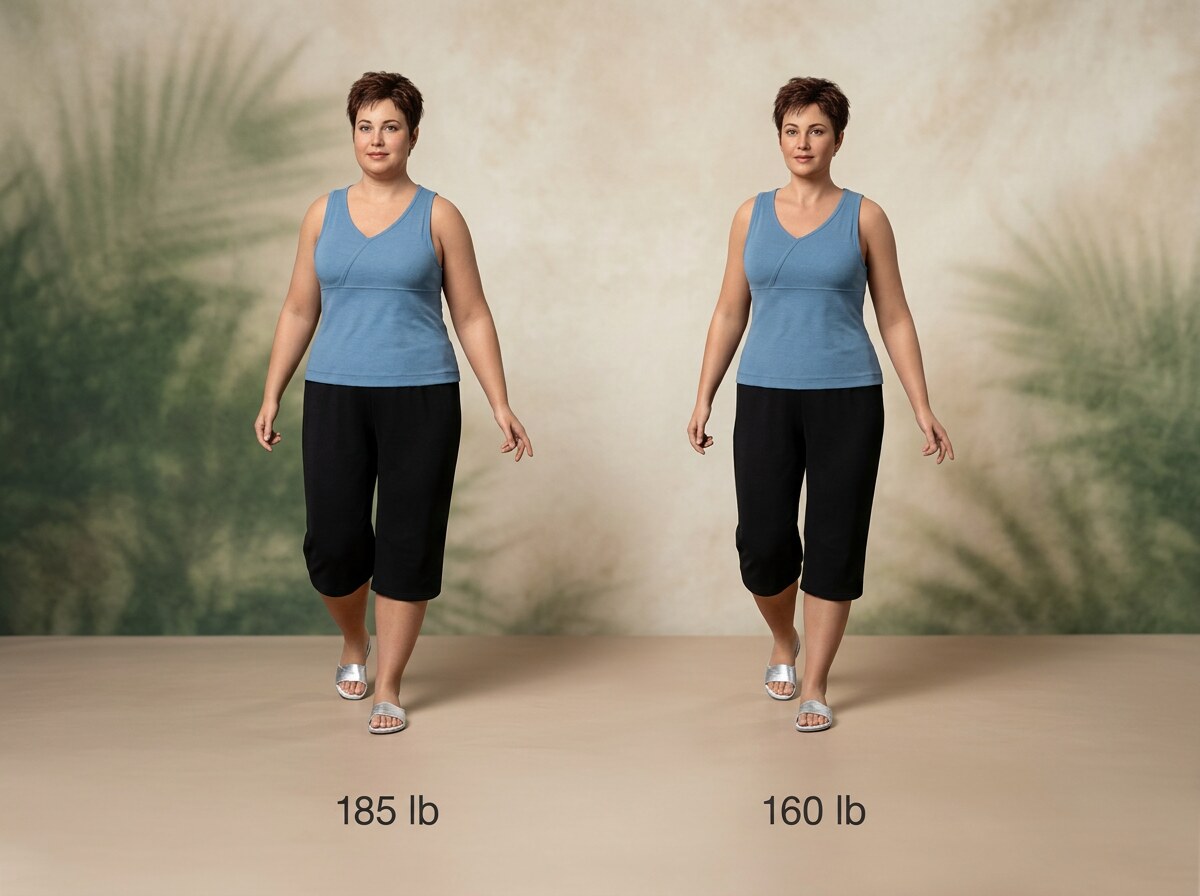
The figure above shows Priya at 185 pounds and at 160 pounds, her goal. The first place she noticed the change was her face. By 175 her jawline was sharper and the puffiness around her eyes was gone. By 170 her waistband was looser and her arms looked leaner in short sleeves. The last place the weight came off was her hips and thighs, which is common for women her height. The mirror told her nothing for the first two months. The scale told her a little. The figure tells the story her mirror refused to.
If you want to see what your own change might look like, try the simulator. Pick your height and your starting weight, then slide to your goal. The render will show you where the weight tends to leave first and last. It helps to know what you are looking for.
Pick one tiny action
Priya’s walk was five minutes. Not thirty minutes. Not a workout. Five minutes, after tea, around the block. That is the size that works. If you choose something too big, you will need willpower to keep it up, and willpower runs out.
Pick one action that takes less than ten minutes and attach it to something you already do every day. After your morning coffee, do five squats. Before you brush your teeth, drink a glass of water. When you get home from work, put on your walking shoes and step outside for one song. The action should be so small it feels almost silly. You are not trying to burn calories. You are trying to build a cue.
How the streak builds
Priya started with a paper calendar and a marker. Every night she drew an X after her walk. She missed a day the first week, and the empty square bothered her more than she expected. She missed nothing the second week. By the third week the walk felt less like a chore and more like the end of the day. She stopped checking the weather. She started walking a little farther because she wanted to.
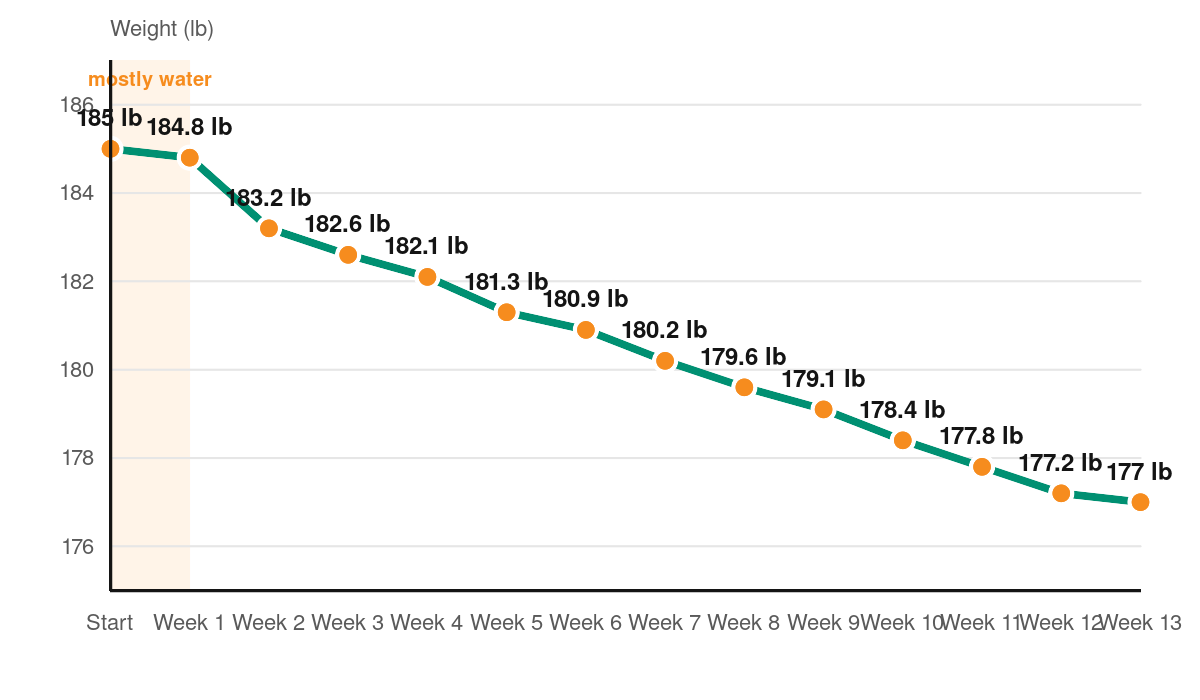
The graph below shows her weigh-ins over the first thirteen weeks. The first point is 185, her starting weight. The first week she lost almost nothing, because the walk was too short to matter and she had not changed how she ate. The second week she was down a pound and a half. The third week she lost less. The line is not straight. Some weeks it barely moves. But the direction is clear, and the streak kept her going when the scale did not.
If you want to watch your own streak build, log your tiny action in the app. The counter does not care how small the action is. It only cares that you showed up.
Why small beats perfect
A diet restart asks you to be perfect. A habit stack asks you to show up. The first one collapses the moment you have a bad day. The second one survives a bad day because the action is so small you can do it even when you are tired, sad, or busy. You can walk for five minutes in the rain. That is the bar. It is low enough that you never have to start over.
Priya’s bad weeks did not disappear. She had a week where her mother was in the hospital and she walked only twice. She had a week where she ate cake three days in a row. But she never restarted, because there was nothing to restart. The walk was still there, waiting after tea. The streak had a gap, not a death. She picked it up the next night and kept going.
A diet ends when you break the rules. A habit just waits for tomorrow.

You expect a new diet to change your body in a week. Your body changes slowly, and your mind gives up before it sees anything. A tiny habit flips that. You expect nothing from a five-minute walk, so you are not disappointed. Then the weeks pass and the scale moves a little, and the streak becomes the reward. You stop needing to see results because the habit itself feels good.
Perceptual adaptation works against you too. You see yourself every day, so you stop noticing the small changes. The mirror lies. The scale stalls. The streak tells the truth. You can see the X’s on the calendar. You can see the number in the app go up. That visible proof keeps you going when your own eyes cannot tell the difference.
Priya still walks after dinner. She is not at her goal yet, but she is closer every month, and she has not restarted anything since she started.