
The diet that lasts is the one you can still name in five years
By Maya · October 2, 2026

Marcus, 47, has lost the same twenty-five pounds three times with three different diets. He is fourteen pounds heavier than when he started the cycle. Every January he picks a new label, keto, paleo, a three-day juice reset, and every March the label peels off. The problem is not his willpower. A label tells you what to cut, but it does not tell you what you will still be eating when you are standing in the kitchen at 7 p.m. with nothing defrosted.
The pattern matters, not the name. People who age well eat mostly whole foods, plenty of plants, enough protein, and not too much of anything. Mediterranean, DASH, a sensible vegetarian pattern, the results look the same. The common thread is repeatability.
Marcus’s story is ordinary. He would clear the pantry on a Sunday, buy the cookbook, and feel clear-headed for two weeks. Then a client dinner landed on a Tuesday, his daughter’s birthday cake arrived on a Friday, and by Saturday morning the whole plan felt broken. He told himself he would restart Monday. Monday became next month. Next month became next January. Each restart left him a little heavier and a little more convinced that he needed a stricter set of rules.
The two-week test
Open your phone or a notebook and write down every lunch and dinner you already eat that contains a vegetable, a protein, and a starch. Do not invent new meals. Do not ban anything. List what is already in your rotation. Scrambled eggs with spinach and toast counts. A rotisserie chicken with roasted carrots and a potato counts. A bean burrito with peppers counts. Frozen salmon fillets with rice and broccoli counts.
Now circle every meal on that list you can imagine eating twice in the same week without dread. Not excitement, just the absence of dread. If the thought of eating tilapia again on Thursday makes you want to order pizza, uncircle it. You are building a shortlist of things your body and your life can actually repeat.
For two weeks, eat only from the circled list. Do not count calories, do not weigh portions, do not cut food groups. Just eat the meals you already know, and notice which ones leave you satisfied enough to stop thinking about food for four hours. At the end of two weeks, you will have a working set of maybe eight to twelve meals. That set is your diet. Not keto, not paleo, not the thing your coworker posted about. Your diet. The one you can still name in five years.
What repeatability looks like on a body
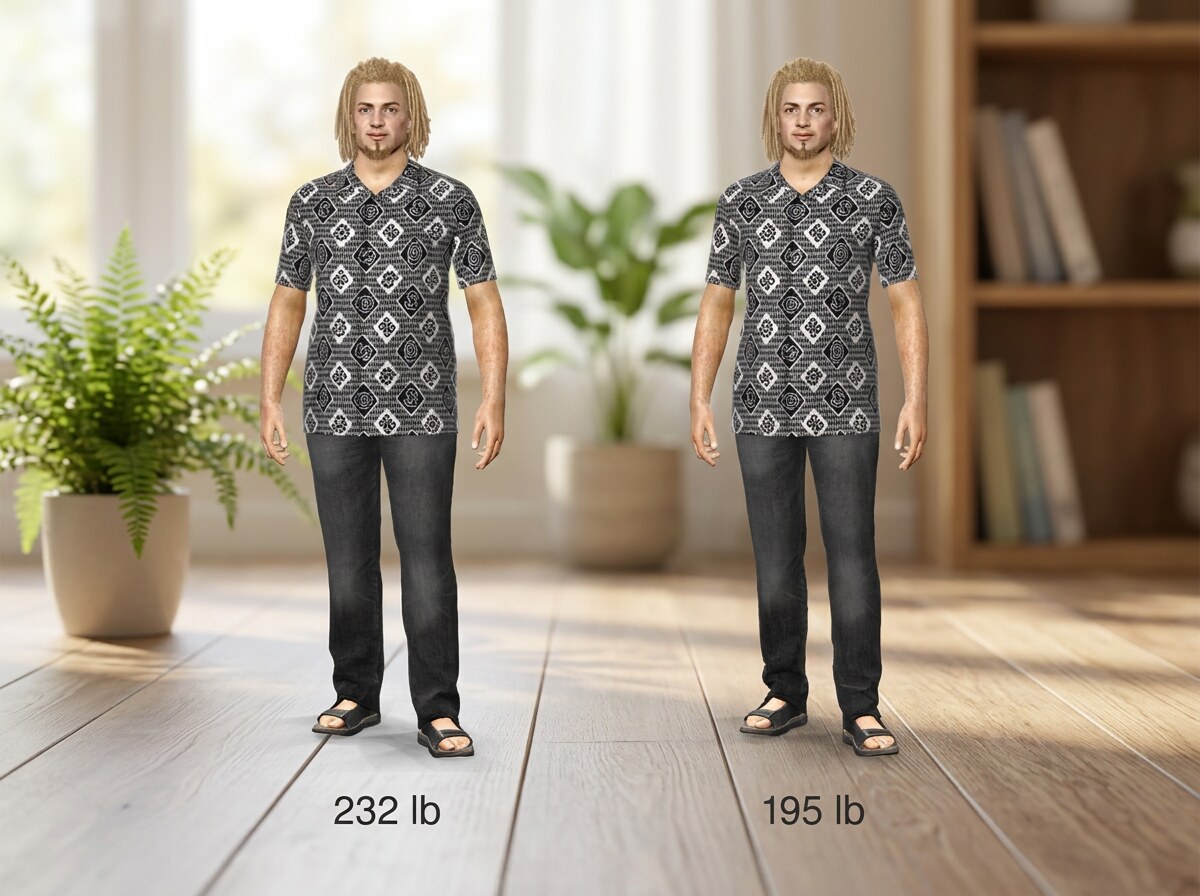
In the figure above, you can see what Marcus’s body looked like at 232 pounds and what it can look like at 195. That is a thirty-seven-pound difference. It is the kind of change that happens not in a dramatic twelve-week cut but in a year of quiet repetition. The first place Marcus will notice the loss is in his face and his waistband. His cheeks will thin out, his jaw will sharpen, and his belt will move one notch tighter before the scale has moved ten pounds. The face shows early because it carries less structural fat, and the waist follows because visceral fat responds quickly to a steady deficit.
What the mirror will not show for a while is his arms and his lower back. Subcutaneous fat in the limbs and the love handles is the last to go. Marcus might lose twenty pounds and still see the same shape in his triceps. That is the moment the old January voice pipes up and says the plan is not working. The plan is working. The figure above shows the whole arc. If you want to see your own arc, you can use the simulator at men.html to set your own starting weight and goal and look at the difference from the outside. The render will not flatter you and it will not discourage you. It will just show you what repeatability builds.
Why your brain fights repeatability
The first week of a new diet feels good because novelty feels good. Your brain releases dopamine when you try something unfamiliar, and that dopamine gets mistaken for progress. You feel lighter, sharper, more in control. Then novelty fades, and the same meals that felt virtuous on Tuesday feel like a sentence on Thursday. That is not a failure of the diet. That is your brain’s reward system doing what it evolved to do, seeking variety.
Marcus’s cycle makes sense once you see it this way. Every January he chased the dopamine of a new label, and every March the dopamine ran out and the label felt like a cage. The two-week test works because it sidesteps the novelty trap entirely. You are not asking your brain to get excited. You are asking it to get bored and stay bored long enough for the boring thing to become background noise. When eating well feels as unremarkable as brushing your teeth, you have won.
The other shift is identity. When Marcus was on keto, he was a keto guy. When he was on paleo, he was a paleo guy. Each identity came with a tribe and a set of rules. A diet identity breaks the moment you eat a sandwich. A broken identity feels like a moral failure, and moral failures need a fresh start. The fresh start is the restart. The restart is the trap. You are not a diet person. You are a person who eats, and you are building the set of meals that lets you eat well for the rest of your life. That identity does not break on a Tuesday.
The graph does not care about your January enthusiasm
Marcus ran the two-week test in late January, after he had already started and abandoned his annual keto attempt. He circled eleven meals. He ate from that list for thirteen weeks. The graph below shows what happened.
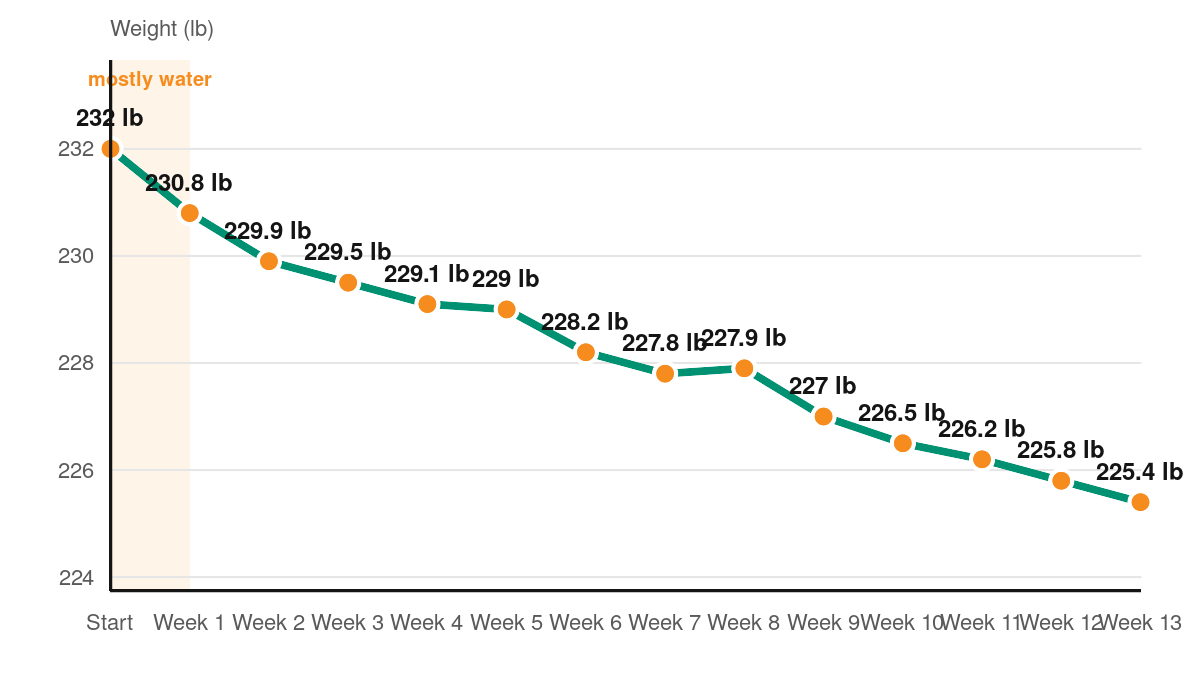
The first week dropped two pounds, most of it water, because any shift away from processed food flushes glycogen and the water it holds. Weeks two and three flattened out to almost nothing, a quarter-pound here, a half-pound that. That is the part where the old Marcus would have declared the plan broken and started researching carnivore. He stayed on the list. By week six he was down six pounds, and the rate had settled into a half-pound a week that felt effortless because he was not fighting his own preferences. By week thirteen he was down six and a half more. That is twelve and a half pounds in three months, no label, no white-knuckling, no restart. The graph is not steep, and that is why it is real.
A half-pound a week sounds small, and small is what you want. Small means you are not losing muscle. Small means you are eating enough to train, to sleep, to show up for your life. The graph spans three months, but the real timeline is five years. At half a pound a week, Marcus reaches 195 in about eighteen months and stays there, because the meals that got him there are the same meals he will eat on a random Wednesday in 2030. The label diets promise speed. Repeatability promises decades.
Protein, plants, and the long game
After age forty, adults lose muscle mass if they do nothing to keep it. The best countermeasure is eating enough protein at regular intervals and moving your body against resistance. The two-week test does not prescribe a protein target because prescription is what makes people restart. If you look at your circled list and most of the meals are starch with a vegetable on the side and protein as an afterthought, add one more circled meal that puts the protein first. A chicken thigh, a can of sardines, a scoop of whey in your oatmeal. Nothing exotic.
Plants matter for the decades ahead too. Fiber feeds the gut bacteria that regulate inflammation, and inflammation is tied to the chronic diseases that steal mobility and independence. The two-week test already requires a vegetable in every circled meal, so you are already doing the thing. You do not need to do it perfectly. You just need to do it again tomorrow.
Talk to your doctor before you change how you eat, especially if you take medication or have a condition that needs monitoring. The two-week test is a way to see what you already eat clearly, not a medical prescription.
Marcus still eats pizza. He eats it on Fridays with his kids, and he does not call it a cheat meal because that language belongs to the restart cycle. It is just pizza. The rest of the week he eats from his list, and the list is boring, and the boring is the point. He is not starting over next January. He is just continuing.