
How to stop restarting your diet every Monday
By Maya · October 16, 2026
Priya is 38 and works three twelve-hour shifts a week on a cardiac floor. She would start a new diet on Monday, pack yogurt and chopped vegetables, and by Thursday morning she was pulling into the drive-through on the way home because the Tupperware sat forgotten in the fridge and she was too tired to care. She told herself she lacked discipline. She needed a place to put the new habit where her brain did not have to decide.
A diet that lives entirely on willpower asks you to choose it again every few hours. That works until you are underslept, stressed, or simply worn thin after a long shift. Habit stacking sidesteps the choice by wiring a new behaviour to an existing anchor, something you already do on autopilot, like brushing your teeth, starting the coffee maker, or unlacing your shoes when you walk in the door. The anchor does the reminding, and you do the one extra thing.
The anchor you already own
Priya’s anchor was the ten minutes right after she got home from a day shift. She always dropped her bag on the bench by the door, kicked off her clogs, and stood in the kitchen drinking a glass of water while she stared at the mail. That sequence had been the same for six years. It was not a decision; it was the off-ramp her body took without asking.
She picked one addition and made it small enough that she could do it even when she was dead on her feet. Before she opened the stack of bills, she pulled a container of rotisserie chicken and a bag of pre-washed greens from the fridge and put them on the counter. That was the whole habit. She did not have to cook or measure anything. She just put protein and a vegetable on a plate before she did anything else.
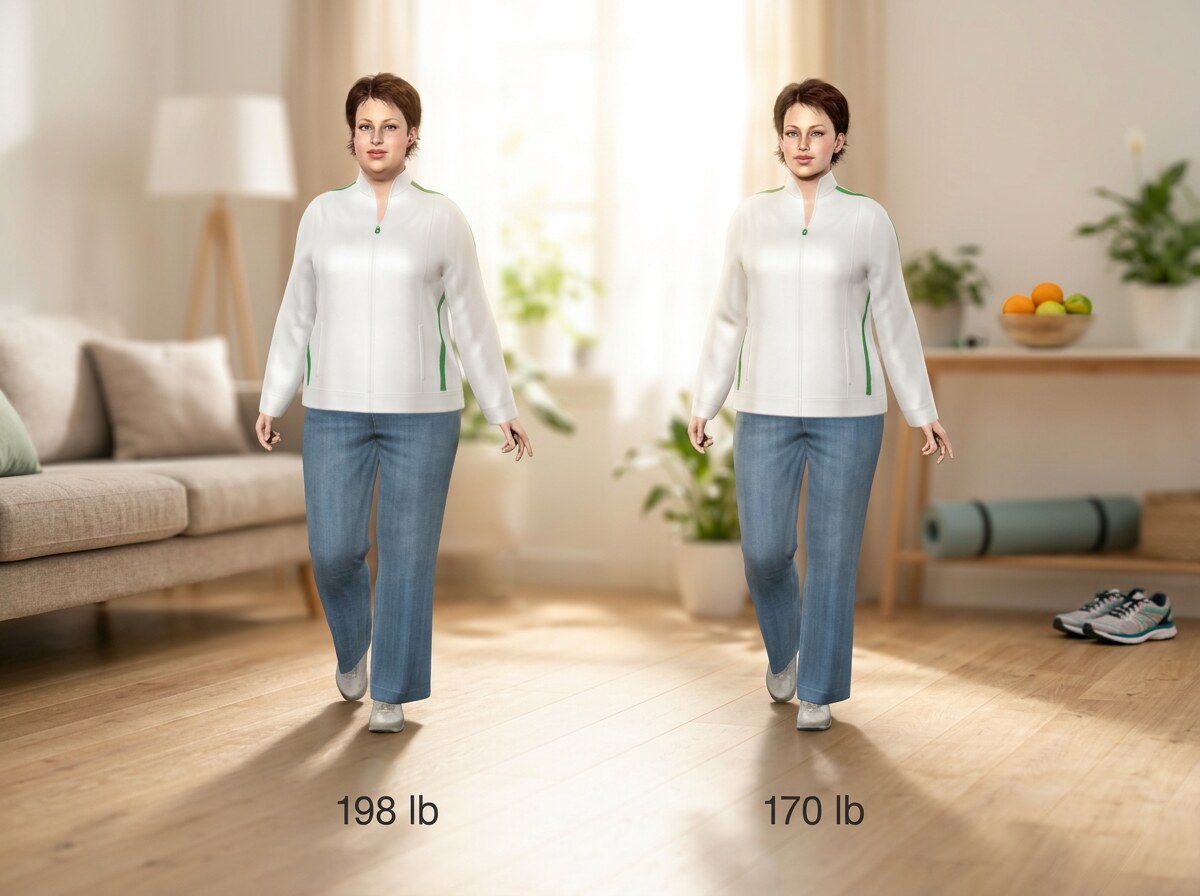
The figure above shows Priya at 198 pounds and again at 170, the weight she is working toward. Twenty-eight pounds on a five-foot-four frame is the difference between a face that looks puffy after a night shift and a jawline that reads as rested even when she is not. Her waist is where the change lands first. At 198 her scrub tops pulled across the middle, and by 185 the same tops hung straight. The last place it leaves is her upper arms and thighs. The mirror will tell her nothing has happened for weeks at a time, which is why the render matters. When you cannot see the change day to day, seeing the two versions side by side in the simulator reminds you that the distance is real even when the Tuesday-morning reflection looks the same as last Tuesday.
One thing, not a whole menu
Most Monday resets fail because they try to change breakfast, lunch, dinner, and snacks all at once. That is four or five new decisions a day, and decisions take effort. By Wednesday evening you have made a lot of them, and the old defaults walk right back in.
Priya changed exactly one meal: the one she ate right after her shift. On her days off she ate whatever she normally ate, and she did not pretend otherwise. The post-shift meal was the only one that got the protein-and-vegetable rule, and because it was bolted to an anchor she never skipped, it stuck. After three weeks her scrub pants fit differently and she noticed she was not famished when she woke up the next afternoon, which made the rest of her eating a little easier without any extra effort.
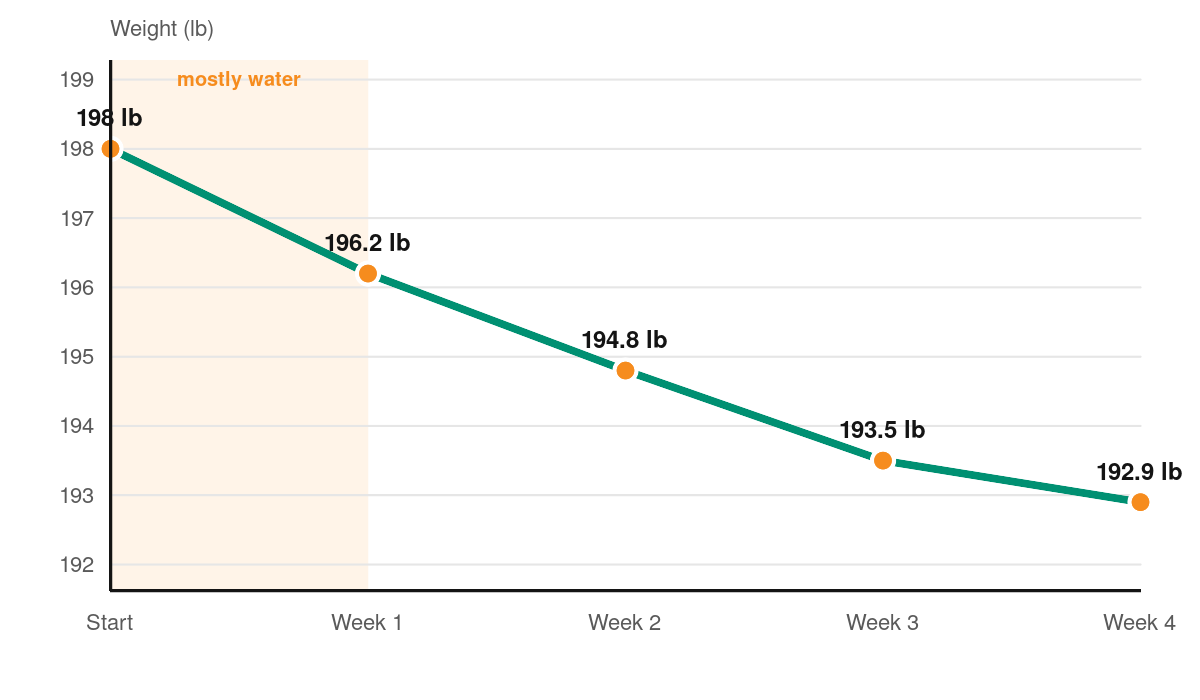
The graph below tracks Priya’s first four weeks. She started at 198 and the scale dropped to 196.2 in week one, then 194.8, then 193.5, settling at 192.9 after a month. The first week’s drop was mostly water, and the next three weeks settled into a steady half-pound to one-pound rhythm. That is what one meal changed slowly can look like, and it is enough to see the line point downward without white-knuckling through every meal.
Why a routine sticks when motivation fades

By the end of a long shift, you have been making decisions all day, and the drive-through looks better than the cutting board. Priya’s post-shift sequence ran on autopilot, the way you tie your shoelaces the same way every morning without thinking about it. Adding one step to the end of it felt effortful for about five days, and then it became part of the furniture. She stopped noticing she was doing it, which is the whole point. The behaviour faded into the background, and a habit you do not notice does not ask for motivation.
After two weeks, Priya had not missed a single post-shift meal, and she found that skipping it felt off. She simply wanted to keep the run going. You do not need to track every calorie. Track the one thing you stacked onto your anchor, and let the streak carry you through the weeks when the scale barely moves. Opening the app after a shift and tapping that you hit your one habit takes five seconds, and the counter ticking upward is a small hit of satisfaction on a day when nothing else went right.
This week
Pick one anchor and one small thing. That is enough.