
Four boring things Marcus kept when he stopped chasing longevity
By Maya · October 30, 2026

Marcus is 54 and runs a small accounting practice in Boise. For three years his browser history was a graveyard of longevity headlines. One month he bought taurine in bulk. The next he was timing his meals to a six-hour window. After that came the dark chocolate headline, then the claim that meat eaters outlive vegetarians, which flatly contradicted the one he had read in April. His supplement shelf filled up, his waistline did not budge, and his bloodwork at the annual physical was a quiet disappointment.
Six months ago he stopped. He wrote four things on an index card: protein at breakfast, two strength sessions, a walk after dinner, and a consistent bedtime. He decided they were the whole program until the card wore out. He is down 13.8 pounds. His fasting glucose moved more in those twelve weeks than in the three years of rotating through whatever the news feed served him.
The figure above shows Marcus at 215 and again at 190. Twenty-five pounds on a six-foot frame rearranges a man in ways the mirror takes months to admit. The first place Marcus noticed it was his face. The puffiness around the jaw softened, and the line between his cheek and his neck got sharper. That showed up around the fifteen-pound mark, which is typical. The face often gives the earliest visible signal because it carries less padding to begin with. The waist came next. His belt moved two notches, and the love handles that had sat stubbornly above his hips began to flatten. The last place the weight let go was his lower back, which is also typical. That patch hung on until the final five pounds, and for weeks the scale said one thing while the mirror said another.
That disagreement between the scale and the mirror is normal. You can drop enough weight to need new jeans and still see the same person in the reflection. The brain adapts to what it sees every day, so the changes register for a friend who visits once a month long before they register for you. If you want to know what you actually look like at 190, you can see it in the simulator at /men.html before your own mirror catches up.
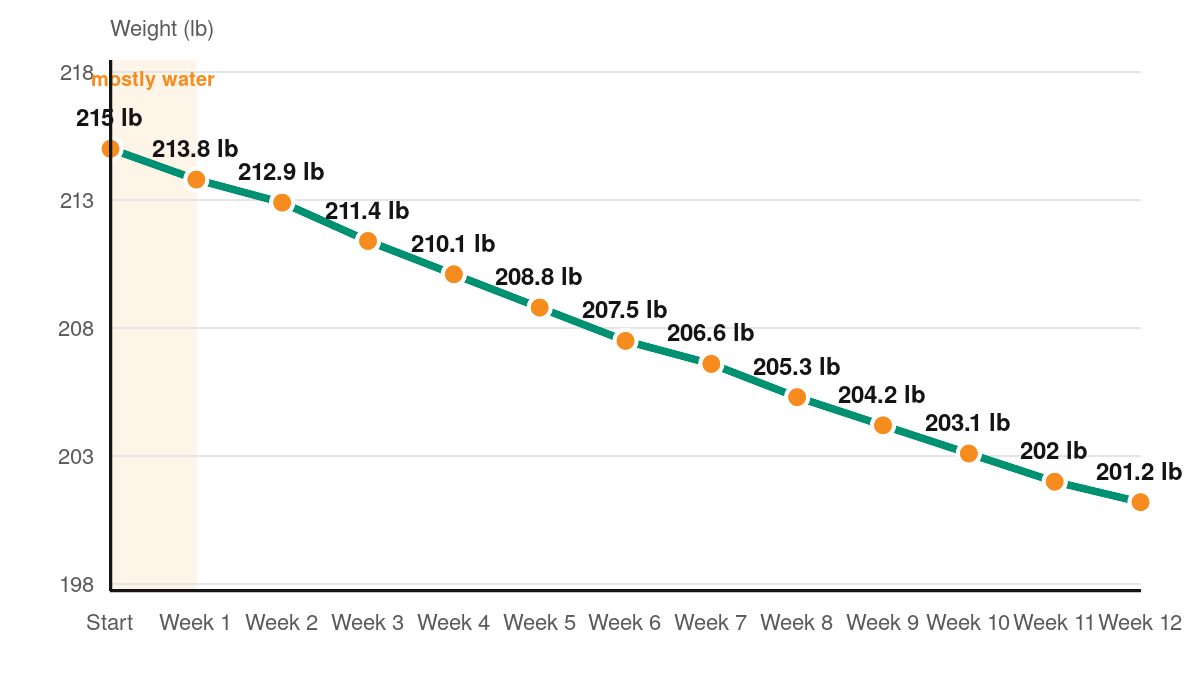
The graph below tells the week-by-week truth of how those first pounds came off. Marcus did not drop two pounds every week. The first ten days were faster, mostly water, as his body adjusted to fewer evening snacks and a steadier meal rhythm. Then the rate settled into something slower: a pound, sometimes a pound and a half, occasionally a week where the line barely moved. Week seven was the most frustrating. He had done everything right and the scale gave him less than a pound. That is the week most people quit, because the effort feels wasted. Marcus kept walking.

The psychology that keeps a 54-year-old accountant on a plan when the scale stalls is not motivation. Motivation is a feeling, and feelings go to bed early. What worked for Marcus was a filter he could apply in ten seconds to any new longevity claim that crossed his screen. The filter has three questions. First: can I do this for a decade without spending more than twenty dollars a month? Second: would this still work if nobody ever wrote an article about it? Third: does it ask me to add something to my day, or just to buy something?
Most headlines fail the first question. A supplement that costs sixty dollars a bottle and has been studied for eighteen months is a gamble, not a plan. The second question is the brutal one. Intermittent fasting, cold plunges, and exotic mushrooms are interesting precisely because someone wrote about them. Protein at breakfast is not interesting, which is why it survives. The third question separates actions from purchases. Buying a pill is not a behavior that reshapes a Tuesday. A walk after dinner is.
Marcus keeps the card on his nightstand now. It is creased and coffee-stained and he has not changed a word. The longevity headlines keep arriving, and some of them might help someone, somewhere. A right answer you cannot stick to is worse than a boring answer you can. The four things on the card cost almost nothing, require no subscription, and will still make sense in 2035. If the advice sounds like something a healthy 75-year-old will be glad he started at 54, do it this evening and let your own results be the confirmation you need.