
Do I really need to walk faster, or is walking at all enough?
By Maya · October 29, 2026

Renata is 61 and has walked the same two-mile loop near her condo for years. She knows which neighbor’s sprinkler overshoots the sidewalk and which corner the crows prefer. She walks at a chatty pace, the kind where you could tell a long story without catching your breath. For a long time she figured that was the deal: she was out there, she was moving, and that had to count for something.
It does count. A slow stroll is a real walk. It gets you outside and settles your head. The headlines that make a slow walk sound worthless are aimed at people who are not walking at all. Renata was never that person.
What she wanted was a way to get a little more out of the loop without turning it into a project. She did not want new shoes or a heart rate strap. She wanted one small thing she could do inside the walk she already had.
Brisk blocks
Renata started adding three ten-minute brisk blocks a week. On Monday, Wednesday, and Friday, she picked two stretches of her usual loop and pushed the pace for ten minutes each. Faster than comfortable, still able to talk in short sentences. Just a gear she had not been using.
The rest of the walk stayed the same. She still stopped to look at the garden with the dahlias and waved at the man with the small brown dog. The only difference was that for twenty minutes total, she was working a little harder.
What surprised her was how quickly the brisk blocks became the part of the walk she looked forward to. They gave the loop a shape. The first ten minutes were a warm-up. The middle was the work. The last stretch was a cool-down with the crows.
A pace you can watch
The problem with walking at a chatty pace is that it never changes. You can do it for five years and have no idea whether you are fitter than you were the year before. Renata wanted a number she could check without buying anything.
She started timing the same half-mile stretch every Friday. The first week she walked it in just over eleven minutes. She wrote it down and moved on.
Over the next three months the number came down in small pieces. Ten minutes and fifty seconds. Ten and a half. Ten minutes. The change was small enough that she would not have noticed it without the weekly check. But the graph below tells the story of the whole thirteen weeks, and the line moves in the right direction almost every single time.
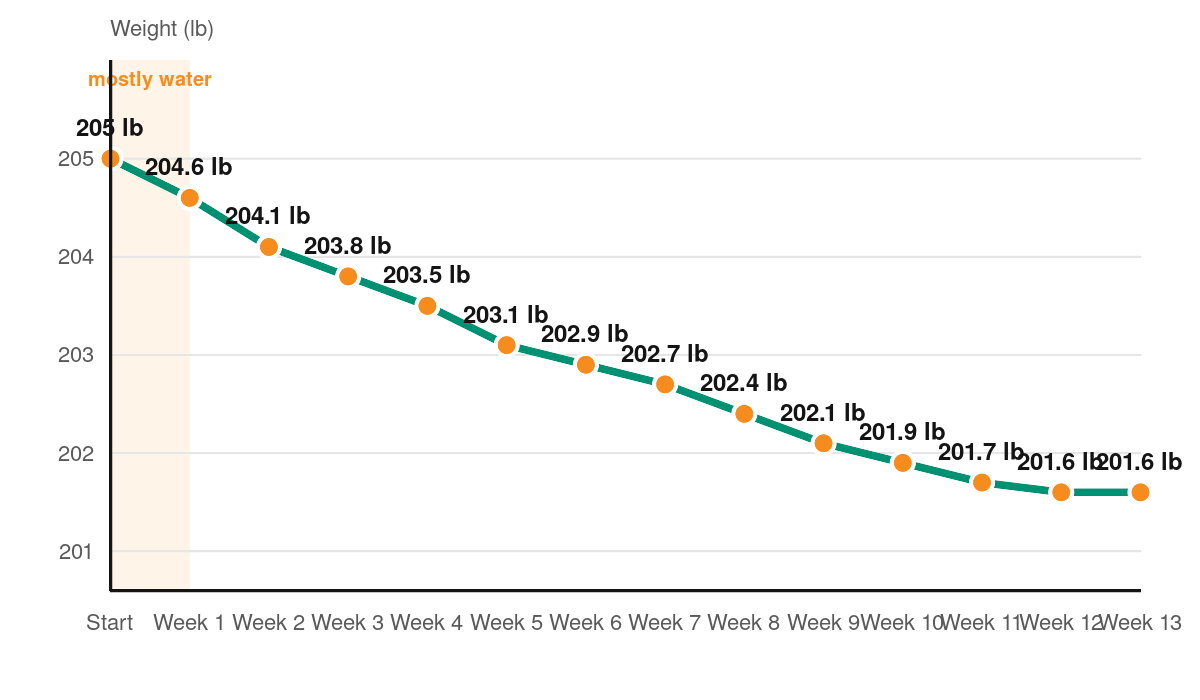
Her weight moved too, but not in a way that would make anyone gasp. The scale dropped from 205 pounds to 201.6 over those thirteen weeks. About three and a half pounds. She was not dieting hard and she was not walking to lose weight. She was walking to feel like the loop belonged to her again, and the scale was just along for the ride.
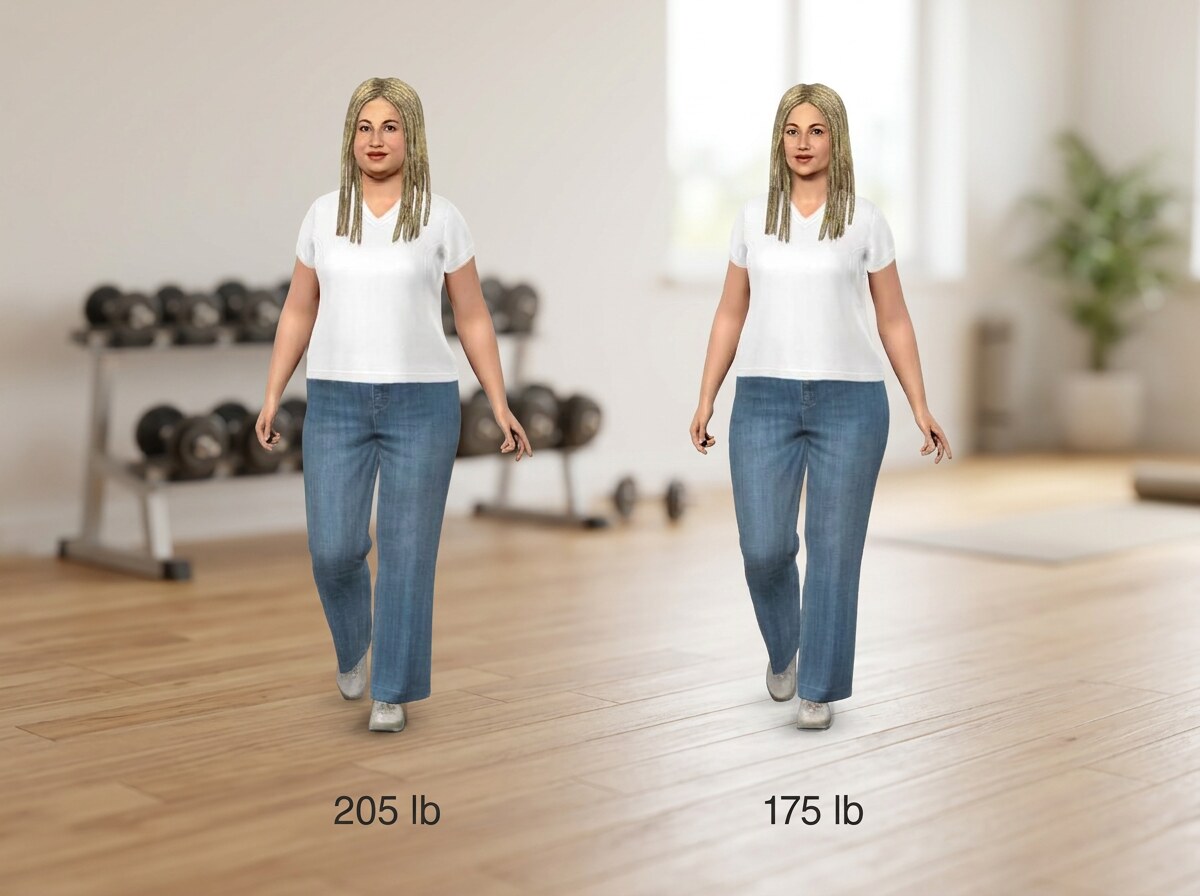
The figure above shows Renata at 205 pounds and at 175 pounds, which is where she is heading. Thirty pounds is a real change on a 5-foot-4 frame. The first place it shows is her face and her waist. At 205 her jawline is softer and her waistband sits snug. At 175 the puffiness around her cheeks is gone and her middle looks longer, less compressed. You can see the change the figure shows, but you will stop noticing your own changes in the mirror. The scale and the mirror disagree. That is why a tool like our simulator is useful: it shows the two versions side by side, the way a photograph from six months ago looks. You can make a render of your own numbers on our women’s page and see what your version of this change looks like.
A faster gear
Renata used to think of herself as a slow walker. It was part of how she described herself, the way some people say they are not morning people. The brisk blocks changed that. She still walks slowly for most of the loop, but she no longer thinks of slow as what she is. She thinks of it as the gear she uses between the fast parts.
The headlines ask about walking faster. Renata found she liked having a faster gear more than she liked walking fast overall.
The first brisk block feels longer than ten minutes. You will check your watch at six minutes and wonder if it is broken. The second block feels a little shorter. By the third week, you will know where the block starts and ends without looking, and your body will settle into the effort the way it settles into a familiar chair.
The trap is expecting the pace to improve every single week. It will not. Some Fridays Renata was slower than the Friday before. She slept badly, or it was humid. The weekly number is a trend. One slow Friday means nothing. Five Fridays that are all faster than the month before mean everything.
What kept Renata going was that the brisk blocks were attached to a walk she already took. She did not have to decide to exercise. She just had to decide to push for ten minutes twice during a walk she was already on. The decision was small enough to survive a tired day.
One thing to do this week
Pick two stretches of a walk you already take and push the pace for ten minutes each. Faster than comfortable, still able to talk in short sentences. Time the same half-mile stretch once a week and log the pace so you see the trend, not the day.