
You can't see your own progress and that's normal
By Maya · September 23, 2026
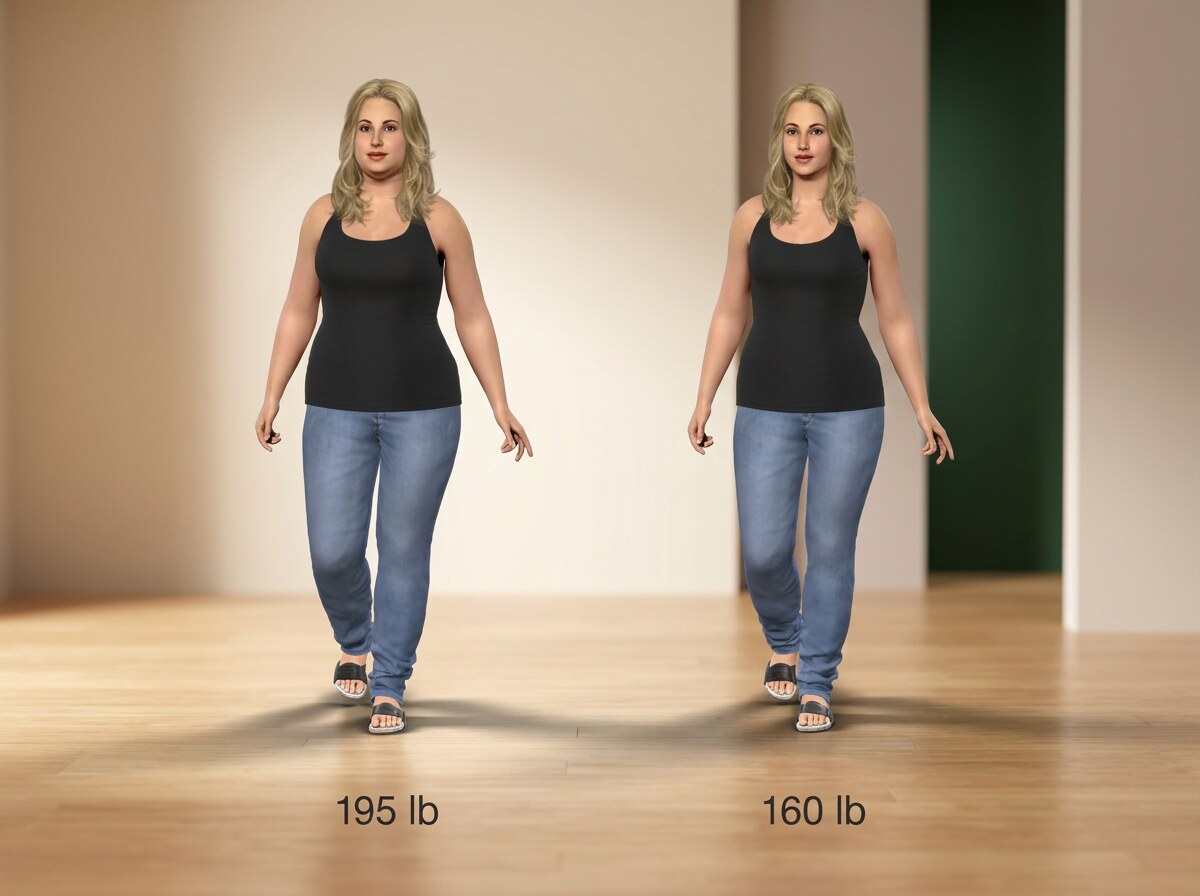
Say you start at 195 pounds and your goal is 160. The first ten pounds feel like a revelation. Your face sharpens, your jeans sit differently, and every morning the mirror hands you a little win. Then somewhere around 180, the wins dry up. The scale keeps moving but the person looking back at you seems frozen in place.
You are not stuck and your body has not stopped changing. Your eyes have simply gotten used to the slow drip of change. When you see something every day, your eyes stop registering small differences. A daily shift of a fraction of a pound is invisible. After a few months, the image you carry around in your head is an old one, and the mirror does nothing to correct it because the mirror only ever shows you today. Your brain blends the daily view into an average and that average lags weeks behind reality.
The friend who sees you every two weeks has a better refresh rate. They get the sudden contrast your eyes miss. When someone says “you look different” and you feel the urge to dismiss it, write the comment down. Treat it as a data point from an outside observer who is seeing the change all at once, not in daily slivers.
The figure above shows a woman at 195 pounds and again at 160. On a 5’5” frame, thirty-five pounds reshapes the waist, pulls the upper arms closer to the body, and brings definition to the jawline. The change is real. Your perception is the part that lagged.
This is why an external reference matters. Your eyes cannot give you an honest progress report because they are part of the system that is changing. You need something outside your own head that holds the before image still. A photo taken in the same doorway, in the same clothes, every four weeks, does not adapt. It just sits there, and when you line it up next to a new one, the difference is plain. You can also use our body simulator to see what the change looks like on a realistic figure at your height. Pick your start and goal weight on the women’s simulator and you get a preview that is often more accurate than the blurry self-assessment you carry around in your mind.
When the mirror stops cooperating, the story you tell yourself shifts. It goes from “I am making progress” to “maybe this stopped working.” That story has consequences. It makes a bag of chips feel less like a setback and more like a shrug. The scale might still be dropping a pound a week, but if your eyes deny it, your motivation starts to hollow out from the bottom.
The fix is not to stare harder in the mirror. That just gives your eyes more daily data to blend into the usual view. The fix is to break the daily exposure loop deliberately. Take progress photos on a fixed schedule instead of glancing every morning. Cover the bathroom mirror for a weekend. Use a tool that shows you the change your eyes refuse to compute. Give yourself a before-and-after that your own perception cannot smooth over.
Weight change is slow, and you are too close to see the shape emerging. That does not mean the shape is not there. It means you need a different angle or a different tool. The scale gives you numbers. Photos give you proof. A simulator gives you a preview of where you are headed. Your job is to stop relying on the one instrument that actively fails at showing gradual change.
This matters for the long run too. If you cannot see your own progress, you are more likely to abandon habits that are actually working. That makes it harder to stick with the routines that protect your strength, mobility, and metabolic health over the decades. Talk to your doctor about what a healthy weight trajectory looks like for you, and then give the job of tracking it to something that does not have a stake in keeping your self-image frozen in place.