
What 20 pounds actually looks like on your body
By Maya · September 16, 2026
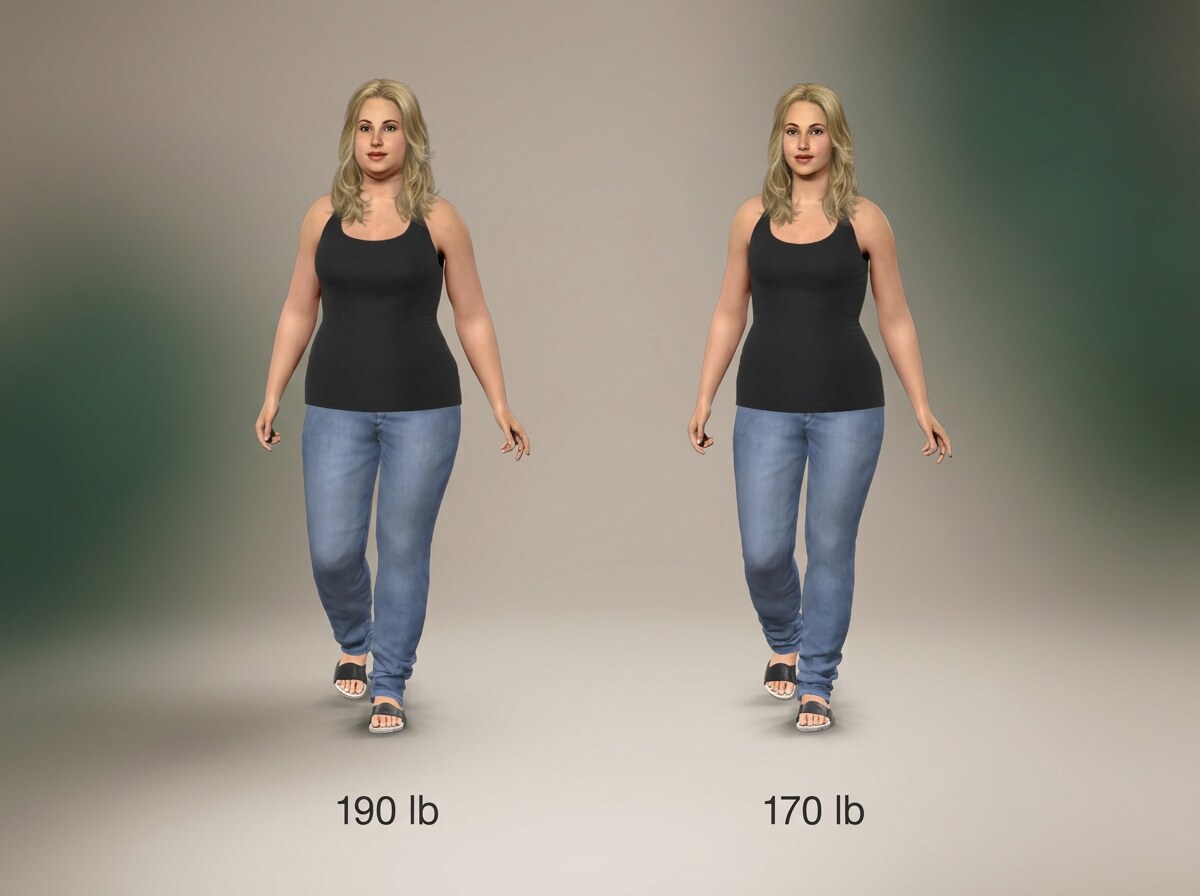
Twenty pounds is the first big milestone a lot of us circle on the calendar. It is enough weight that other people start to notice. It is enough that your clothes fit differently, sometimes in ways that surprise you. And it is enough that the person in the mirror finally starts to look a little more like the person you feel you are.
But twenty pounds does not look the way most of us expect. It does not come off in neat, even layers all over the body. It comes off in specific places first, and the order is mostly out of your control. Knowing what to actually look for makes the weeks between weigh-ins a lot easier.
The face
The first place a change shows up is almost always the face. Look at the figure above. The woman on the left carries a little more softness along the jawline and under the chin. On the right, twenty pounds lighter, the jaw has a cleaner line and the cheekbones sit a touch higher. This is not a dramatic movie-makeover transformation. It is the kind of change that makes you catch yourself in a car window and think, wait, something is different.
The reason the face leads the charge is simple. There is not a lot of structural fat on the face, so even a modest overall loss shows up quickly around the eyes and jaw. For many of us, this is the change that keeps us going in the first month. The scale might be moving slowly, but a slightly sharper reflection is a concrete win you can see every morning. If you want to see this on your own starting point, you can try the simulator at the women’s visualization page and slide the weight down a few pounds. The face is where the first five pounds live.
The waist and the back
After the face, the next place twenty pounds shows is around the middle. This is where the visual math gets a little unfair, because the waist is also the place we are most impatient about. We want the jeans to button looser on week two. The body has other plans.
What actually happens is that the back and the sides slim down before the front of the waist catches up. You will feel a bra strap sit smoother or notice less fullness around the ribcage before you see a big change head-on in the mirror. This is why the my jeans fit but the scale hasn’t moved moment is so common. The tape measure is telling a story the scale has not caught up to yet. Trust the fit of your clothes over the number on any single morning.
The arms and the legs
The arms and legs are often the last to give up their padding, and the change there is subtle. Twenty pounds will take some circumference off the upper arms and slim the thighs enough that a pair of pants stops pulling across the lap. But nobody is going to see twenty pounds and suddenly have thin limbs. That is not how bodies work.
The mirror lies here because you see your arms every day. Perceptual adaptation means your brain adjusts to the small, incremental changes and tells you nothing is happening. This is why progress photos exist. A picture taken eight weeks apart will show a difference your daily glance in the bathroom mirror completely misses. When you feel stuck, put the two photos side by side. The arms and legs are changing, just slower than the face and the torso.
Why the mirror lies week to week
Say you start at 190 pounds and lose twenty pounds over four or five months. The graph below shows what a realistic timeline looks like. It is not a straight line down. There are weeks where the line stays still. There is even a small bump or two where water weight or a salty weekend masks the fat you actually lost. The mirror on those still weeks will look exactly the same as the week before, because water retention smooths out the definition that fat loss is trying to reveal.
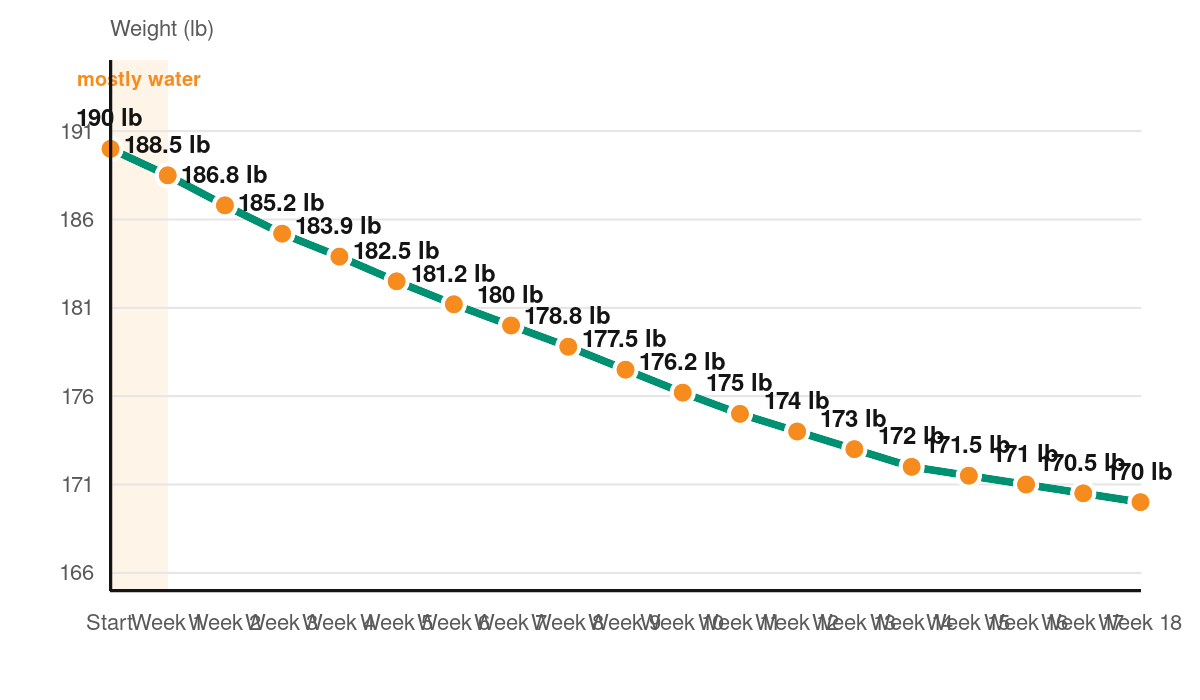
This is the mental trap. You do the work for seven days, step on the scale, see no movement, and then look in the mirror expecting a reward that is not visible yet. That disappointment can spiral into a skipped workout or a what does it matter dinner. The fix is to widen the lens. One week is noise. Four weeks is a signal. The mirror is a lagging indicator, not a live feed. Give it time to catch up.
The paper towel effect
There is a useful idea called the paper towel effect. When a roll of paper towels is new, taking off one sheet does not change how big the roll looks. When the roll is nearly empty, that same single sheet wraps around several times and the roll shrinks noticeably. Body fat works the same way. The first ten pounds might not look like much on a larger frame. The second ten pounds, from 180 down to 170, will look like a bigger change because there is less surface area for the remaining fat to cover.
This is why twenty pounds can feel anticlimactic at first and then suddenly very real. You are not doing anything wrong. You are just working through the outer layers of the roll. The visual payoff accelerates as you go.
Sticking with it long enough to see it
The hardest stretch of any weight loss effort is the middle. The initial enthusiasm has faded, the scale has settled into a slower rhythm, and the mirror is still showing you roughly the same person. This is where most people quit, not because the plan is not working, but because the visible proof is not arriving on the schedule they expected.
The way through is to anchor your motivation to something more reliable than the mirror. A streak works well. Marking an X on the calendar for every day you hit your calorie target or got your walk in gives you a visual chain you do not want to break. The chain becomes the reward while the body catches up. By the time the chain is long enough, the mirror will have something to show you.
Another anchor is a single pair of goal pants. Not a size you wore in high school, but one size down from where you are now. Try them on every two weeks. In the early weeks they will be tight. Then one day they will zip without a fight. That moment is real, and it will carry you through another month of the middle slog.
Twenty pounds is a quiet transformation. It will not announce itself with a drumroll. It will show up in a slightly sharper reflection, a pair of jeans that fit without a struggle, and a picture you did not hate being in. That is what you are working toward, and it is enough.