The scale stalled but my jeans fit differently
By Maya · September 13, 2026
Say you start at 190 pounds and you are six weeks in. For the last three of those weeks the scale has not moved. Not down, not up. It sits there like it is daring you to quit. Meanwhile your belt is one notch tighter, you are sleeping through the night for the first time in months, and your jeans feel different across the front even though they weigh the same as always.
That is progress showing up somewhere other than the scale.
What the scale actually measures
The scale measures one thing: how much you weigh right now. It does not know what that weight is made of. Fat, muscle, water, the food still moving through you, the glycogen your muscles are holding onto after a hard week of training. All of it lands on the same number.
When you eat in a deficit, your body does two things at once. It burns fat, and it responds to the stress of the deficit by holding on to water, especially in the first few weeks. Fat goes down while water goes up, and the scale reports the net result, which can be zero.
A plateau in the middle of a good stretch is common for this reason. The fat is leaving. The water is covering for it. Your waist is the place where the truth shows up first.
At 5 feet 5 inches, going from 190 to about 185 pounds is not a dramatic visual transformation. Nobody at work is going to say anything. What changes is the shape of the midsection, and it changes in a specific order. The upper abdomen softens first. The lower belly, the part that hangs over the waistband, is usually the last to go, which is why your jeans can feel different at the waist before they look different in the mirror. Your face thins a little around the jaw and under the chin, and your arms lose some of the roundness at the upper arm, but slowly, and only if you are looking month to month instead of day to day.
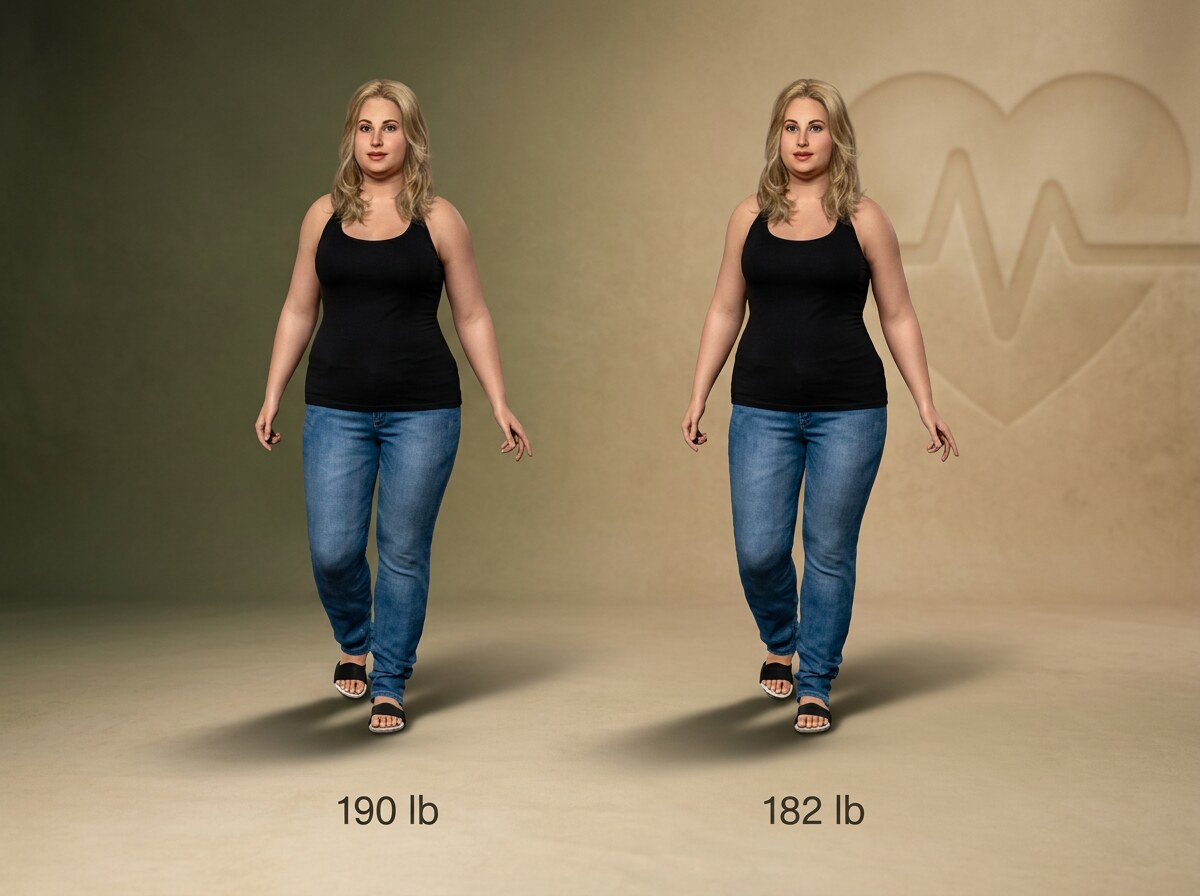
The figure above shows the same person at 190 and at 182, her goal. The difference is real, and it is not dramatic in any single week. It accumulates. If you want to see what that looks like on your own frame, try the simulator on our women’s page and put in your height and both weights to look at the two bodies side by side. It will not flatter you. It will not scare you. It will show you the shape of the change you are actually working toward.
Where you carry it matters
Fat is not stored evenly. Some people carry more of it under the skin around the hips and thighs. Some carry more of it deep in the abdomen, wrapped around the organs. The second kind also responds to a calorie deficit and to movement.
You cannot see the difference between the two from the outside, and neither can the scale. But a tape measure at the navel can. If your weight is unchanged and your waist is down half an inch, the fat that matters most is leaving.
Measure your waist once a month. Same spot, at the navel, relaxed, after exhaling. Write it down next to your weight. Over a few months, the two numbers together tell a story the weight alone cannot.
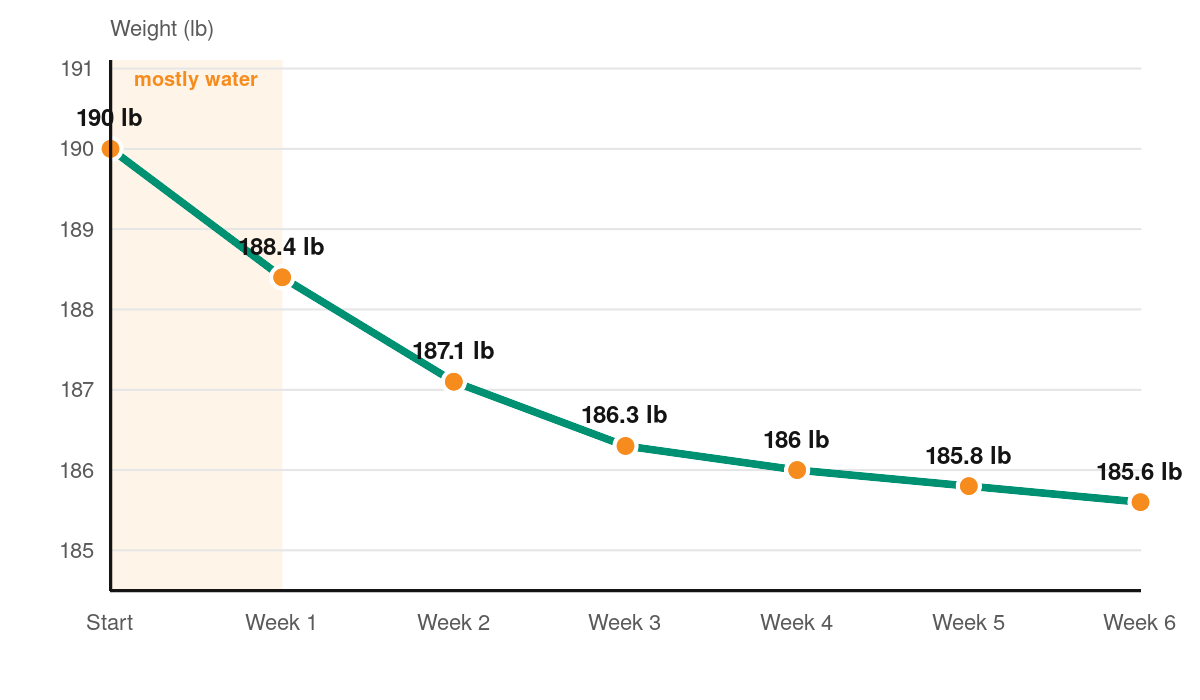
Six weeks of weighing in, with a stretch of no change in the middle, looks like this. You start at 190, drop to 188.4 in week one, then 187.1, then 186.3. Then three weeks where nothing much happens: 186, 185.8, 185.6. That is the plateau. Six weeks of consistent work, four and a half pounds down, and the middle of it feels like failure.
The hardest part of a plateau is what you tell yourself about it. Three weeks of the same number and the story writes itself: this is not working, I am doing something wrong, I might as well stop. None of that is based on evidence. It is based on a number that was never designed to measure what you actually care about.
Your brain adapts to what it sees every day. If you look in the mirror every morning, you will stop noticing small changes by the second week. If you step on the scale every morning, you will treat normal daily fluctuation as meaningful signal. The fix is to measure more slowly and more widely. Once a month for the waist, once a week for the weight, and a note about how you slept and how your clothes fit. That is a dataset that can actually tell you something.
Streaks help here, but only if they are streaks of behavior, not streaks of results. You can control whether you walked today. You cannot control whether the scale moved. Build the streak around the thing you control and the plateau stops feeling like a verdict.
A person who eats in a deficit and moves most days and measures their waist once a month sees an unchanging week as a data point. A person who is trying to lose weight sees it as a threat. Same behavior, different story, and very different odds of still doing it in six months.
The decades ahead
Where you carry fat is not just a cosmetic question. The fat around your organs is the fat that tracks with metabolic health over the long haul, and metabolic health is linked to staying independent at 70 and 80. Muscle and strength matter for the same reason. A slow deficit that preserves muscle, plus a waist measurement that trends down over months, is doing more for your future than any three-week sprint ever will.
The scale cannot show you that part. A number that does not move in week four of a six-month plan is a reason to measure something else for a while. Waist at the navel, once a month, logged next to your weight. If you want both in one place, the app at /app.html will hold them side by side. Talk to your doctor before you make any big changes to how you eat, especially if you are on medication or managing a condition.
Your jeans can tell you something the scale cannot, and they usually tell you first.