
What keto actually does in your first month
By Maya · September 7, 2026
The first week of keto is easily the most flattering week of almost any diet, but very little of what you lose is actual fat. When you cut carbohydrates down to just a couple of dozen grams a day, your body quickly burns through the glycogen stored in your liver and muscles. Glycogen stores are wet. Every single gram of glycogen holds water right along with it, so when that store empties, the water leaves too. And it leaves fast. That is why people weigh themselves on day six of a low-carb diet, notice they are down five or six pounds, and immediately run to tell someone about it.
Say you are a five-foot-five woman starting at 190 pounds. We are going to follow that first month, because the gap between what the scale does in week one and what it does in weeks two through four is exactly where most beginners quit.
The week one plunge
The water goes first, and you can visibly see it. Your face looks less puffy when you wake up. Your stomach is flatter before breakfast than it has been in months, and your rings and waistbands suddenly feel loose. None of that is imaginary, but none of it is fat, either. Along with the glycogen water, you also drop sodium and the fluid that follows it. That sudden shift is why the first few days can leave you feeling lightheaded and headachy. People call this the keto flu, and you can handle most of it with extra salt and some patience. If you take blood pressure medication or anything for diabetes, talk to your doctor before you start, because those doses were set for a body eating a very different diet.
Treat week one as a loan rather than a payment. The day you eat a bowl of rice or a plate of pasta, some of that water comes right back, and the scale can jump three or four pounds overnight. Nothing went wrong.
You just refilled a tank.
Beginners who do not realize this see the rebound, assume keto is broken, and abandon the whole thing in week five.
What a real month of fat loss weighs
Underneath the water weight, the math is the same as every other diet. A pound of body fat is worth roughly 3,500 calories. A deficit you can actually live with will produce about one to two pounds of fat loss a week. Four weeks of consistent dieting yields four to eight pounds of actual fat loss, and hitting the top of that range takes real dedication.
Keto helps some people hit that deficit without tracking every bite, which is a massive benefit. Protein and fat are naturally filling. Cutting carbs also quietly eliminates most of the food people eat without thinking: the crackers, the morning pastry with coffee, the bread basket, or that second helping of potatoes. You end up eating less simply because there is less to graze on. But keto does not change the laws of thermodynamics. Fat does not leave your body any faster just because you skipped the toast.
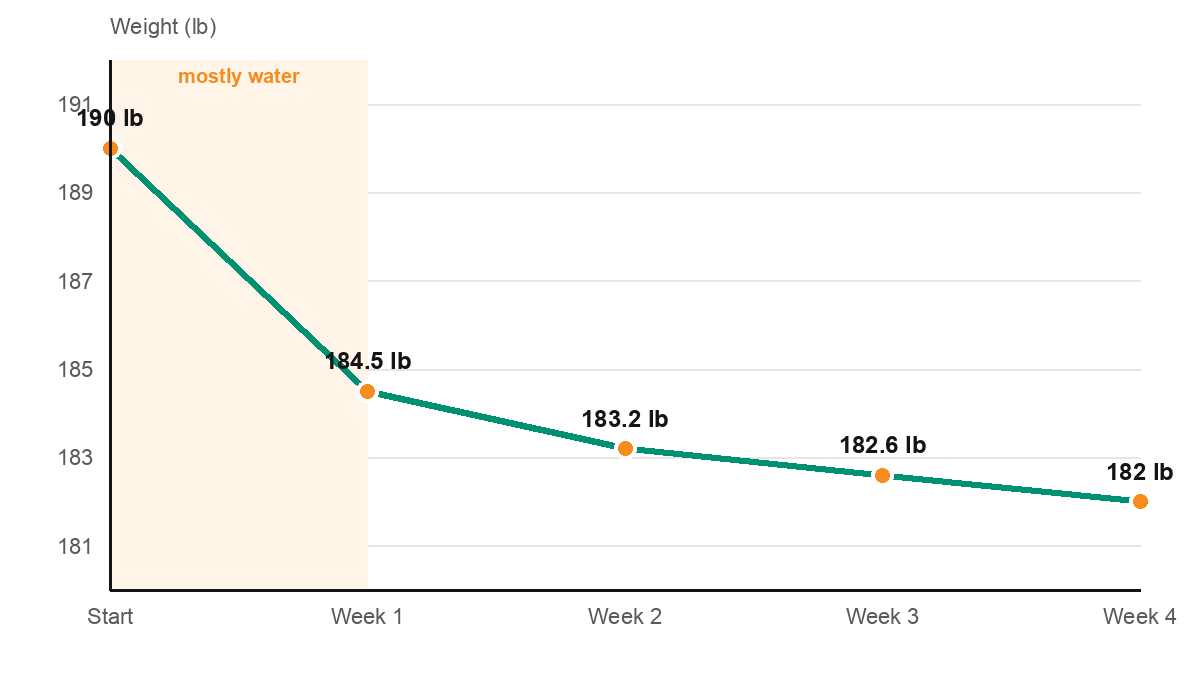
So, a realistic month for our 190-pound example looks like this. You lose five or six pounds of water in the first week, followed by a steady one to one-and-a-half pounds of fat each week after that. By the end of week four, the scale reads somewhere around 182. It felt like a rocket for six days and a crawl for twenty-two, but it was a perfectly successful month of dieting. The graph below is what that month looks like on a tracker.
Eight pounds on a body
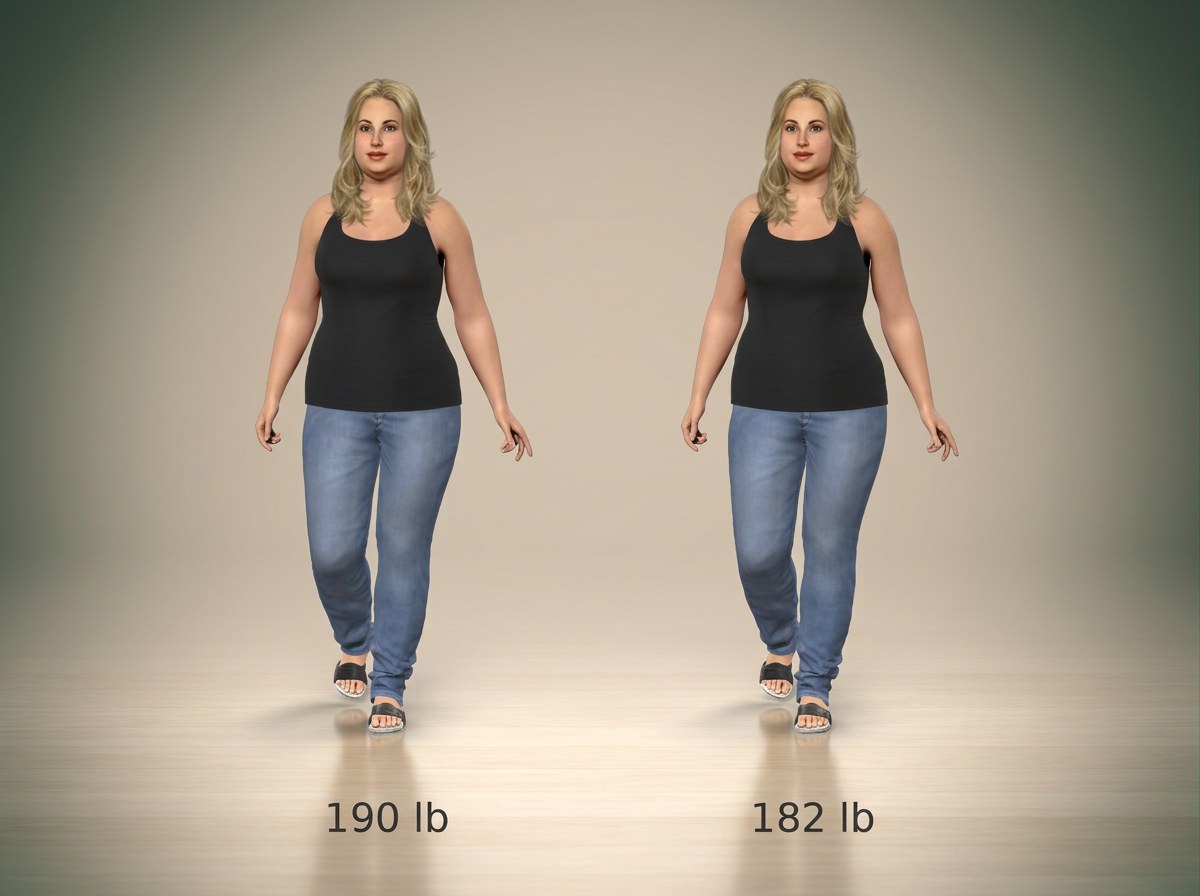
Nobody really prepares you for how this looks. The figure above shows that same woman at 190 pounds and at 182, same height, same everything else. Eight pounds is a real change, but it is a quiet one. On a five-foot-five frame, it shows up first in the face and neck, slightly around the waist, and in the way clothes drape. It is not a dramatic silhouette change that everyone on the street will notice. That is the honest reality of four weeks of hard work.
Compare that to how you felt during week one, when six pounds vanished in six days, and you can see why the mirror and the scale end up in an argument. The scale in week one moved for reasons that had almost nothing to do with your actual body shape. The mirror in week four shows a smaller change than the number suggests, because a big chunk of that number was never fat to begin with. Both are telling the truth, just about different things.
The best approach is to look at the whole arc instead of the daily readout. You can put your own numbers into the simulator on the women’s page and see your starting weight and your four-week weight side by side before you even start. Doing that early sets a fair expectation.
Eight pounds looks like eight pounds.
Thirty looks like a different person. Knowing what to expect four weeks out is worth more than any before photo you have not taken yet.
The dip after the drop
Fast starts are motivating for about ten days, but then they turn into a mental trap. Your brain treats week one as the standard rate. When week three delivers a normal pound and a half, it feels like a failure instead of progress, and the diet that felt brilliant on Tuesday feels broken by Friday. Beginners usually abandon a perfectly good month of keto because of expectations set by that initial water loss, not because they are hungry or fighting cravings.
You can prevent this by deciding what week four should look like before you even begin. Write the number down. If you start at 190, aim for eight pounds down. Weigh yourself daily, but judge your progress on the weekly average. Sodium levels and sleep quality can easily swing your daily weight by a couple of pounds in either direction. Logging your weight daily in the app makes the overall trend obvious in a way that staring at this morning’s number never will.
There is another, slower problem to watch out for. You see your own face every day, so you adapt to the changes instantly. Weight loss of a pound a week is practically invisible to the person living inside the body. That is why other people often notice your progress before you do, and why you can lose fifteen pounds and still feel like nothing has changed. Try taking photos from the exact same spot, or trying on the same pair of jeans once a month. You can also use our simulator. Any of these will give you an objective reference point your bathroom mirror can’t.
In your first month, focus on building a habit instead of keeping a perfect streak. A perfect run of keto days feels great until a birthday dinner arrives. If you view it as a streak, the streak is dead, and often the diet dies with it. Someone who eats this way most of the time but has lasagna on Saturday is still eating this way on Sunday.
Carbs, muscle and the long game
The unglamorous risk of any rapid weight loss is losing muscle along with the fat. Aggressive deficits, especially low-carb ones where your appetite drops off a cliff, will take lean tissue with them if you let them. Eat plenty of protein at every meal and lift something heavy twice a week. Even if you do it badly, and even if it is only for twenty minutes, you will hold onto far more muscle. A body that keeps its muscle looks better at 182 than one that does not, and you will notice the difference in your arms and shoulders first.
This matters long after your first month. Muscle is what you will rely on in your sixties and seventies for climbing stairs and carrying groceries, or just getting up off the floor. It is much easier to hold onto muscle now than to rebuild it later. A diet that costs you strength is a bad trade for a lower number on the scale. If keto suits you, keep doing it. If it does not, keep the habits that worked: eat more protein, stop snacking mindlessly in the kitchen, and use the data you gathered about how your body actually responds when you change what you feed it.